
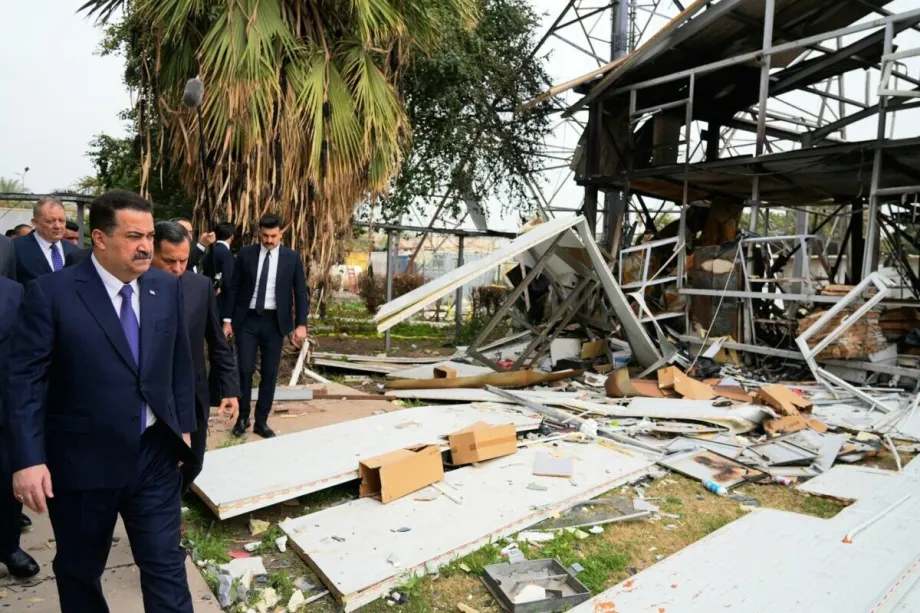
The structural integration of the Popular Mobilization Forces into the Iraqi state has created a recursive security crisis. By providing legal cover to proxies with foreign loyalties, Baghdad has effectively subsidized its own destabilization, leaving the prime minister to preside over a fragmented authority that prioritizes survival over sovereignty.
The Joke That Wrote Itself
There is a particular category of political absurdity that defies satire, not because it is too subtle to mock, but because it is so shameless that any satirist attempting to embellish it would only shrink it. Iraq has once again gifted the world with such a moment.
The Commander-in-Chief of Iraq’s Armed Forces, Iraqi PM Mohammed Shia’ al-Sudani, recently issued a formal statement extending his thanks to the Ministry of Defense for successfully shooting down two drones that were heading to strike an Iraqi airbase. A routine enough communiqué, one might think, until one pauses to consider a small but catastrophic detail: the Commander-in-Chief also leads the Ministry of Defense. He also leads the Popular Mobilization Forces — the PMF, or Hashd al-Sha’abi — which launched the drones in the first place. And the targeted airbase? Also under his command. In other words, one man launched an attack on himself, defended himself against it, and then formally thanked himself for the successful defense. The statement was not leaked. It was not a parody. It was published.
The Architecture of Absurdity
To understand how such a situation becomes structurally possible, one must grasp the peculiar, deliberately engineered dysfunction at the heart of the Iraqi state.
Iraq’s national army was built as a unifying, sovereign institution: a force loyal to the Iraqi state, capable of defending the country against all threats, whether they come from Tehran, Washington, or elsewhere. The Popular Mobilization Forces (PMFs) were created in 2014 in the crucible of an existential crisis, when the Islamic State swept through northern Iraq and the national army collapsed. A fatwa from Grand Ayatollah Ali al-Sistani called on Iraqis to defend their country. Hundreds of thousands responded. The PMF was born of genuine patriotism and genuine desperation.
But it did not stay that way.
The PMF was formally integrated into the Iraqi state apparatus in 2016 and placed, nominally, under the command of the Prime Minister. This integration was sold as a means of asserting state control over a powerful militia network. What it actually achieved was the opposite: it gave those militias the legal cover, the salaries, the weapons procurement pipelines, and the institutional legitimacy of the Iraqi state, while leaving their actual loyalties entirely intact.
Sovereignty as Performance
What the drone incident reveals is not a mistake in Iraq’s political system. It is the system, operating precisely as designed by those who benefit from its inherent contradictions.
The United States spent two trillion dollars and twenty years attempting to build Iraqi state institutions. It discovered, too late, that it had also inadvertently built the political space in which Iran’s influence could entrench itself. The 2003 invasion did not merely topple a dictator; it demolished the Sunni-dominated architecture that had previously contained Iranian penetration of Arab Iraq, and replaced it with a Shia political order whose most powerful factions had spent years in Tehran’s embrace.
Into this void stepped the PMF. Into this contradiction walked every Iraqi Prime Minister since 2005: each one condemned to lead a government whose security apparatus contains forces that will, on any given Tuesday, take orders from a foreign capital and attack the very installations that same government is supposed to protect.
The Nation Al-Mutanabbi Foresaw
The great Abbasid poet Al-Mutanabbi wrote his famous hemistich in the tenth century, lamenting the decay of an Arab political order that had lost its dignity and brought ridicule from the world. He was writing about a different Iraq, in a different millennium. But the line has never felt more contemporary.
“O nation at whose ignorance other nations have laughed”
The word he used was not “weakness.” It was not “defeat.” It was jahl — ignorance, willful or otherwise; the absence of wisdom; the failure to know oneself. It is not simply that Iraq is weak. For two decades, Iraq’s leadership has pretended not to see the contradiction at the core of their political order. They smiled for the cameras, issued press releases, thanked the Ministry of Defense, and hoped no one noticed that the Commander-in-Chief was thanking himself.
The international community has largely obliged. Western capitals issue periodic statements about Iraqi sovereignty. Regional powers pay lip service to Iraq’s territorial integrity while their proxies roam freely inside it. But pretense has a cost. Every time the fiction of Iraqi sovereignty is maintained, the rot deepens. What was intended as the structural bone of the state withered into a mere theatrical mask
The Only Way Out
None of this is inevitable.
But that future requires an act of political courage that no Iraqi leader has yet been willing to perform. That will not happen tomorrow. It may not happen this decade. But the drone incident is also a clarifying moment. It strips away the diplomatic language, press releases, and institutional facades. It shows, with a remarkable clarity, exactly what Iraq is: a state in costume, led by a man who must thank himself for failing to destroy himself.
Were Al-Mutanabbi alive today, he would see through the charade in an instant, roll his eyes, and laugh with bitter disdain.