
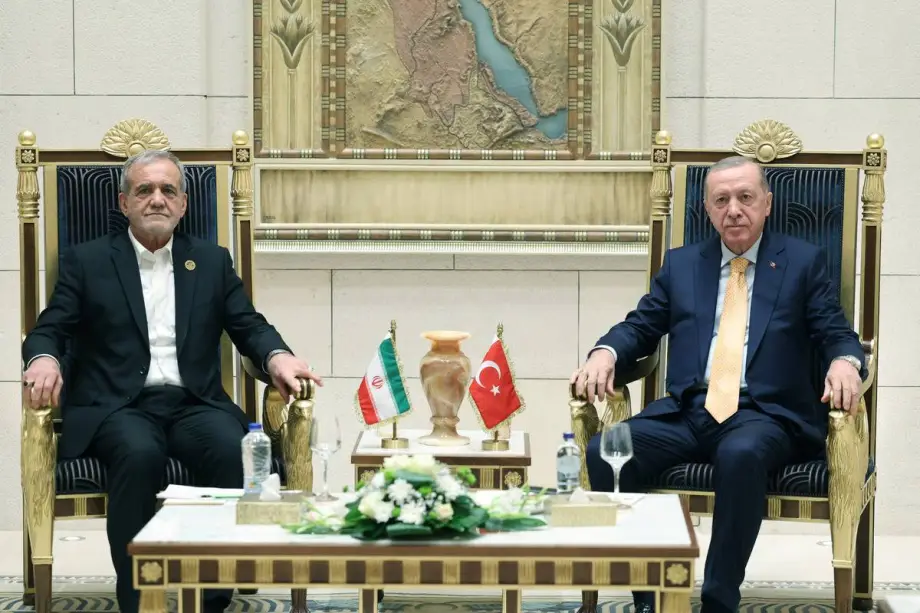
The assumption that Turkey can fill a post-Iranian power vacuum ignores the fundamental divergence in their strategic models. Iran’s influence is embedded in the structural erosion of neighbor states via proxies, whereas Turkey’s outward-facing policy remains a traditional extension of national security, subject to electoral and economic accountability.
Whenever the question of Iranian influence in the Middle East arises, Turkey is often presented as a ready-made alternative. The logic seems straightforward: if Iran’s power diminishes, Ankara will naturally step forward to fill the void. However, this assumption is based on a misleading comparison between two countries whose regional ambitions are built on fundamentally different foundations.
Some analysts have begun to frame the issue precisely in these terms. Ilan Giladi, of the University of Haifa, argued in an article published in Haaretz that Turkey could emerge as a key security actor in the region following any major confrontation with Iran. According to this view, Gulf states have already begun to recalibrate their defence strategies in ways that reduce their reliance on the United States and open the door to a greater Turkish role
However, this argument assumes that Turkey could replicate Iran’s regional influence without addressing a more fundamental question: does Ankara have the same structural and ideological framework that enabled Tehran to establish and maintain its network of influence across the Middle East?
The divergence begins with the nature of the state itself.
Modern Turkey emerged in 1923 as a republic, built on the ruins of the Ottoman Empire. Mustafa Kemal Atatürk’s project was primarily inward-looking, focusing on the construction of a modern nation-state with clearly defined national boundaries and a political identity rooted in secular nationalism. Even as Turkey has expanded its diplomatic, economic and military presence in the region over the past two decades, its foreign policy has remained an extension of national interests rather than a vehicle for ideological transformation.
Iran took a different approach. Since the 1979 Revolution, the Islamic Republic has defined itself not just as a state, but as an ongoing revolution. In this context, regional influence is not merely a foreign policy instrument; it forms part of the regime’s identity and survival strategy. This explains why Iranian behaviour in the region has remained remarkably consistent across different presidencies and political factions. It is the system itself, rather than individual leaders, that anchors Tehran’s external ambitions.
This difference is reflected in the tools that each country uses to project influence.
By contrast, Turkey has primarily relied on the conventional tools of state power: military deployments, security agreements, economic partnerships and diplomatic engagement. Even when Ankara has intervened militarily, for example in Syria or Libya, it has not established a transnational militia network intended to function as an ongoing extension of the Turkish state.
There is also a contrast in how domestic and foreign policy interact in each country.
For Iran, regional expansion often serves as a mechanism for managing internal pressures. Economic crises, political dissent or social unrest frequently coincide with increased activity in Iran’s regional spheres. External engagement helps to reinforce the regime’s ideological narrative and strategic depth.
Elections, economic performance and debates within institutions regularly reshape Turkey’s external posture. When internal pressures intensify, Ankara tends to adjust its regional ambitions rather than escalate them.
Therefore, comparing Turkey and Iran as rival models of regional hegemony is deeply misleading.
Iran has historically grown its influence by exploiting institutional vacuums within fragile states, such as the erosion of state authority in Lebanon, the fragmentation of sovereignty in Iraq, the collapse of the balance of power in Syria, and the political divisions in Yemen. Its strategy has often depended on embedding loyal armed networks within weakened political systems.
Framing Turkey as a potential successor to Iran ultimately reveals more about analysts’ approach to the Middle East than about the region itself. There is a persistent tendency to assume that the decline of one dominant power will inevitably produce another.
However, a different question may be more important.
Does the region actually need an alternative to Iran?
Regional hegemony is not a vacuum waiting to be filled. It is a structural imbalance that has repeatedly destabilised the Middle East. Rather than identifying the next dominant power, the real challenge for the region is building a political order in which states can regain sovereignty, free from the logic of proxies, militias and competing hegemonies.