
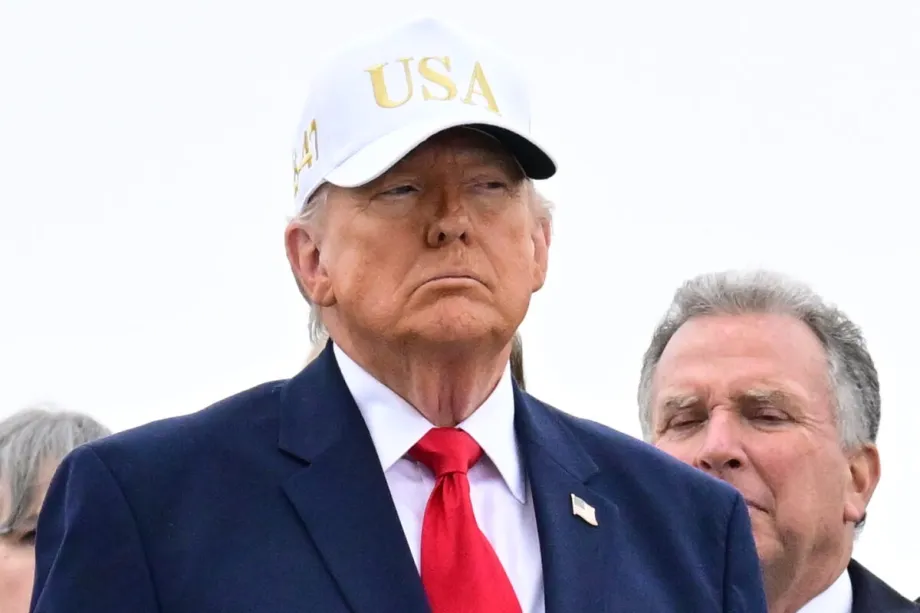
Trump’s disappointment is irrelevant. Iran chose its new leader amid war, proving the state is bruised but not broken. Continuity under pressure demonstrates political confidence and sovereignty. Washington’s assumption of a right to judge has no bearing on Tehran’s decision.
Donald Trump said he was “disappointed” by Iran’s choice of Mojtaba Khamenei as the country’s new supreme leader. The remark was vintage Trump: blunt, theatrical and heavy with the assumption that Washington still has the right to sit in judgement over the inner life of other nations. Yet the more revealing story lies elsewhere. Iran did not pause for American approval. It did not wait for a signal from Washington. Under wartime pressure, it made its decision and moved on. That is not a minor detail. It is the point.
Iran, in that view, can be pressured, sanctioned, threatened and bombed, but it is still expected to choose a future that feels acceptable to the United States. Trump’s disappointment belongs to that mindset. So did his earlier talk about who might or might not be acceptable in Tehran.
But states do not prove their sovereignty by making easy choices in quiet times. They prove it when the pressure is greatest. Iran selected a new leader in the middle of war, after the killing of the previous supreme leader and amid direct confrontation with the US and Israel. Whatever one thinks of the Islamic Republic, that fact carries weight. It says that the state was bruised but not paralysed. It says that the centre held. It says that the machinery of authority, however contested and however imperfect, remained capable of acting when many in Washington clearly hoped for confusion, fracture or collapse.
This is why the moment matters. Iran’s adversaries did not merely want to weaken Tehran militarily. They wanted to expose the state as brittle, divided and unable to reproduce its own leadership under pressure. Instead, the system produced continuity. That alone will unsettle those who mistook bombardment for political transformation.
None of this requires romanticising the Iranian state. One does not have to endorse every feature of the Islamic Republic to recognise what happened here.
More than that, it is a sign of political confidence. Weak states delay, drift and look over their shoulder before they move. States that still trust their institutions act.
Trump’s reaction also revealed something familiar about the American political imagination. For decades, Washington has struggled to accept that there are governments in the Middle East that do not organise their legitimacy around American comfort. When they comply, they are described as pragmatic. When they refuse, they are cast as irrational, dangerous or doomed. Iran has lived under that gaze for nearly half a century. Its entire post-revolutionary history has unfolded against an American insistence that Iranian independence must eventually give way to submission, exhaustion or internal implosion.
That is why this succession has a meaning beyond the person of Mojtaba Khamenei himself. The question is not simply whether he represents continuity with his father. The deeper question is what Iran wanted to say by choosing continuity at all. The answer seems plain enough. In wartime, the state chose endurance over experimentation, consolidation over spectacle and internal coherence over external approval. It was a message first to Iranians, then to the region and only lastly to Washington: the country remains capable of deciding for itself.
That does not mean the choice will silence critics inside Iran or end debate about the future of the Islamic Republic. Nor does it mean succession by itself solves the immense burdens created by war, sanctions and internal strain. Leadership continuity is not the same thing as political resolution. But it does matter that Iran reached for order when others were betting on disorder.
The wider lesson is uncomfortable for those who still speak the language of regime engineering. Military superiority does not automatically translate into political obedience. Air strikes do not manufacture legitimacy. Threats do not confer the right to choose another nation’s future. If anything, they often harden the very instincts they are meant to break. Iran’s decision suggests that outside pressure, rather than dissolving the state, can reinforce its determination to preserve itself on its own terms.
So yes, Trump was disappointed. That much is clear. But his disappointment changes nothing essential. Iran made one of the most consequential decisions any state can make while under extraordinary duress. It did so without waiting for a blessing from abroad. Friends of American primacy may dislike what that says. Students of sovereignty should pay close attention. In the end, the most important fact is not that Washington objected. It is that Tehran decided.