
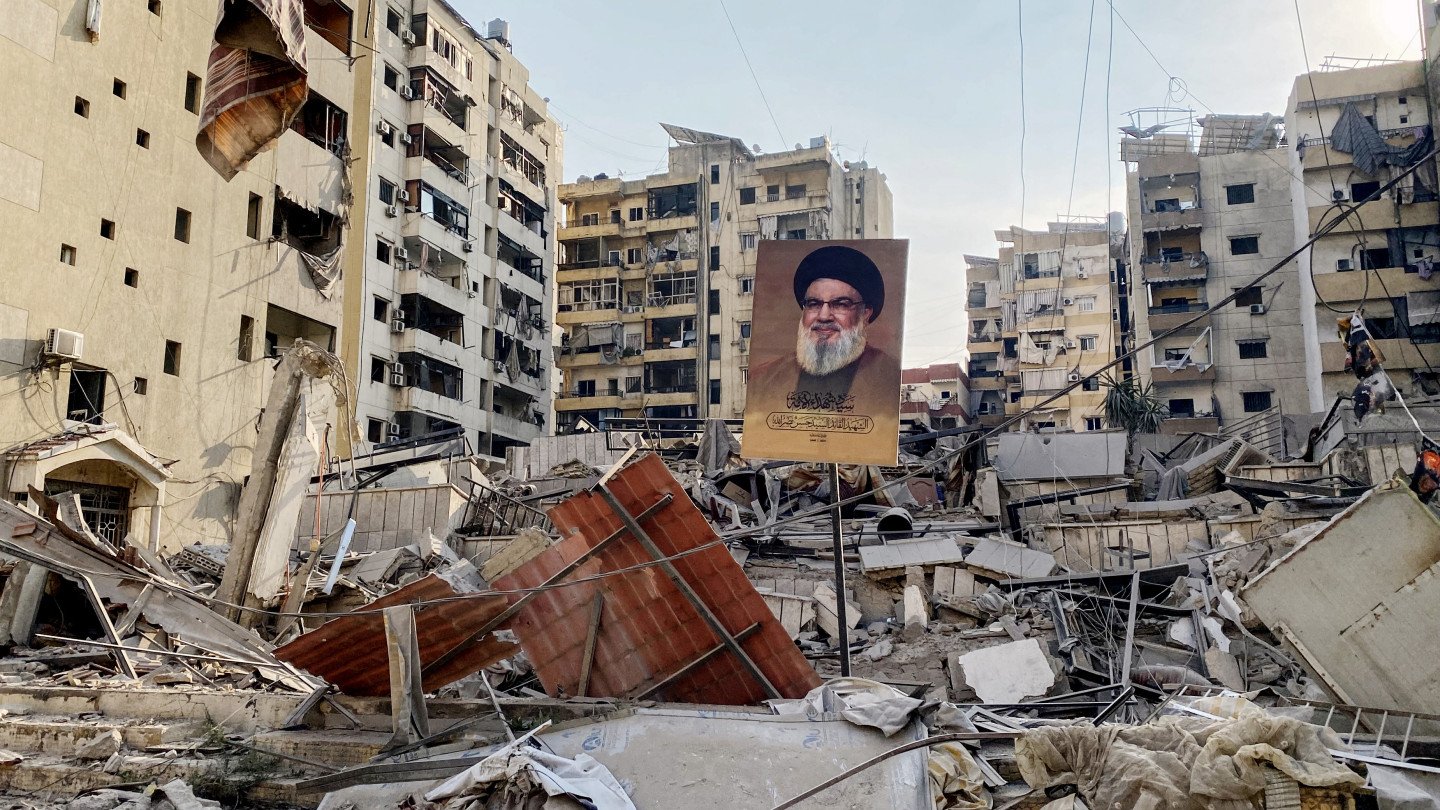
Beirut, Lebanon – It took Hassan al-Hussein three hours to walk from his apartment in Beirut’s southern suburbs to Martyrs’ Square in the heart of the Lebanese capital, something that is usually no more than a 10 or 15-minute drive if there is no traffic, after the first Israeli bombs fell on Dahiyeh.
Hussein, along with his wife and three young children, would walk, rest, and sometimes carry the children as they fled to what they hoped would be safety. They are now sleeping on the street with what little they could carry with them in the chaos and panicked escape.
Like so many others, Hussein was caught off guard by the start of the war. Hezbollah had given no indication that it planned on entering the war launched by Israel and the United States against Iran. Quite the opposite.
Though the party said that the assassination of Iranian Supreme Leader Ayatollah Ali Khamenei was a “red line” for them, they had also given assurances behind closed doors that they would not start a new war with Israel at a time when the country was still recovering from the last one.
“We didn’t hear [that the war had started], we saw it. We saw with our own eyes. The children were scared,” Hussein told The New Arab.
Hezbollah’s decision to launch rockets and drones at Israel, which has led to a devastating Israeli response targeting all corners of Lebanon, triggered an overwhelming negative response in the country as citizens expressed outrage over being dragged into yet another conflict that would bring destruction to so many lives.
This also led the Salam government to order a ban on all of Hezbollah’s military activities and the army to arrest anyone attempting to attack Israel.
Despite all of this, Nicholas Blanford, a non-resident senior fellow at the Rafik Hariri Centre, argued that Hezbollah’s fate was far from certain.
“There are going to be repercussions when all of this is over,” he told The New Arab. “It is very hard to say at this stage how the war is going to end.”
‘The last war with Israel’
For over six months, the Lebanese state has been working to disarm all non-state actors in the country so that the decision for war and peace rests solely with the government.
In the area south of the Litani River, Hezbollah played along, saying that it withdrew its forces and allowed the army to dismantle whatever military sites and equipment it came across.
That work was supposedly completed at the end of 2025, with the army establishing operational control over the area. Before the second phase of the disarmament process could begin, which constituted the area between the Litani and Awali rivers, the war began.
Now, even as Hezbollah remains resistant to any talk of giving up its arms, Blanford said that the government was likely going to be forced to disarm Hezbollah after the war, no matter what the consequences might be.
“The government will have no choice, even if it forces a showdown with Hezbollah, the weight of the opinion in the country and certainly internationally will have simply no tolerance for Hezbollah to remain as an armed entity. That could make things very difficult in Lebanon once the fighting with Israel stops,” he explained.
This has put the army in an uncomfortable position.
Even as fighting has continued to intensify in the weeks since the war began, the Lebanese government has insisted that the army needs to take action now and arrest any individuals taking part in the conflict.
Conscious of the potential internal conflict that could erupt if they attempted to do this by force, army commander Rodolphe Haykal has reportedly been hesitant in carrying out the orders.
This has not deterred Israel, which told Lebanon that it could either disarm Hezbollah itself or face “more severe measures” and that it would not stop fighting until Hezbollah no longer posed a threat to Israel.
This could prove challenging, as its forces are, according to reports in Israeli media, spread too thinly between the wars in Iran and Lebanon for Israel to forcibly disarm Hezbollah. It would likely require a ground invasion, something that would put Israeli troops at significantly more risk.
“As far as the Hezbollah guys are concerned, the deeper the Israelis come into Lebanon, the better, and I think the Israelis know that and that’s why they acted with a lot of caution when they did back in October 2024,” Blanford stated.
According to the analyst, Israel could send in ground forces and take the territory up to the Litani River, but he added that it was unlikely that they would hold it for very long, given how large an area it encompasses.
Instead, a more likely scenario would be Israel taking the territory and then slowly working back to the border, turning Shia villages into rubble so that Hezbollah would not be able to operate there.
Even this is easier said than done, as Hezbollah is treating this as if it were the “last war” with Israel.
“This is why they are throwing themselves into the fight with kind of a view that either we’re going to win this one or the other side is going to win, but there aren’t going to be any more battles after this one,” Blanford said.
“One can start speculating in all sorts of directions what will emerge from all of this, but I think that the Hezbollah that went into this war is not going to be the same Hezbollah that comes out of it.”
Should Hezbollah be able to survive the war, no matter what form that might take, it then must deal with a much bigger problem: facing the Lebanese public.
Hezbollah’s public perception
Lebanon’s Shia have long been Hezbollah’s backbone. As long as they had the support of the Shia community, then they could operate in the Lebanese political theatre from a place of strength.
This new war, though, has put that theory to the test, with many Shia expressing outrage with the party after the outbreak of the war and even clans in Baalbeck supporting the government’s decision to ban Hezbollah’s military activities.
“No, they should not respond. We want security, and we don’t want anything to happen. We need to have our conscience at peace and the country’s peace, and that nothing would happen,” a woman from Dahiyeh who was displaced at the start of the war told The New Arab, on the condition of anonymity.
Others, like Hussein, are not necessarily angry with Hezbollah for starting the war and are more concerned about the safety of their loved ones.
“For me, I’m not [bothered], but for my kids, yes. They are the most important thing for me; [the war] doesn’t affect me. I don’t get scared, but for them I am,” he said.
However, Hezbollah also continues to maintain support in the Shia community. When Israel issued an evacuation order on 5 March for all of Dahiyeh, some people shouted chants of support for the group and its former leader, Hassan Nasrallah, amid the hurried chaos as residents fled, unsure of when the Israeli bombs would start to fall on their homes.
After the war began, Hezbollah sought to change the narrative of its reason for entering the war in the first place.
While Hezbollah’s initial rocket attack came after the assassination of Khamenei, the party argued that, yes, they wanted to seek revenge for his killing, but the real reason was the 15 months Israel violated the November 2024 ceasefire agreement on an almost daily basis, bombing homes and killing hundreds of people in that time. According to Hezbollah, their strategic patience had worn out.
Blanford was sceptical as to whether anyone really believed what the party was saying.
“I don’t think that people are buying that Hezbollah’s strategic patience just happened to run out at the same moment that Khamenei was killed, and that Iran came under attack,” he stated.
How much longer Hezbollah can refuse to give up its weapons largely depends on how it fares in the war.
If the party is able to “give the Israelis a really bloody nose,” Blanford said, then that could get some in the Shia community to continue supporting it and its arms. But even that might not be enough.
“They’ve got an uphill struggle now, once this is all over, to persuade the Shia that they are still acting in their own parochial interests when clearly this latest demonstration of force has got nothing to do with benefitting Lebanese Shia,” he added.
When it comes to Hezbollah’s fate, “there are too many variables at this stage to really say”.