
This article explores the systemic collapse of Iraqi stability during the 2026 war. Mansour analyzes how the closure of the Strait of Hormuz has decimated Iraq’s oil-dependent budget, while a fragmented security sector and political deadlock in Baghdad leave the state unable to restrain vanguard militias or protect its borders from foreign intervention.
Baghdad Slides Into a Conflict It Long Wanted to Escape.
The U.S.-Israeli war against Iran has triggered one of the Middle East’s long-feared nightmares: a full-blown regional conflagration. The expansion of the conflict has had especially significant consequences for Iran’s western neighbor, Iraq.
For the past few years, Iraq had avoided getting entangled in the convulsions that followed Hamas’s attacks on October 7, 2023. Despite its strong ties to Tehran, Baghdad managed to stay largely outside the line of fire, mostly because both the Iranian and Iraqi governments discouraged Iranian-aligned militias in Iraq from joining the fight. These armed groups had emerged as a major force in the country after the toppling of the Iraqi dictator Saddam Hussein in 2003 and then again a decade ago, during campaigns against the Islamic State (also known as ISIS). After the October 7 attacks in Israel, neither Baghdad nor Tehran wanted to jeopardize Iraq’s relative stability and the economic and security benefits that came with it. Even as other zones of Iranian influence—Lebanon, Syria, and Yemen—got roped into the fray, Iraq pursued a careful strategy of multialignment, maintaining ties with both Iran and the United States in an effort to avoid being pulled into the conflict.
The current war is pushing that fragile balancing act to its limits. As Iran abandons the preservation of the regional status quo in favor of a strategy of disruption, so, too, is it willing to endanger Iraq’s fragile stability. Since the start of this war, pro-Iranian Iraqi armed groups have launched hundreds of attacks on U.S. bases in Iraq and neighboring countries. Iranian forces have also struck multiple sites in Iraqi Kurdistan, killing fighters belonging to the peshmerga, the autonomous region’s security force. And they have hit important oil production facilities. Washington, for its part, has struck targets associated with Iranian-aligned militias in Iraq, opening a front it had been careful to keep closed in recent years. Meanwhile, the wider regional war is beginning to squeeze Iraq’s economy as its new parliament, having not yet agreed on a president or prime minister following elections in November, is incapable of dealing with the war’s fallout. The longer this war continues, the greater the risk that Iraq will slide into the chaos it has spent years trying to escape.
BOXED IN
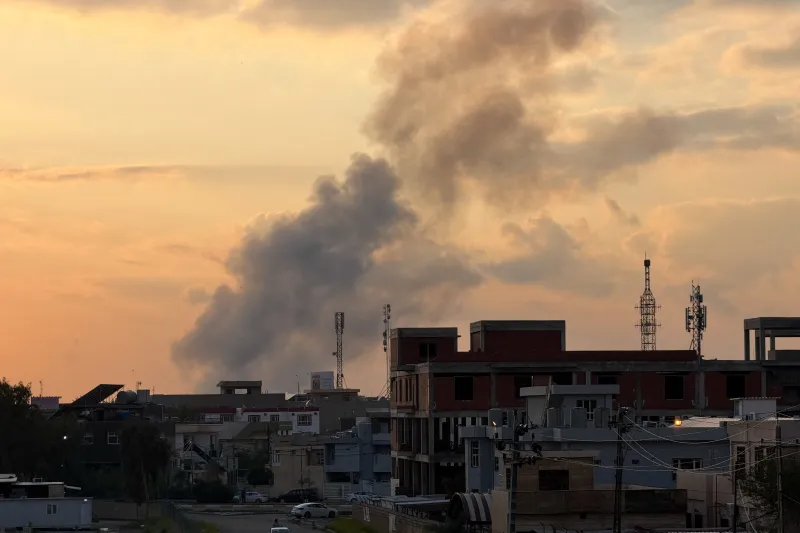
The spillover of the Iran war into Gulf states has won tremendous international attention, but Iraq has also become an important battleground in the conflict. Violence in the country since the beginning of the U.S.-Israeli offensive against Iran has already killed dozens of people. Iranian-aligned factions linked to the Iraqi Popular Mobilization Forces, an umbrella network of armed groups that operate both within and outside the government, have launched drones and rockets at the U.S. embassy in Baghdad, bases in Iraq home to American personnel, and sites in Iraqi Kurdistan with U.S. affiliations, such as hotels. The U.S. military, for its part, has carried out airstrikes against infrastructure, weapons depots, and commanders linked to these factions. The United States may now even be attacking sites directly linked to the Iraqi military; last week, the PMF claimed that Washington was responsible for strikes on an Iraqi military base and PMF headquarters that killed Iraqi security officials. Such strikes, even if targeted against PMF factions that are aligned with Iran, will inevitably result in the deaths of Iraqi soldiers, given the closely linked operations of the Iraqi military and the PMF. Although Washington has not claimed responsibility for the attacks, Iraq’s prime minister instructed the Iraqi foreign ministry to summon the U.S. embassy’s charge d’affaires, and the Iraqi government formally authorized all military units, including the PMF, to respond to any attacks. These events are producing a dangerous cycle of retaliation and could damage U.S.-Iraqi relations.
For much of the period following Hamas’s October 7 attacks, Iraq’s leaders sought to prevent precisely this scenario. Baghdad and Tehran worked to restrain Iraq’s Iranian-backed militias, fearing that escalation would draw Iraq into a regional war. Maintaining the status quo in Iraq, one defined by relative stability and an economic boom, benefited both capitals. It also served the interests of some of the most powerful armed groups, including the Badr Organization and Asaib Ahl al-Haq. These PMF-linked groups had significant stakes in preserving the status quo in Iraq, having gained political influence and economic power after integrating into state institutions—particularly since the fight against the Islamic State a decade ago. So did Tehran; Iraq served as a critical security buffer, insulating Iran’s western flank from cross-border threats, such as attacks by Sunni militants. Iraq is also an economic lifeline for Iran; Iraqi banking networks facilitate access to U.S. dollars, and Tehran circumvents sanctions by selling its oil and gas to Iraq, and through schemes such as blending Iranian fuel with Iraqi exports.
After one Iraqi armed group, Kataeb Hezbollah, attacked a U.S. military outpost in Jordan in January 2024, killing three U.S. service members, Iranian officials and PMF leaders quickly pressured the group to halt attacks. In June, during the 12-day war, Tehran discouraged Iraqi militias from getting involved.
Such restraint has now eroded. As the confrontation between the United States, Israel, and Iran deepens, Tehran is redirecting its strategy from a focus on preserving the status quo—which many Iranian officials now view as having failed—to one geared toward waging what it sees as an existential fight. That means more strikes against U.S. targets in Iraq and against targets in Iraqi Kurdistan, the autonomous region that Iranian officials deem to be closely tied to the United States and Israel. The leaders of some larger PMF groups believe that conflict is bad for business, but smaller vanguard militias have fewer incentives to preserve stability. Their ideological commitments, security interests, and economic networks are tightly bound to Iran’s projection of power in the region. The more Tehran is weakened by the war, the more these factions risk losing both their patron and their leverage in Iraq and the region.
The government in Baghdad is ill equipped to stop these actors from carrying out strikes. Iraq’s security sector remains deeply fragmented, and the prime minister, also formally the commander in chief, exercises limited authority over the armed groups. Even the PMF leadership struggles to control them. This fragmentation is partly the legacy of the 2003 U.S.-led invasion and occupation of Iraq, and partly of the 2020 U.S. strike that killed the Iranian commander Qasem Soleimani and PMF leader Abu Mahdi al-Muhandis, who were the figures most able to coordinate and discipline Iraq’s constellation of militias.
As a result, the risk of deeper internal conflict in Iraq is growing. The killing of an officer in the Iraqi National Intelligence Service by a pro-Iranian militia on March 21 underscores how these groups, long suspicious of the Iraqi state as overly aligned with Washington, may increasingly turn their weapons on the state. The attack was their warning to Baghdad to stop trying to curtail and disarm those factions. But keeping those efforts up is essential for Iraq’s internal security and increasingly so for its regional position. Last week, Gulf states with which Iraq has been improving relations—Bahrain, Jordan, Kuwait, Qatar, Saudi Arabia, and the United Arab Emirates—released a joint statement to condemn attacks by Iranian-aligned actors, and especially those carried out from Iraq. The longer the war continues, the higher the chance that Iraq’s new partnerships in the Gulf, which offer economic opportunities, energy diversification, and alternatives to dependence on Iran, will face setbacks.
DIRE STRAIT
On the economic front, Iraq is highly vulnerable to the consequences of a prolonged regional war. The country’s fiscal stability depends overwhelmingly on oil exports, which account for more than 90 percent of government revenues and finance the country’s public sector, which is one of the largest in the Middle East. Disruption to oil production, export infrastructure, or shipping routes in the Strait of Hormuz poses immediate risks to the Iraqi state’s ability to pay salaries, maintain public services, and contain popular discontent.
Even before the escalation of the current conflict, Iraq’s economy was becoming increasingly strained. The country’s population is growing rapidly, and over the past few years, its young people have entered the labor market in numbers that dwarf available opportunities in the private sector. In response, the government expanded public-sector employment dramatically, with government jobs becoming the primary mechanism through which Iraqi leaders have attempted to manage social frustration. This model was economically sustainable, for a time, because high oil prices provided Baghdad with large energy revenues to underwrite the salaries of those hundreds of thousands of new workers.
But this strategy left the state financially exposed. In recent months, plans to delay salary payments and changes to public-sector benefits have unsettled civil servants and the wider public. Government spending has remained elevated even as oil revenues have fallen, straining Iraq’s fiscal position. Small but persistent protests, often led by specific professional groups or local communities, had emerged even before the war in several Iraqi cities to demand jobs, salary protections, or the preservation of benefits—early signs of broader economic dissatisfaction.
The war now threatens to intensify these pressures. The closure of the Strait of Hormuz in early March caused Iraqi oil output to plunge from roughly 4.2 million barrels per day to around 1.4 million, dealing a severe blow to the government’s primary source of revenue. Iranian-aligned militias have also attacked oil tankers and Iraq’s energy infrastructure. The resulting shock has shaken investor confidence just as major international energy companies, including BP, TotalEnergies, and Chevron, were beginning to reengage with Iraq’s energy sector, which had only recently regained a measure of stability following the turmoil caused by the Islamic State during the last decade. Now, the Iraqi government has forced foreign-operated oil fields to halt operations, through a legal framework called force majeure, because the government cannot move the oil those fields are producing.
Baghdad has little choice but to look for alternative sources of income. Unlike other Gulf producers, which can reroute their oil exports over land or through the Red Sea, or which can rely on storage capacity and established financial reserves, Iraq has few options other than shipping oil through the Strait of Hormuz. The only serious alternative to exporting out of the southern port of Basra is the Kirkuk-Turkey pipeline, which crosses Iraqi Kurdistan on its way to the Mediterranean Sea. But this pipeline can transit only 250,000 barrels of oil per day—a fraction of the volumes typically shipped from Basra.
Moreover, Iraq remains heavily dependent on Iran for imports of natural gas and electricity for its domestic energy grid. These imports are especially crucial during the summer, when temperatures frequently reach or surpass 120 degrees Fahrenheit and electricity demand surges. Even in May, temperatures can hit nearly 100 degrees. In such times, power shortages have historically triggered waves of public protest. Disruptions to Iranian energy production and export will exacerbate shortages just as demand peaks.
Baghdad’s economic woes extend beyond energy. Iraq relies heavily on imports of food, medicine, and consumer goods that come across its border with Iran or through its southern ports, which sit on the Persian Gulf. Already, the chaos produced by the war has driven up food prices and placed additional pressure on the Iraqi dinar. Rising fuel costs and disruptions to energy supplies have also led to long lines at fuel stations in several areas. All these stresses could, at some point, reignite the unrest that similar socioeconomic grievances have spurred in Iraq in recent years, when protesters have taken to the streets only to be violently repressed.
RUDDERLESS IN BAGHDAD
The war is also unfolding amid a protracted and contentious political deadlock. Following parliamentary elections in November that did not produce a decisive majority, Iraq’s political parties remain at loggerheads, and months of negotiations over who becomes president and prime minister—traditionally Kurdish and Shiite representatives, respectively—have produced little progress. This stalemate has left Iraq’s governance in the hands of a weak caretaker administration with limited authority to manage an escalating regional crisis or to shield its critical infrastructure and its population from the war’s reach.
This political vacuum is straining relations between the Iraqi government and that of Iraqi Kurdistan. Those ties were already growing more tense in recent years as the balance of political power began shifting more in favor of the central government, as federal court rulings and other measures curbed Erbil’s autonomy over oil and finances. Kurdish leaders are increasingly questioning why the federal government seems unable to prevent the Iraqi-based, Iranian-aligned armed groups from launching drone attacks against sites in Iraqi Kurdistan. At the same time, the broader Kurdish region (which straddles Iran, Iraq, Syria, and Turkey) is at risk of becoming even more embroiled in the conflict as U.S. and Israeli officials have considered trying to foment an uprising among Iranian Kurds to pressure the regime in Tehran. Although Trump said in early March that he did not want the Kurds to join the war, the CIA has, according to multiple news organizations, provided support to some of these groups. The possibility of a U.S.-Israeli-backed Kurdish uprising has made Iraqi Kurdistan a direct target for Iranian retaliation.
The regional war is also reshaping debates within Iraq’s political class about the country’s relationship with Iran. After the United States invaded Iraq in 2003, it did not simply bring about regime change; it dismantled the Iraqi state, replacing it with a fragmented political order. In the vacuum that followed, Iran found a strategic opening to expand its influence in a country that had long been a bitter adversary—especially after Saddam invaded Iran in 1980, leading to a devastating eight-year war between the two countries. In the last two decades, Tehran has wielded enormous leverage over Iraq’s political, economic, and security institutions. It has influenced who occupies key positions and cultivated ties with political elites and parties that exert informal sway over the Iraqi government’s major economic, security, and political decisions. This influence has extended through a dense network of Iranian-aligned armed groups whose diffusion through Iraq’s security and political institutions has allowed Tehran to shape policies and constrain actions that run counter to its interests.
Some Iraqi politicians now discreetly view the current regional confrontation as a potential opportunity to loosen that grip. More nationalist parts of the political elite are calling on the state to reassert its sovereignty, curb the militias’ autonomy, and rebalance Iraq’s foreign relations particularly by strengthening ties with Arab Gulf states and the United States. Yet many also fear that a weakened or embattled Iran, locked in what it perceives as an existential fight and increasingly willing to disrupt the regional status quo, could prove even more destabilizing to Iraq. Iranian behavior in the Strait of Hormuz offers one such indication, as Iraqi officials, despite their close ties to Tehran, have been forced to negotiate for permission for their tankers to pass, in many cases unsuccessfully.
DAMAGE CONTROL
The ongoing Iran war has already put Iraq in a much more difficult place than it was before. As the war drags on, this burden will mount on multiple fronts, as militia violence escalates, the oil-dependent finances of the state slump, political gridlock drags on, and the United States potentially continues attacking the PMF.
Baghdad’s options for addressing these challenges are limited. The forces driving escalation lie largely beyond the control of Iraqi leaders. Iran appears increasingly willing to tolerate regional instability as its confrontation with Israel and the United States deepens. Iraq, with geographic, political, and economic ties to Iran and Western forces stationed on its soil, is likely to feel much of the resulting pressure.
What Iraq needs to avoid further chaos is for the war to end. Until that happens, Iraqi leaders will need to reduce the country’s exposure to the conflict as much as they can—protecting critical energy infrastructure, finding alternative export routes such as the Kirkuk–Turkey pipeline, and limiting attacks launched from Iraqi soil that could trigger wider retaliation. Baghdad should also deepen trade and energy cooperation with other neighboring states, building on the trade and fragile trust that had begun to emerge among them in recent years. None of these steps can fully shield Iraq from the war’s spillover effects, but they could help prevent further destabilization.
The 2003 U.S. invasion of Iraq reshaped the Middle East in ways few policymakers anticipated, including by inviting the expansion of Iran’s regional influence. This year’s American war could generate its own unpredictable consequences. And Iraq is one of the places where those aftershocks are most likely to surface—and where they may prove hardest to contain.