
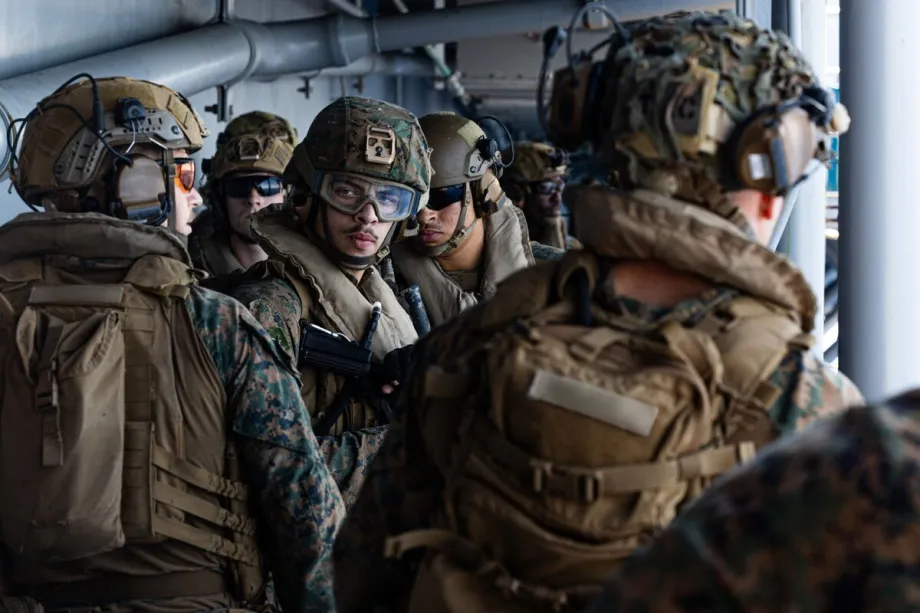
The current trajectory toward ground operations reflects a failure of limited kinetic strikes to produce strategic clarity. By maintaining “optionality” through troop deployments, the administration risks a war of drift that mirrors the Vietnam experience, where incremental escalation replaces defined victory, ultimately jeopardizing the domestic economy and military readiness.
Washington has a favourite word for moments like this: options. It sounds sober. Responsible, even. It suggests prudence, flexibility, a commander-in-chief keeping every door open. But in practice, “options” is often just the polite way this town avoids saying what it is really doing. It is preparing itself, step by step, to go further than it said it would.
That is what makes the talk around Iran so unsettling. The administration keeps insisting that it does not need a ground war. Senior officials have said the United States can achieve its aims in Iran without ground troops, even as thousands more U.S. forces are being moved into the region to preserve “maximum optionality.” Read that sentence twice. If ground troops are unnecessary, why is Washington still so determined to keep the idea alive?
That is not cynicism. It is memory.
One month into this conflict, even sympathetic observers would struggle to say with confidence what success is supposed to look like. The White House now appears to face only hard choices: escalate further, possibly even on the ground, or try to negotiate an exit from a war whose aims have become harder to define the longer it has gone on. That is often how trouble announces itself in Washington—not with one catastrophic decision, but with a series of smaller ones made in the fog of wanting not to look weak.
And whatever this war is, it is not cost-free. That much is already obvious at home. The Strait of Hormuz is one of those places Americans only hear about in a crisis, but they pay for it almost immediately. In 2024, roughly 20 million barrels of oil a day moved through the strait—about one-fifth of global petroleum liquids consumption—and there are very few practical alternatives if traffic is badly disrupted. In plain English: when that waterway is in trouble, so are gas prices, shipping costs, and household budgets.
Those numbers matter not because public opinion should dictate strategy minute by minute, but because they show something important: the country is not in the mood for another war sold in the language of control and finished in the language of sacrifice.
There is also a basic military question that should be asked more often and answered more honestly. If Iranian retaliation has already shown that American forces and facilities in the region are vulnerable, what exactly is the theory behind putting more Americans within range? A ground war is not just “more pressure.” It is more funerals. More catastrophic injuries. More families being told that the mission changed after the mission had supposedly already been defined. It is one thing to posture about resolve in a briefing room. It is another thing to ask young Americans to bear the cost of that posture with their bodies.
Some advocates of escalation seem to think the mere possibility of a ground operation strengthens Washington’s hand. Maybe, in a narrow tactical sense, it does.
America’s allies seem to understand that. European officials have made clear, in public and in diplomatic language, that they see the United States as increasingly unpredictable and insufficiently clear about where this war is headed. Calls for restraint, for protecting civilians, and for restoring safe navigation through Hormuz are not diplomatic noise. They are signals of deep unease. The war already looks wider, messier, and more economically dangerous than Washington’s original rhetoric suggested.
Trump, of all people, should understand the political trap here. He returned to power promising not to repeat the old bipartisan habit of turning the Middle East into a graveyard of American credibility, money, and lives. A ground war with Iran would do exactly that. It would not look like strength. It would look like Washington falling back into its oldest reflex: when the first use of force fails to produce clarity, answer with more force and pretend clarity is right around the corner.
It rarely is.
There is still time to avoid the worst version of this. But avoiding it requires a little more than saying “no plans at this time.” It requires shutting the door on a ground invasion, not theatrically, not temporarily, but decisively. It requires admitting that a policy can be costly even before it becomes catastrophic. And it requires remembering that the most dangerous wars are often the ones launched by leaders who insist, all the way through, that they remain in control.
America does not need another war of drift. It does not need another “limited” mission that expands because nobody in power wants to be the first to say enough. And it certainly does not need to send more Americans into a conflict whose boundaries are already harder to see than its costs.