
Israel’s southern Lebanon incursion aims to create a buffer zone but risks strengthening Hezbollah by allowing it to reconstitute as a guerrilla force. The Lebanese government’s fragile authority limits its ability to confront Hezbollah. Prolonged occupation deepens instability and undermines state institutions.
The Lebanese government has failed to effectively confront Hezbollah. But a prolonged Israeli incursion will only reenergize the group.
As many focus on the US/Israeli war on Iran, another related conflict is intensifying in Lebanon. On 2 March Hezbollah fired rockets and drones into Israel in retaliation for the attacks on Iran. Since then, the Israeli military has attacked Beirut, the Beqaa Valley, the Baalbek-Hermel governorate, and the south.
More than 1,000 people have been killed and 2,500 injured and over one million (almost a fifth of the population) have been displaced. On 22 March, Lebanon’s leadership warned of the threat of invasion. On 24 March, Israeli Defence Minister Israel Katz announced that Israel intends to seize control of southern Lebanon up to the Litani River to create a ‘defensive buffer’.
The war on Iran may yet see the US declare victory relatively early, perhaps in a matter of weeks, and disengage. But the conflict unfolding in Lebanon is unlikely to see Israel walk away any time soon.
Instead, it reflects Israel’s shift towards a longer-term struggle for regional primacy after Hamas’s cross border attacks of 7 October – one that Lebanon’s fragile state may not endure.
Hezbollah’s role in the Lebanese state
For decades since its formation, Hezbollah operated a parallel state in Lebanon, with significant logistical and financial support from Iran. The group wielded a veto over the country’s politics and maintained a military force far stronger than the Lebanese army.
The situation changed after 7 October 2023. Hezbollah began firing rockets into Israel the very next day in support of Hamas, and conflict between the group and Israel quickly intensified.
That culminated in a sequence of attacks in September 2024 which saw Israel decapitate Hezbollah’s senior leadership, including long-time secretary-general, Hassan Nasrallah. In November, a fragile ceasefire was agreed, though in practice it remained tenuous, with Israeli operations continuing and the terms only partially observed.
For a time afterwards, Hezbollah seemed to be in decline, with public perception shifting, as Hezbollah was seen by many Lebanese as having unnecessarily exposed the country to conflict.
The technocratic Lebanese government that took office fifteen months ago appeared to offer something different. Led by Prime Minister Nawaf Salam alongside President Joseph Aoun, the former head of the Lebanese Armed Forces, it moved quickly to assert that it alone should hold the monopoly on arms in the country. That push was strongly encouraged by the US and Israel as part of a broader plan to dismantle Hezbollah.
The new government deployed the army south of the Litani River for the first time in decades, reasserted control over Beirut’s airport, and signalled a harder political line, including efforts to curb the language and symbols of ‘resistance’ that had long normalized Hezbollah’s armed presence in the state.
These early moves suggested a government that was attempting to reclaim control of territory and establish legitimacy.
The Hezbollah dilemma
Yet the limits of that push were clear. Hezbollah has refused to disarm north of the Litani River and continues to wield political influence. US Special Envoy for Syrian Affairs Tom Barrack recently called it a ‘legitimate political party in Lebanon’ (though the US has designated it a Foreign Terrorist Organization since 1997).
Reportedly, Hezbollah has been reconstituting and adapting, returning to a more dispersed, guerrilla-style organization rooted in asymmetric warfare and a mission of long-term resistance. Crucially, it still commands loyalty across much of Lebanon’s Shia community.
These realities point to the Lebanese state’s continuing structural fragility. The country’s sect-based political system fragments authority and, combined with decades of political corruption and mismanagement, undermines coherent governance.
Hezbollah has filled gaps left by the government within Shia communities, providing social services, education, healthcare and local support. As a result, in these areas, citizens still tend to turn to Hezbollah rather than the government to meet their everyday needs.
Disarming Hezbollah illustrates the government’s dilemma. It can insist that arms belong in the hands of the state and declare Hezbollah’s military arm illegal. But any attempt to use force to disarm the group would likely lead to civil war. There is little political or public appetite for that, in a country still marked by the memory of fifteen-years of civil war in the 1970s and 80s.
Others will believe that disarming Hezbollah leaves the country even more exposed to Israeli attacks, given the weakness of Lebanon’s army.
The Lebanese people are paying the price
The Lebanese people have not yet had the chance to recover from a series of devastating events. An economic collapse in 2019 was followed by rampant inflation, the port explosion of 2020, the COVID-19 pandemic, and the Israeli bombing and ground incursions of 2024.
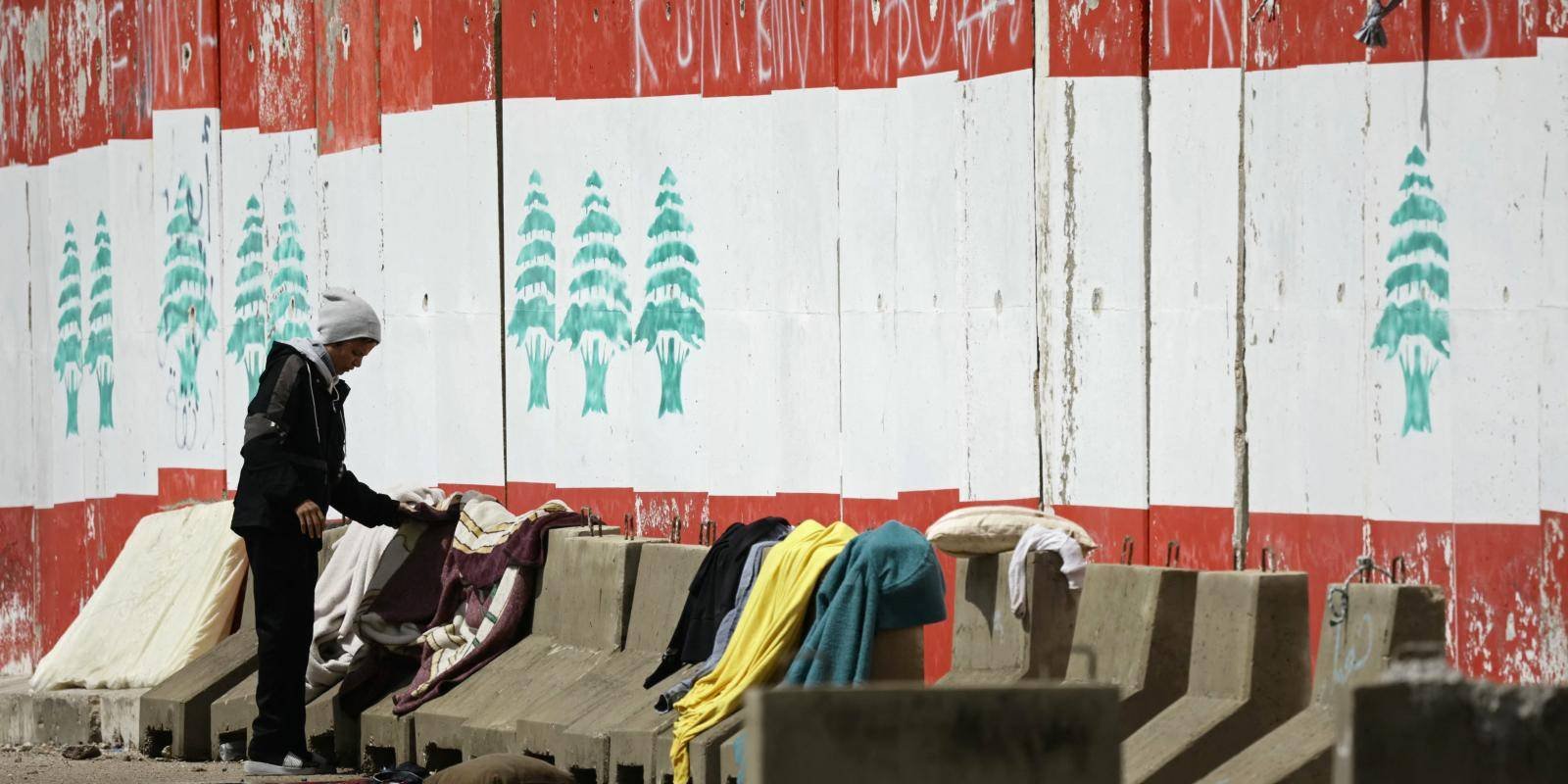
Populations that had only recently returned to their homes now once again find themselves displaced or forced to live exposed to Israeli attacks. Communities remaining in the south of the country are now at risk of being cut-off, with Israel destroying bridges across the Litani River and intent on creating the ‘defensive buffer’ announced by Katz.
Those who have been displaced are now homeless or sheltering in cramped or unfit facilities. The Lebanese government is making efforts to track displaced people and provide shelter and relief items. Its response is a marked improvement compared to previous crises. However, with no end to the fighting in sight the state is having to rely on civil society and international actors to provide support to communities in need.
What next for Lebanon?
Israel’s strategy risks undermining what little possibility remains of a coherent Lebanese state operating in place of Hezbollah.
Parliamentary elections, due in May 2026, were postponed for two years due to the violence, with some parties already using developments to stoke sectarian divisions and further party interests. The gains made by independent parliamentarians and the fragile new government hang in the balance.
A prolonged Israeli military presence will likely deepen instability and further weaken Lebanese state institutions. It will also create the conditions for Hezbollah to reconstitute its military capabilities and rebuild popular support.The first step should be a ceasefire by both sides and an end to Israeli incursions into Lebanon. But this now looks highly unlikely in the near term.
That means the only viable path to keep Hezbollah weakened and potentially one day disarm it is to build the Lebanese government’s capacity to provide reliable public services and to protect the entire population, including Shia communities, both of which the government has historically struggled to do. US and international engagement should therefore be concentrated on this objective.
A first step would be tying international reconstruction assistance to visible state delivery, ensuring that aid reaches all affected communities through government channels. Diplomatic efforts toward a broader regional settlement should also address the external flows of support, namely from Iran, to Hezbollah that have long undermined the Lebanese government’s authority over its own territory.
In the meantime, in the event of Israel seizing territory in the south, Lebanon’s government will have limited options. It can transmit messages of national solidarity. And it can deploy the army to Beirut to signal stability there and deter civil tensions.
But the damage being done will make the government’s job even harder: it was already unclear how it would pay to rebuild infrastructure destroyed in 2024. Dealing with the destruction and displacement caused by this new fighting will need more time and money, something which the government does not have, and which will be hard to raise.
The Lebanese government will also need to carefully assess the risk of if and how to confront Hezbollah. The government banned Hezbollah’s military activities on 2 March and expelled the Iranian ambassador to Lebanon on 24 March. But challenging Hezbollah while the group is fighting Israel could inflame internal tensions and increase the risk of civil war.
Meanwhile the displaced will be vulnerable to exploitation, creating possible public health risks, forcing children to stay out of school and adults out of work, creating possible tensions with local residents, and compounding decades of trauma.
Regardless of when the fighting stops, Lebanon and its citizens will be left picking up the pieces for years to come.