
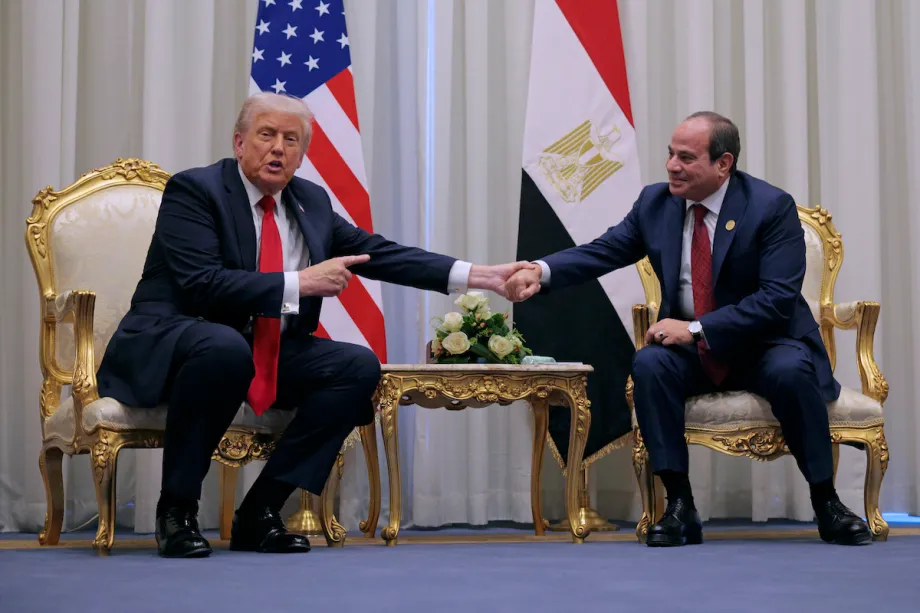
President El-Sisi’s “calculated neutrality” reflects a prioritization of domestic stability over “just a step away” security pledges. By maintaining ties with Tehran and resisting military intervention, Cairo seeks to prevent an Israeli-led regional order, even as it risks losing vital Gulf investments and facing deepening economic isolation.
When Egyptian President Abdel Fattah El-Sisi used his well-known phrase “just a step away” years ago, referring to his country’s readiness to defend Arab national security, he did not expect to face a real test and a difficult dilemma that could cost him dearly.
Tensions in Egyptian-Gulf relations, against the backdrop of the ongoing war against Iran and Iranian strikes targeting countries in the region, have escalated from discontent to suspicion, disagreement and possibly a reassessment in the near future.
Assessments within ruling circles in Gulf capitals reflect negative views of Egypt’s position, amid what is described as “abandonment” and a lack of solidarity by a strategic ally that has received tens of billions of dollars, as well as significant political and diplomatic support, particularly from Riyadh and Abu Dhabi, to consolidate its rule following the military coup of 3rd July 2013.
A step away
“When Arab national security faces a real threat and we are called upon, we will be right there; we are just a step away,” was one of El-Sisi’s most notable statements in May 2014, when he was a presidential candidate. The phrase was repeated in subsequent speeches and statements, raising expectations of the strategic ally holding power in Egypt, now serving a third presidential term extending until 2030.
When the Israeli-American war on Iran began on 28th February and quickly escalated on the same day to include Iranian strikes on US bases in Gulf capitals, Cairo appeared unsettled and possibly wary of being drawn into the conflict, or perhaps in a wait-and-see position to gauge its direction and outcomes.
This was evident in the delayed tour by the Egyptian president to the UAE and Qatar on 19th March, followed by Saudi Arabia and Bahrain on 21st March, without including Kuwait and Oman for unknown reasons.
The situation was further complicated by the Eid Al-Fitr sermon attended by the Egyptian president, which sparked widespread controversy after it included a supplication with a Shia tone: “O God, by the right of Fatima, her father, her husband and her sons, and the secret within her, do not place Egypt in need of any ignoble of Your creation.” This was seen as a gesture of rapprochement toward Iran, a Shia-majority country, and was openly criticised by former Saudi army officer Abdullah Ghanem Al-Qahtani in remarks to the BBC, who said: “The position of our brothers in Egypt was strange and unexpected, and some steps were notable, such as the Eid Al-Fitr sermon, which I believe was inappropriate in both timing and content.”
Further escalating tensions, Ambassador Khaled Emara, Assistant Foreign Minister and former head of Egypt’s mission for the care of Egyptian interests in Tehran, made remarks seen as lacking prudence. In an interview with the independent platform Al-Manassa, he said: “Iran has the right to strike US bases in the Gulf, and targeting US bases in the Gulf is consistent with international law, as it has the right to defend itself.”
Has Egypt fallen short in supporting the Gulf? What is Egypt’s position on the Iran war? In response, Egyptian media outlets raised counter-questions: what do Gulf states want from Egypt? Who is seeking to drag Egypt into the war?
Diverging approaches
Egypt’s decision-makers are aware that the country is not a party to the conflict with Iran, and that any involvement of the Egyptian army in military activity related to the war would undermine Cairo’s role as a neutral mediator and could expose it to Iranian retaliation that would worsen its economic crisis and disrupt international navigation through the Suez Canal.
According to political researcher Mohamed Gamal, Egypt’s position cannot be seen as a break with the Gulf states as much as it reflects differences in defining the threat, national security priorities, strategic considerations and risk management aimed at avoiding an expansion of the war.
Gulf states view Iran as a direct threat that must be neutralised or contained, while Cairo approaches the crisis from the perspective of the cost of escalation and its impact on economic and regional stability. This requires it to balance security, economic and political considerations in a highly complex regional environment, according to Gamal.
Cairo is concerned about the expansion of Israeli dominance in the region in the event of Iran’s collapse. It sees the Israeli-American war as part of a plan to advance the objectives of Prime Minister Benjamin Netanyahu’s government, which seeks to reshape the Middle East under Tel Aviv’s leadership with US backing. This poses a threat to Egyptian and Arab national security.
Egyptian observers believe that US bases in the Gulf, along with defence partnership agreements linking Gulf capitals with the United States, Britain, France, Turkey and Pakistan, are meant to provide protection for Gulf airspace and territory, rather than draw Egypt into a war in which it has no stake.
A difficult equation
Cairo is maintaining a position of strategic balance; while it is outside the war, it remains part of a difficult equation. It is engaged in mediation alongside Turkey, Pakistan and Saudi Arabia, as it understands that the defeat of Iran would mark the beginning of an Israeli-led era in the region. This is in addition to the impact of the current war on market instability, capital outflows, disruptions to energy supplies, the depreciation of the local currency, and a decline in remittances from around 12 million Egyptians working abroad, most of whom are in the Gulf, according to political analyst Shehab Ezz El-Din.
It appears, according to Ezz El-Din, that Gulf states seek to buy support or draw Cairo into the US-Israeli war, as they insist on maintaining the American security umbrella with Egyptian backing, rather than activating the concept of collective Arab national security to protect the security and sovereignty of Arab states. This American security umbrella has underpinned Gulf security doctrine for decades, and Washington’s military intervention has placed the entire region at risk.
Gulf capitals, particularly Riyadh and Abu Dhabi, may have expected an Egyptian response commensurate with the scale of the situation, possibly extending to the deployment of military support forces, along with clear political positions, logistical and intelligence support, and broad media and public backing. However, Egypt’s approach did not meet Gulf expectations, as its decision-makers opted to remain, to some extent, on the side of neutrality.
As the war enters its second month and countries around the world are economically affected by the continued closure of the Strait of Hormuz, Egypt’s position and Cairo’s complex considerations regarding the regional and international geopolitical situation may appear more justified, particularly as the war’s course and direct military repercussions have directly affected 17 countries.
Cairo’s calculated position was met with Gulf anger, which saw Egypt as falling short of expectations. Kuwaiti writer Fouad Al-Hashem said they had seen Egypt as a mother that would defend her children, but it had instead proved to be a stepmother that did not even offer them comfort.
Egypt’s approach has been characterised by caution, with a preference for playing an active diplomatic role without being drawn into the war or antagonising any of its main parties (the United States, Israel and Iran), while also seeking in the future to build an Arab security framework and revive proposals for a joint Arab force.
El-Sisi’s government may pay a price for its recent positions on the war and the slow pace of its engagement with Gulf allies. It could incur significant losses due to a potential decline in Egyptian-Gulf relations and an expected drop in Saudi and Emirati investments and deposits flowing into the country. However, it may also resort, with political tact, to other options to ease tensions with Riyadh and Abu Dhabi in particular and to appease the two allies, Mohammed bin Salman and Mohammed bin Zayed.