
The internal power struggle: Two visions for Hamas
Hamas is currently experiencing one of the most significant leadership crises in its nearly four-decade history. The movement’s internal elections, held in February 2026, crystallized a fundamental divide between two competing visions for the organization’s future: a pro-Iran camp versus the pragmatists. Results were expected during Ramadan in March 2026; however, the US-Israel war against Iran is believed to have cast a heavy shadow over the process. This is not merely a contest between personalities but a struggle over Hamas’ strategic identity, ideological orientation, and relationship with the broader Middle Eastern order.
The pro-Iran camp: Hayya and the Gaza leadership
Khalil al-Hayya, Hamas’ leader in Gaza and the movement’s chief negotiator in cease-fire talks with Israel, represents the faction most deeply embedded in Iran’s network of militant groups. Hayya’s ascendancy is inextricably linked to the legacy of former Hamas Gaza leader Yahya Sinwar, under whom he served as deputy head of the Hamas Political Bureau and was one of the few figures Sinwar trusted implicitly.
Documents recovered by Israeli forces from Gaza reveal the depth of coordination between Hayya and Iranian officials. In July 2023, he held secret meetings with senior Islamic Revolutionary Guards Corps (IRGC) commander Mohammed Said Izadi to discuss operational plans that would eventually culminate in the October 7 attacks. These documents demonstrate that Hayya was not merely a recipient of Iranian largesse but an active participant in strategic planning with Tehran’s security apparatus.
Hayya’s faction, which includes Basem Naim, Usama Hamdan, and remnants of the Gaza-based leadership, advocates for maintaining Hamas’ position within Iran’s regional network of militant groups, known as the Axis of Resistance. This camp views the relationship with Tehran as essential not only for military capabilities but for ideological coherence. They have consistently pushed for closer ties with Syria under the Assad regime, Hizballah, and other Iranian proxies, even at the cost of alienating potential Arab state sponsors.
The pragmatists: Mashaal and the external leadership
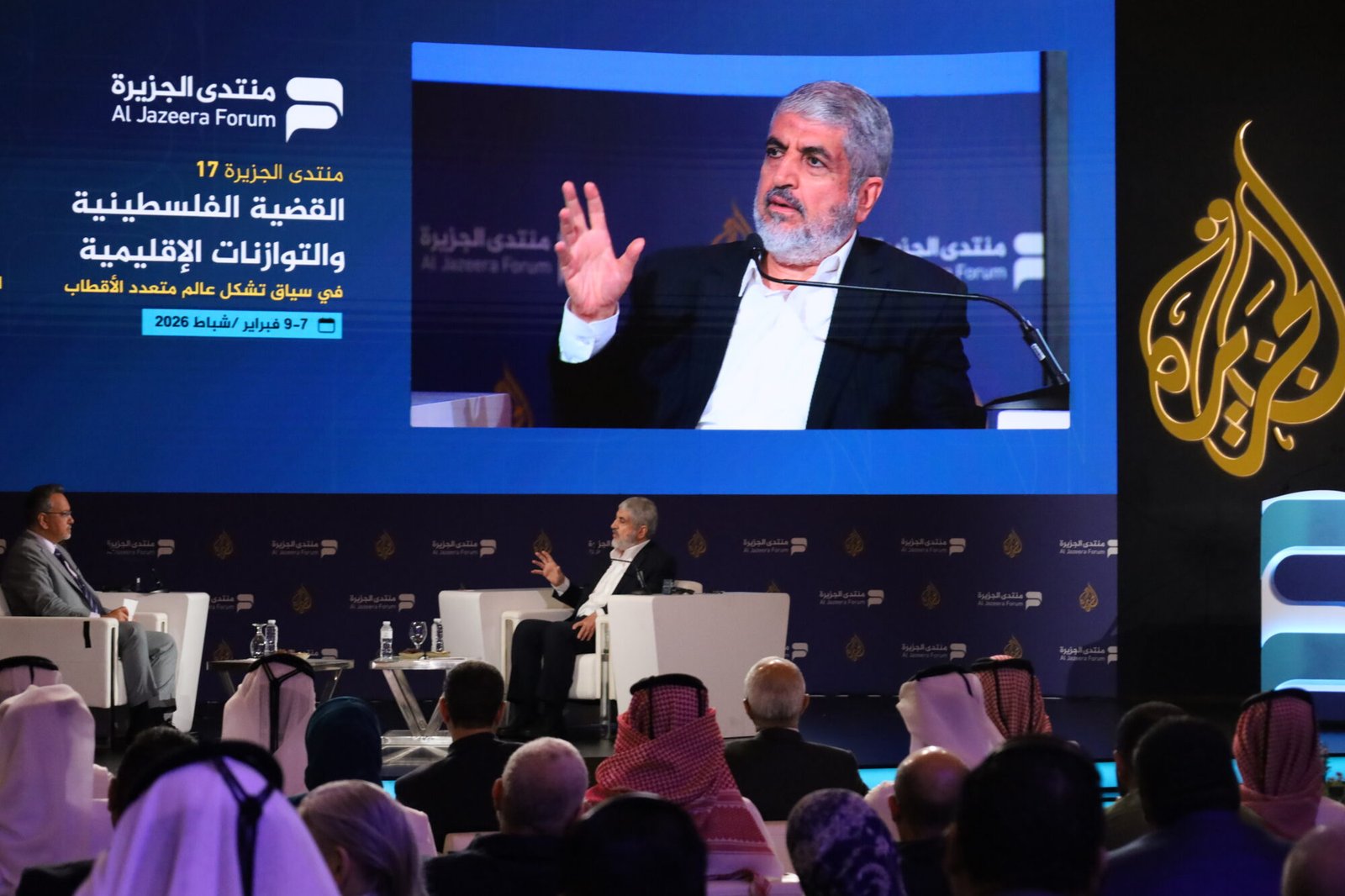
Khaled Mashaal, who heads Hamas’ external leadership from Qatar, represents a fundamentally different approach. Having served as the movement’s Political Bureau chief for 21 years until 2017, Mashaal brings decades of diplomatic experience and extensive relationships across the Arab and Islamic world. His vision for the group emphasizes political pragmatism, regional reintegration, and a diversification of the movement’s sponsor base beyond Iran to include Sunni states, as Hamas was increasingly seen as an Iranian proxy in recent years.
The same captured documents that illuminate Hayya’s Iranian coordination reveal the depth of tension between Mashaal and the pro-Iran elements within Hamas. Yahya Sinwar explicitly warned Ismail Haniyeh, then the head of the group’s Political Bureau, that Mashaal’s return to prominence had “caused problems and obstacles” in relations with Iran. In a March 2023 letter, Sinwar advised excluding Mashaal from any delegation to Tehran, stating that his presence would reduce the chances of success by “at least 60%.”
Mashaal’s controversial decision to support Syrian opposition forces against the Assad regime in 2011, which led to Hamas’ expulsion from Damascus, remains a point of contention inside the movement; eventually, the pro-Iran faction led a “reconciliation” with the Assad regime in 2022. However, his defenders argue that this original stance preserved Hamas’ credibility with Sunni Arab populations and prevented the movement from becoming entirely subordinate to Iranian interests.
The Gaza dilemma: From center stage to secondary arena
More than a year ago, Israel officially classified the Gaza Strip as a “secondary arena.” This designation, in Israeli military parlance, carries profound implications that have become increasingly apparent during the recent regional escalation. The classification indicates that Israel has calculated that the threat level from Gaza no longer calls for major military operations, it can divert those resources elsewhere, and all forms of threat and confrontation in Gaza can be managed through lower-intensity deterrent options.
The six implications of Gaza’s downgraded status
Military exhaustion: Israel has completed all major military operations that could incur significant incalculable losses. The ceiling of military threats from Gaza has been lowered to manageable levels.
Routine confrontation: All forms of confrontation in Gaza have become within reasonable, routine, planned parameters that Israel can tolerate and manage.
Political objectives achieved: Israel seems satisfied with the political position it has reached in Gaza and is prepared to preserve it as the basis for any deal that addresses its security requirements.
Diminished international pressure: International pressure on Israel to reduce its military operations in Gaza — which still frequently cause significant harm to Palestinian civilians — has either ended or no longer represents a significant problem. Israel seems to be able to commit any amount of harm to Gaza’s civilian population and the infrastructure on which it relies without provoking meaningful global outrage.
Gaza as negotiable: The “secondary” Gaza problem can be accepted by Israel as part of any deal, provided its security demands in the territory are met.
Failure of the “unity of arenas”: Israel has officially foiled the axis’s plan for the “unity of arenas.” In practice, this strategy meant that several different Iran-backed groups would engage Israel simultaneously even when one resistance movement began a conflict for its own reasons. In the end, Israel isolated each region and arm of the axis individually, a result of the groups’ failure to launch a collective, early unified attack.
Hamas’ silence and strategic recalculation
The current US-Israel war with Iran has confirmed these realities. Israel seems able to place Gaza on ice with all its problems, needs, and plans, until it finishes with whatever front emerges or heats up, whether that be in Lebanon, Iran, or elsewhere. Gaza no longer appears to be a major factor in its calculations.
Most significantly, Hamas remained completely silent during the first three weeks of the current Iran war that began with US and Israeli airstrikes on February 28, 2026. Those not in the pro-Iran camp inside Hamas maintained complete silence through mid-March, even as the region teetered on the brink of wider war. This silence speaks volumes about the movement’s strategic paralysis and internal divisions.
The contrast with Hizballah’s immediate and vocal support for Iran is striking. While Hizballah rushed to demonstrate solidarity with Tehran, firing a salvo of missiles into Israel on March 2, Hamas’ leadership in Qatar calculated that participation in this war would not serve its interests. The movement appears to have made a final decision to stay out of the conflict, given the unprecedented confusion caused by the divergence of Iranian and Qatari positions.
Qatari pressure and Gulf realignment
Recent developments have revealed the extent of external pressure on Hamas to distance itself from Iranian actions against the Gulf states. Hamas’ call for Iran to refrain from targeting neighboring countries raises several important issues that illuminate the movement’s precarious position.
The four dimensions of Hamas’ request
First: Qatari pressure and threats
The request that Iran refrain from targeting neighboring countries likely came under Qatari pressure and threats to Hamas’ political leadership in Doha. Most reports suggest this was the case, indicating that it was not a voluntary gesture but rather a response to external pressure. Qatar, which hosts Hamas’ political leadership and provides crucial financial and diplomatic support, has significant leverage over the movement’s decision-making.
Second: Adoption of the Gulf narrative
In its statement, Hamas adopted the Gulf states’ narrative about the Iranian bombing, which claims that the strikes targeted civilian facilities. The movement did not adopt the Iranian narrative, which states that the attacks only targeted “American bases” in these countries. This is an important development that brings Hamas’ current position closer to the Gulf-American one.
The deliberate omission of any mention of American bases — the fundamental point of contention and the essence of the Iranian narrative — signals a significant rhetorical shift that aligns Hamas more closely with Gulf state interests rather than those of its traditional Iranian patron.
Third: Hamas will not risk participation
Hamas’ statement calling for a rapid end to the war clearly suggests that, for now, it has decided not to join in the fighting alongside Iran in the manner Hizballah has and did in a limited way after October 7 under the banner of the “unity of arenas.” That decision appears to be driven less by ideology than by hard constraints and the dictates of political survival. Hamas currently lacks the military capacity to open a meaningful new front with Israel; even during the Gaza war, its rocket fire largely diminished over time. At present, both Hamas and roughly 1.9 million Palestinians are compressed into just 40% of the Gaza Strip’s territory, under conditions of extreme deprivation and volatility. Hamas understands that any move inviting overwhelming Israeli retaliation, especially one causing even greater civilian losses, could trigger public anger and potentially revolt against it. For that reason, the movement appears to have concluded that this war is not in its interest.
While this position seems firm for now, it may not be entirely irreversible. Hamas could revisit it if the regional war were to escalate in ways that fundamentally reshaped its calculus — for example, if Israel or the United States expanded the conflict in a manner that inflicted mass civilian harm inside Iran, or if Tehran directly pressed its allies to demonstrate military solidarity. Even then, however, Hamas would likely remain constrained by its own weakness inside Gaza and by the acute risks of provoking a devastating Israeli response at a moment when its overriding priority is survival in whatever comes next in the coastal strip.
Fourth: Broader US pressure
The pressure on Hamas is not only coming from Qatar but also from the US as it seeks to shield its bases in the Gulf states — pressure that was made clear by the movement’s reference to them as “neighboring countries.” If Hamas strongly rejects bombing Qatar — which it supports and depends upon for protection — it would not oppose bombing American bases in the United Arab Emirates, Saudi Arabia, and Bahrain, countries with which Hamas does not hide its political contradictions.
However, the statement did not call for refraining from bombing Qatar alone but for refraining from bombing all of the Gulf countries, including those whose policies Hamas opposes and publicly criticizes. This suggests that the pressure is broader than just Qatari influence, and that the statement’s formulation may be a product of behind-the-scenes negotiations for a cease-fire in Gaza that are ongoing and sponsored by Turkey and Qatar in coordination with the US.
The contradiction: Pro-Iran elements in Gaza
While Hamas’ political leadership in Qatar maintained strategic silence or issued carefully calibrated statements, the movement’s military spokesperson in Gaza — representing the pro-Iran faction — took a markedly different tone. Abu Ubaida, spokesman for the Izz ad-Din al-Qassam Brigades, lauded the Iranian missile strikes against Israel on International Quds Day: “On International Quds Day, we praise the missile strikes carried out by the Iranian Revolutionary Guard targeting the Zionist enemy entity, as part of the continuous bombardment operations on the entity, using high-quality and fragmentation missiles that healed the hearts of our wounded people and illuminated the hearts of the free before lighting up the skies of Tel Aviv.”
This statement, attributed to Hamas’ military wing based in Gaza, demonstrates the continued influence of pro-Iran elements within the movement and their willingness to publicly align with Tehran even as the political leadership seeks to navigate a more cautious path. The divergence between these two wings of Hamas — the political leadership in Qatar and the military command in Gaza — has never been more apparent.
Implications of Ali Khamenei’s death for Hamas
The immediate financial crisis
Iran’s financial support to Hamas has been estimated at around $100 million annually, with additional military assistance flowing through Quds Force and Hizballah channels. The elimination of Supreme Leader Ayatollah Ali Khamenei throws this support network into disarray. Even if the Iranian regime survives, the current military campaign, the succession struggle, and internal turmoil will inevitably disrupt the flow of resources to Palestinian proxies.
Captured Hamas correspondence reveals that Iranian officials, particularly Izadi, had already expressed reluctance to fund the “external leadership” under Mashaal’s influence. With Ali Khamenei’s death, any factional disputes within Tehran’s security apparatus will be magnified, potentially freezing all support to Hamas until a new power equilibrium emerges in Iran.
Military capabilities and the post-war environment
The military implications extend beyond finances. Iranian technical assistance was long crucial to Hamas’ rocket program, tunnel construction, and unmanned aerial efforts. The key question now, however, is not only whether Iran mattered in the past, but whether Hamas still retains the local capacity to build and improve these systems on its own. Evidence suggests that it does not, at least not in any meaningful way. Hamas’ rocket program depended on more than improvised workshops, and that production ecosystem is widely believed to have been dismantled. Its drone program appears to have collapsed almost entirely due to a lack of integrated technology, shortage of materials, shrinking operational space, and complete Israeli aerial dominance. In addition, Gaza’s catastrophic living conditions have left Hamas with little public support for renewed military activity that could invite further destruction.
In that sense, Iranian support would still matter, but mainly as a possible enabler of rearmament, adaptation, and future innovation rather than as a supplement to an intact domestic military industry. Hamas today is not simply struggling to upgrade its capabilities; it is struggling to preserve the basic conditions for military reconstitution at all. Combined with the loss of top commanders and the severe attrition suffered by the Izz ad-Din al-Qassam Brigades, this leaves Hamas in a substantially weakened position. Its ability to project military power is likely to remain limited for years, with or without renewed Iranian backing.
The regional realignment question
Ali Khamenei’s death forces Hamas to confront a fundamental strategic question: Can the movement survive without Iranian patronage, and if so, what alliances will replace Tehran’s support?
For the Mashaal faction, this moment presents an opportunity to reorient Hamas toward the Arab world and Turkey. Doha, Ankara, and potentially Riyadh could provide alternative sources of funding and political support. However, any such realignment would require Hamas to moderate its positions, potentially accept constraints on its military activities, and distance itself from the Iranian axis, all of which the Hayya faction opposes.
Scenarios for Hamas’ future trajectory
The interaction between Hamas’ internal leadership contest and the broader regional transformation creates several possible scenarios for the movement’s evolution:
Scenario One: Hayya victory and Iranian continuity
If Khalil al-Hayya prevails and seeks to keep Hamas anchored in the Iranian axis, this should not be read as a coherent strategy for near-term victory. It is better understood as a strategy of organizational survival through endurance, ideological continuity, and waiting out a hostile environment. The faction’s implicit theory is not that Hamas can soon rebuild Gaza, rearm at scale, expel Israel, and win a new war. Under current conditions, that would be highly unrealistic. Rather, the logic is closer to this: preserve the movement’s chain of command, retain its identity as the spearhead of armed resistance, avoid formal political surrender, and hope that time, regional instability, Israeli overreach, and eventual renewed Iranian assistance reopen space for reconstitution. In that sense, this is less a theory of victory than a theory of non-defeat.
That position is deeply risky and may indeed verge on nihilism. Hamas’ military infrastructure has been severely degraded, Gaza’s physical space is compressed, and the social environment is far less permissive than before. Even if Iran remains willing in principle to help, rebuilding meaningful military capacity inside Gaza would face enormous operational obstacles. The more plausible expectation within this camp is not imminent triumph, but stubborn resistance until the balance changes: a loosening of Israeli control, a regional shift that restores Iranian supply lines, or a political breakdown in postwar arrangements that again makes Hamas indispensable to some constituency. The danger, of course, is that this is not a strategy for governing or recovery at all. It is a bet on survival through prolonged ruin.
Scenario Two: Mashaal victory and Arab reorientation
A Mashaal victory would likely accelerate efforts to reintegrate Hamas into the Arab state system. This could involve accepting constraints on military activities, engaging more constructively with Palestinian Authority reconciliation efforts, and distancing the movement from Iran and its proxies.
Such reorientation would face significant obstacles. The Hayya faction and the military wing might resist what they would view as capitulation. Iran and its allies would likely attempt to undermine any Hamas leadership they perceive as disloyal to Tehran’s militant network. And Israel and the United States would demand concrete evidence of Hamas’ transformation before accepting its reintegration.
Scenario Three: Organizational schism
The intensity of the current leadership contests raises the possibility of an organizational split. Hamas could fracture into competing factions, one aligned with Iran and based in Gaza, the other oriented toward the Arab world and operating from Qatar and Turkey.
Such a schism would have profound implications for Palestinian politics. It could create competing claims to represent militant factions, complicate any reconciliation with Fatah, and potentially lead to intra-Palestinian violence. Historical precedents, including the Fatah-Hamas split of 2007, demonstrate how quickly Palestinian factional disputes can escalate to armed conflict.
Policy recommendations for US policymakers
The transformation of Hamas’ position presents both risks and opportunities for US policy. Several recommendations emerge from this analysis:
-
Monitor the leadership contest
US intelligence should closely track the Hamas leadership election, reportedly held in February 2026, and be prepared to engage differently depending on which faction prevails. A Mashaal victory would create openings for diplomatic engagement that should be explored, while a Hayya victory would necessitate continued pressure and isolation.
-
Coordinate with Arab allies
The United States should work with Qatar, Egypt, and Saudi Arabia, as well as Turkey, to develop a coordinated approach to Hamas. Arab states have significant leverage over the movement and should be encouraged to use it constructively to steer Hamas away from Iranian influence and toward more pragmatic positions.
-
Exploit the internal divisions
The visible split inside Hamas should not be approached through crude American “divide and weaken” tactics, which have repeatedly failed elsewhere in the region. Washington should begin from a more precise assessment: There is a real and consequential cleavage between a pro-Iran current, associated with figures such as Khalil al-Hayya, and a more politically opportunistic current around Khaled Mashaal, which is more attentive to Arab state legitimacy, Qatar-based intellectual influence, and the search for political recognition. Mashaal has explicitly called for direct US engagement with Hamas, invoking the precedent of Washington’s opening to Syrian President Ahmad al-Sharaa. That alone does not make Mashaal “moderate,” but it does show that part of Hamas wants political relevance and external recognition, not only military patronage. At the same time, Hamas is consolidating its hold in the parts of Gaza where it still operates, and there is little realistic prospect that it will be compelled to fully surrender, eradicated, or rendered irrelevant through military means alone. The policy challenge, therefore, is not to make the perfect the enemy of the achievable, but to identify and reinforce those tendencies within the movement that point in a more pragmatic and less Iran-dependent direction.
The United States therefore should not try to “pick winners” inside Hamas in a visible or heavy-handed way. It should instead shape the incentive structure around the movement. The goal is not to endorse Mashaal’s wing, let alone legitimize Hamas as a whole, but to widen the gap between those who see Hamas’ future in political adaptation and those who remain tied to the Iranian axis. That means rewarding behavior, not personalities: signaling that any Hamas current that prioritizes a sustained cease-fire, accepts a non-Iranian regional framework, and cedes day-to-day governance to a broader Palestinian and Arab-backed arrangement will find indirect channels of communication more open than a current that insists on permanent armed alignment with Tehran. Quiet, deniable third-party channels through Qatar and other Arab interlocutors would be far more effective than public US outreach, which would likely discredit the very actors Washington is trying to empower.
There are also things Washington should not do. It should not publicly brand one faction as America’s preferred interlocutor; Hamas’ internal politics are shaped by suspicion, and any figure seen as an overt US client would likely be destroyed internally. It should not demand maximalist end-states up front, especially total ideological surrender dressed up as immediate compliance, because that would strengthen the pro-Iran camp’s argument that political engagement is merely a trap. And it should not confuse humanitarian pressure with political leverage: Hamas has shown repeatedly that mass human suffering in Gaza does not by itself force strategic moderation. What moves the organization is political relevance, recognition, and a credible belief that a non-Iranian path offers survival without total humiliation. That is why US policy should tie any indirect opening not to rhetoric, but to measurable choices: restraining armed activity, accepting a postwar governing formula not monopolized by Hamas, and reducing dependence on Tehran.
This approach is also more realistic because Mashaal’s current is not “pro-peace” in any conventional sense. It is better understood as a stream that may be more willing to trade exclusive reliance on Iran for Arab political space. The background matters here. In April 2023, a Hamas delegation including Ismail Haniyeh, Khaled Mashaal, Khalil al-Hayya, and Mousa Abu Marzouk visited Saudi Arabia in a politically significant effort to reopen ties after years of estrangement. That episode showed that outreach to Arab capitals was not imaginary inside Hamas; it was already being tested before the war.
At the ideational level, Hamas is also exposed to a wider debate over what “resistance” should now mean. Prominent voices are speaking of the limitations of Hamas’ resistance approach, and placing greater emphasis on political strategy, institutional reconstruction, and Arab leverage than on simply reproducing open-ended armed confrontation for its own sake. That matters because Hamas is highly sensitive to elite Arab framing, especially from Qatar-hosted intellectual and political circles. Washington cannot manufacture that discourse, but it can avoid undercutting it by making clear that meaningful political repositioning would be read differently from renewed military integration into Iran’s regional camp.
The most important analytical point is that the United States should not treat Hamas as uniformly motivated by human loss, devastation, or public misery in Gaza. Those factors matter at the margins, but they have not historically been sufficient to alter the movement’s core line. What matters more is whether Hamas sees a path to political recognition, organizational survival, and continued relevance. That is precisely why internal divisions can be widened: not because one wing has become liberal or post-Islamist, but because different wings now see different routes to survival. US policy should therefore aim to make the Arab-facing, politically adaptive route look more rewarding than the Iranian, militarized one — while understanding that this is a long game of incentive design, not a one-off messaging campaign.
-
Support Gaza stabilization to deprive Hamas of leverage
Regardless of Hamas’ leadership, the humanitarian situation in Gaza requires urgent attention. However, US policy should recognize that Hamas has consistently weaponized Gaza’s dire conditions to maintain political relevance and extract concessions from the international community. The movement has used images of suffering, infrastructure collapse, and civilian deprivation as tools of political warfare, turning humanitarian catastrophe into diplomatic leverage.
A comprehensive stabilization strategy should prioritize several objectives. First, channel humanitarian assistance through international organizations and non-Hamas local actors, ensuring aid reaches civilians without empowering the movement’s political or military structures. Second, support infrastructure reconstruction projects that are administered transparently and independently, reducing Hamas’ ability to claim credit for improvements it did not deliver. Third, work with regional partners — particularly Egypt, the UAE, and Saudi Arabia — to develop alternative governance models that can gradually reduce Hamas’ monopoly on service provision.
The “secondary arena” designation presents a strategic opportunity: With the war concluded under the Trump peace plan, the international community can now address Gaza’s humanitarian needs through a framework that explicitly excludes Hamas from decision-making roles. By stabilizing Gaza’s conditions without Hamas participation, the United States and its allies can deprive the movement of its most potent political weapon — the ability to hold its own population hostage for diplomatic gain.
Conclusion
The killing of Ali Khamenei represents a fundamental disruption to the regional order that has sustained Hamas for over two decades. The movement’s internal leadership contest reflects genuine uncertainty about how to navigate this new reality. The pro-Iran faction led by Hayya advocates for continuity with a strategy that may no longer be viable, while the Mashaal camp seeks a reorientation whose success is far from guaranteed.
The current US-Israeli war with Iran has revealed the true extent of Hamas’ strategic predicament. The movement’s initial silence, its unprecedented request that Iran refrain from targeting the Gulf states, and the visible divergence between its political and military wings all point to an organization in profound crisis. Gaza’s relegation to “secondary arena” status by Israel has stripped Hamas of its primary leverage and exposed its dependence on regional actors whose interests may no longer align with the movement’s survival.
For the United States and its allies, this moment requires careful calibration. Prematurely writing off Hamas could empower more extreme actors, while prematurely embracing a transformed Hamas could legitimize a movement that has committed horrific atrocities. The path forward demands nuanced analysis, patient diplomacy, and a clear-eyed assessment of the movement’s internal dynamics.
What is certain is that Hamas will not emerge from this crisis unchanged. But change does not necessarily mean either coherent transformation or outright collapse. A third possibility is prolonged muddling through: a movement weakened, internally divided, and strategically incoherent, yet still too entrenched, armed, and symbolically potent to disappear. In that scenario, Hamas would persist in fractured form, with competing centers of authority, inconsistent regional alignments, and no clear governing or military strategy beyond survival. Its most consequential remaining leverage would be the suffering of Gaza’s population and its control over that population — a grim reality that contributed to prolonging the war in the Gaza Strip for more than two years before a cease-fire was reached. The question, then, is not only whether Hamas will transform into something the region can accommodate or fade into irrelevance but also whether it will remain trapped in a state of persistent schism that leaves Gaza and the Palestinian cause suspended in uncertainty, with civilians continuing to pay the price for the movement’s survival. The decisions made in the coming months by Hamas leaders, regional powers, and international actors will help determine which of these paths prevails.
As one Gaza-based analyst noted, Gaza has become “a frozen chicken that can be put in the freezer without any problems.” The tragic irony is that this fate was not inevitable. Had Palestinian policies been founded from the beginning on betting on the Palestinian people — their unity, their decision, their human dignity — rather than being attached to a regional axis, the outcome might have been different. But when Gaza’s fate was harnessed to outside powers and their agendas, this result was perhaps inevitable.