
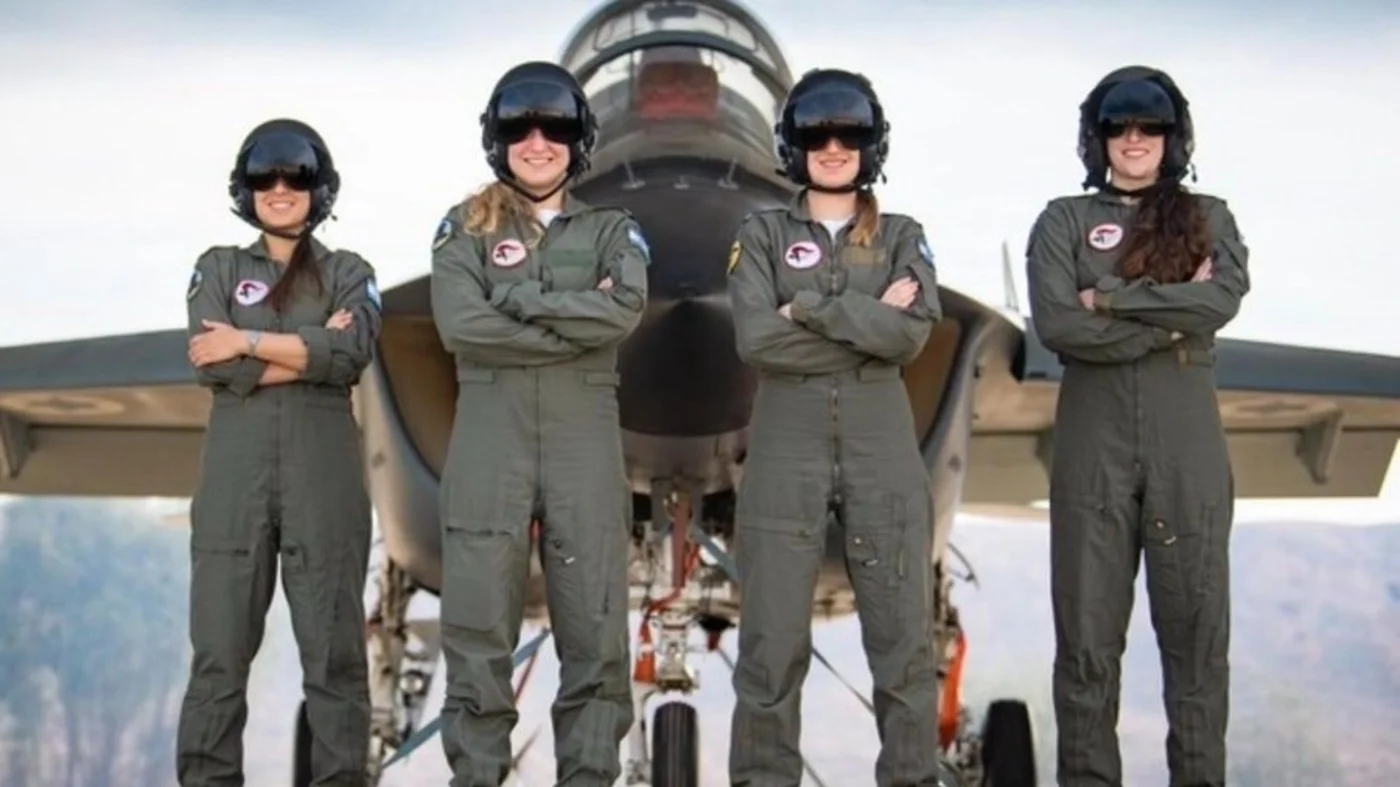
Four Israeli pilots stand, visors down and arms crossed, in front of a warplane – a classic Top Gun-style pose of military prowess, but with a twist. The four pilots are women, with long hair falling onto their shoulders from under their helmets.
It is an image that has been circulating for years, and it resurfaced again in the opening days of the US-Israeli assault on Iran.
The involvement of female fighter pilots in the ongoing operation has been a cause for self-congratulation for Israel’s military, and a point of pride and vindication for many Israelis.
“Approx 30 female aircrew members, including pilots and navigators, are taking part in strikes in the skies over Iran as part of Operation ‘Roaring Lion’,” the Israeli army posted on social media on Monday.
The messaging was also picked up by Yair Golan, the leader of the left-wing Democrats party, who shared the image of the female fighter pilots in a post on social media.
“The participation of dozens of female air crew members in the complex strikes in Iran as part of Operation ‘Lion’s Roar’ is irrefutable proof that daring, professionalism, and patriotism have no gender,” Golan wrote.
For many Israelis who once again find themselves at war, such sentiments convey a clear message about the values – liberal and feminist – they imagine themselves to represent, as well as those they claim to be fighting against.
Deceptive framing
More than 90 percent of Jewish Israelis, spanning the political spectrum from leftists and liberals to the coalition government’s far-right base, support the military attack on Iran, according to a recent poll by the Israel Democracy Institute, an independent research centre.
In street interviews, social media posts and television debates, Israeli women reiterate the same point: they are willing to live under bombardment if it means helping Iranians – and particularly Iranian women – achieve freedom.
“I am writing to you from the shelters, as the echoes of the explosions outside remind me every moment of the fateful connection between our freedom here and the freedom of the people of Iran,” Yasmine Sayeh, an Israeli of Iranian descent, wrote in a post that was shared on a feminist Israeli Facebook group.
On Sunday, International Women’s Day offered another opportunity for Israeli military and political leaders to drive home the message.
“This International Women’s Day, we recognize the women making every mission possible,” said a post on the Israeli army’s Facebook page, accompanying a video celebrating the female pilots and navigators “carrying out missions in the skies over Iran with precision, focus and courage”.
The Israeli army also released figures revealing that more than 21 percent of combatants are women, a steep rise from around 7 percent in 2015.
The army said: “Women have served in the IDF since its establishment, and their service constitutes a significant contribution to achieving its objectives. Even today, in Operation ‘Roaring Lion’, they are an integral part of the IDF’s operational activity, both on the front lines and on the home front.”
On Sunday, Israeli opposition leader Benny Gantz shared a stylised image of a female fighter pilot flying over a blazing skyline as women protested in the foreground, one removing her headscarf and raising it in the air, and another holding a placard reading “WOMAN LIFE FREEDOM”.
“On International Women’s Day – we honor women all around the world both defending & fighting for freedom,” Gantz wrote.
Israeli leaders frequently frame their conflict with Tehran as a struggle against the regime rather than the Iranian people themselves, linking this narrative to the idea of freeing Iranians, especially women, from oppression.
In a public address to Iranians more than a year ago, Israeli Prime Minister Benjamin Netanyahu invoked the rallying cry of the women‑led protest movement sparked by the death of Mahsa Amini, declaring that “Woman, Life, Freedom is the future of Iran”, urging Iranians, particularly women, to rise up against their rulers.
Aligned with this, a familiar strand of militarised Israeli feminism has resurfaced – one that pushes for women’s participation in the machinery of war and celebrates their involvement as a marker of equality.
Israel’s military has long made play of its feminist credentials. Military service is compulsory for women as well as men in Israel, and women are reported to make up about a fifth of combat soldiers.
Israeli military social media posts frequently highlight the role played by female soldiers in the wars in Gaza and elsewhere.
The exploits of an all-female tank crew that “ran down dozens of Hamas terrorists” during the 7 October 2023 attacks were widely reported in Israeli media. And last month, the army announced the formation of a new all-female combat company stationed on the Lebanese border.
‘Shoulder to shoulder’
Following criticism of a female infantry commander in a Channel 14 news report, an Israeli army spokesperson recently posted a picture of himself with his daughter, an Israeli Navy officer, on social media. “The contribution of women to combat is not a slogan… It is a proven operational fact,” wrote Brigadier-General Effie Defrin.
“Over the years, and especially since October 7, female fighters have borne the brunt of the fighting shoulder to shoulder,” Defrin said. “They operate on the lines of contact, cross enemy lines, lead offensive operations, fight in Gaza, Syria, the West Bank and Lebanon, and also operate far from the country’s borders – at personal risk and saving lives.”
Yet such statements ring especially hollow when weighed against the rising death toll and daily violence inflicted on women and girls across the Middle East by Israel’s war machine.
In Gaza, 33,000 women and girls have been killed and more than 75,000 injured since October 2023, prompting the United Nations special rapporteur on violence against women and girls, Reem Alsalem, to accuse Israel in July 2025 of waging “femi-genocide” against Palestinians.
“What is happening to Palestinian women and girls is not collateral damage of war,” Alsalem said. “It is the intentional destruction of their lives and bodies, for being Palestinian and for being women.”
More than 1 million women and girls are living in tents or ruins, starved of food and medicine. Women who once shared household responsibilities now spend hours each day standing in long queues at charity kitchens, carrying heavy containers of water across devastated neighbourhoods, collecting firewood or scraps to cook, and searching for scarce supplies – all while caring for traumatised children and elderly relatives.
Pattern of violence
Many Palestinian women held in Israeli prisons have described patterns of gender-based violence and abuse in Israeli detention.
Some women reported being tortured or sexually abused because of alleged familial ties to individuals accused of affiliation with armed groups. Others described sexual violence or explicit threats of rape used as tools of intimidation and coercion against them and their families.
Similarly, detained Palestinian men have reported being threatened with the rape of their wives or daughters as a means of psychological torture during interrogations, weaponising women’s bodies as instruments of pressure and humiliation.
Another disturbing pattern documented during the war saw Israeli soldiers entering Palestinian homes in Gaza and publicly displaying women’s underwear in humiliating ways, with images and videos circulated online. Such acts are designed not only to mock but to strip women of dignity and deliberately violate deeply held social and cultural boundaries, turning private spaces into scenes of public degradation.
Those who say they are “liberating women” do not turn women into instruments of blackmail, coercion or psychological torture.
Yet while Palestinian women endured these deprivations, Israeli lawmakers were focused on ensuring the comfort of their own female soldiers.
In July 2025, during the war on Gaza, members of the Israeli parliament’s Foreign Affairs and Defense Committee insisted that female soldiers be provided with uniforms and protective gear designed for their bodies, so they could serve comfortably and effectively in combat.
Meanwhile, women in Gaza were facing direct assaults on every aspect of their femininity.
For months, Israeli authorities completely prevented or severely restricted the entry of sanitary pads for women enduring the attacks committed by the very female soldiers being made comfortable in the field.
Many Palestinian women and girls had to resort to using cloths or even pieces of baby diapers to manage menstruation, as they faced direct assaults on their most basic bodily needs.
For pregnant women and newborns, the consequences have been particularly catastrophic. Israel’s assault has devastated Gaza’s healthcare system, with hospitals and maternity wards destroyed, healthcare workers killed and humanitarian and medical supplies blocked from entering the territory.
As a result of the assaults and the systematic starvation imposed by Israel, 2,600 pregnant women suffered miscarriages. After giving birth, many struggled to keep their newborns alive as severe malnutrition caused their breasts to run dry.
Now, in other countries too, the pattern repeats itself.
In Lebanon, humanitarian charity ActionAid has warned that pregnant women, young girls and newborn babies are among tens of thousands of people forced to flee amid Israel’s escalating war against Hezbollah in the country’s south.
“For women and girls, they have particular needs,” said Marianne Samaha, a representative of the relief organisation Basmeh and Zeitooneh. “Obviously, many women are pregnant, many women are currently lactating, they have fled with their newborns, with babies, with children. They need safe spaces where they can stay. And specifically with women and girls, there is a high need for hygiene kits, for dignity kits and for menstrual pads.”
Another Gaza
In Iran, where Israel’s female fighter pilots were this week proudly in action, the death toll now exceeds 1,000. That includes 165 people, almost all of them girls aged between seven and 12, who were killed in the bombing of a school in the southern city of Minab.
Neither the US nor Israel has admitted responsibility, although The New York Times reported that the attack took place in an area where US forces were operating.
But how can Israelis speak of liberating Iranian women when the war has claimed the lives of so many young girls?
Their lives have already been cut short in the very operation now presented as an act of liberation.
When Israeli women celebrate their inclusion in combat roles, the conversation stops at the point of equality. The political implications of that equality – the targets, the destruction, the civilians beneath the bombs – disappear from view.
Israeli feminism has become embedded in the normalisation of the genocidal war against Palestinians, and the devastation inflicted on Lebanon and Iran, in which women and girls are at once both liberated and killed by falling bombs.
Given the similarities in how the objectives of the wars in Gaza and Iran have been framed, and the use of nearly identical techniques in devastating both regions, one could imagine that the outcome of this war may leave Iran looking like another Gaza.
If that were to happen, the women of Gaza are already living the future that Iranian women may have to face – a reality one Palestinian woman captured succinctly: “They have returned us another 100 years in the past.”