
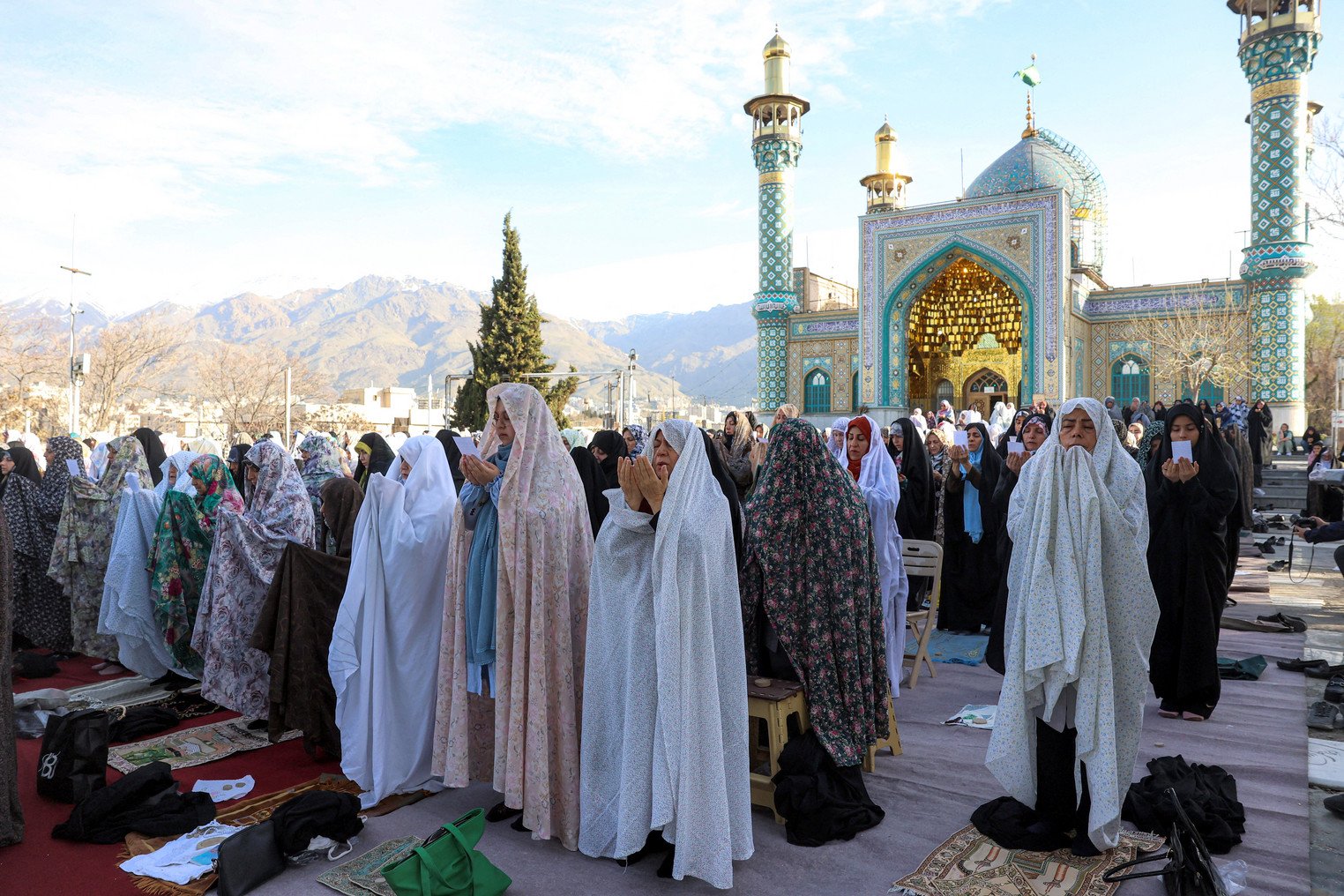
As the U.S. considers striking Iran, Ramadan complicates timing and regional sentiment.The holy month’s sensitivities intersect with broader global shifts from U.S. tariff rulings and European unrest to Asia’s growing space sector signaling changing geopolitical and technological dynamics worldwide.
As the U.S. edges closer to a possible strike on Iran, one overlooked factor stands to complicate the timeline: Ramadan, the holiest month of the Islamic calendar.
An attack during this period — which began this week and lasts through mid-March — could heighten tensions across the Muslim world, galvanizing Tehran’s proxies and perhaps even rallying sympathy behind Iran’s cause, despite its many adversarial relationships across the Arab world.
How Ramadan Reshapes Public Life
A spiritual month headlined by daily fasts and rituals for a quarter of humanity, Ramadan rewires public life in Muslim countries. Work hours shift, community mosques overflow and whole cities eat meals at the exact same time.
Ramadan Hasn’t Stopped Wars Before
Despite its sacred nature, Ramadan hasn’t necessarily been a deterrent to military action — either by Muslim or Western nations. The 1973 Arab-Israeli war took place during Ramadan, when Egypt and Syria attacked Israel. In the 1980s, major offensives in the Iran-Iraq War were launched during the holy period.
The 2001 Precedent
In 2001, the U.S. continued bombing Afghanistan despite calls for a halt from Muslim leaders like President Pervez Musharraf of Pakistan, an ally who warned that air strikes during the holy month “will definitely have negative effects around the Islamic world.”
When asked about the issue in a press briefing in 2001, Secretary of Defense Donald Rumsfeld responded that “the history of warfare is that it has proceeded right through Ramadan year after year after year after year.”
“There have been any number of conflicts between Muslim countries, and between Muslim countries and non-Muslim countries, throughout Ramadan,” he said.
White House Iftars and Domestic Symbolism
Successive U.S. presidents have, however, recognized the significance of the period — at least for domestic political purposes, as part of an effort to acknowledge the increasing cultural significance of Muslim Americans.
Dating back to the 1990s, presidents have held annual White House iftars, though they’ve been easy to dismiss as inclusion signaling. Amid renewed U.S.-backed Israeli military operations, President Barack Obama briefly nodded to Gaza’s humanitarian crisis while speaking at his 2014 White House iftar, but quickly returned to a larger interfaith focus.
Gaza Turns Iftar Into a Referendum
The catastrophic conditions in Gaza were impossible to overlook in 2024, however, and most prominent Muslim American leaders boycotted Joe Biden’s iftar over his policies backing Israel, refashioning the civic tradition into a policy referendum.
Trump’s Iftar Politics
The White House iftar under President Donald Trump lacked that drama in part because the 2025 guest list was heavy on foreign dignitaries — like Saudi Ambassador Princess Reema bint Bandar — and Muslim American outreach was a secondary concern. In his remarks, the president highlighted his 2024 election support from Muslim Americans and riffed on the price of eggs and “stopping schools from indoctrinating children with transgender ideology.”
China’s Ramadan Playbook—and a Crowded News Footer
In failing to lean into Ramadan diplomacy, Washington risks falling behind rivals like China. Beijing has sought to deflect international criticism of its well-documented human rights abuses against its Uyghur Muslim minority in Xinjiang through targeted diplomacy and relentless propaganda aimed to stoke international perceptions of Chinese government tolerance for Islam.
Beijing has flexed savvy understanding through high-profile meetings, cultural investments and curated programming throughout Ramadan with Muslim-majority neighbors like Indonesia, even as it’s drawn international condemnation for its harsh treatment of its own Muslim minorities. And its carefully choreographed engagement with the organization of Islamic Cooperation, a grouping of 57 Islamic countries focused on protecting the interests of Muslims worldwide, has effectively muzzled cohesive international Islamic criticism of such abuses.
In brokering the major Saudi-Iran rapprochement in 2023, China was deft enough to understand the politics of Ramadan — particularly the opportunity it afforded. The talks to normalize relations between Saudi Arabia and Iran were sequenced around the holy month, with the Saudi and Iranian foreign ministers speaking to one another on the phone to wish Ramadan greetings and plan an in-person meeting — which occurred later during Ramadan in Beijing.
Meanwhile, Trump convened his newly formed Board of Peace on Feb. 19, right at the beginning of the holy month. The event featured dignitaries from across the world, including from the UAE, Saudi Arabia, Qatar, Jordan and Turkey, but heads of state from many Muslim nations were absent — in part because the conference coincided with the start of Ramadan.
Supreme Court strikes down Trump’s tariffs: The Supreme Court on Friday struck down Trump’s sweeping tariffs — a major repudiation of a core piece of his economic program. The 6-3 decision is a rare instance of the conservative-led court reining in Trump’s expansive use of executive power. Chief Justice John Roberts and Justices Amy Coney Barrett and Neil Gorsuch joined the court’s three liberals in the majority.
UK says privileged trading terms with US will ‘continue’ in wake of Trump tariff ruling: The U.K. government said it expects its “privileged trading position with the U.S. to continue” after the Supreme Court struck down Trump’s tariffs on Friday. The landmark ruling calls into question the sweeping “reciprocal” tariffs Trump imposed on trading partners last April, including a baseline 10 percent tax on most U.K. goods entering the U.S. The ruling — which applies to tariffs imposed under the International Emergency Economic Powers Act (IEEPA) — does not affect sector-specific duties on sectors like steel, aluminium and automotive.
French far right looks for Charlie Kirk moment after activist’s killing: France’s far right is framing the death of an activist associated with far-right groups as a moment akin to the murder of Charlie Kirk in the United States. The National Rally has in recent days started pointing to the killing of 23-year-old Quentin Deranque in Lyon as proof the poll-topping populist party is the victim of an increasingly radical political left, much as the MAGA movement in the United States did following Kirk’s assassination last year. With key municipal elections next month serving as a bellwether of the National Rally’s electability heading into the 2027 presidential race, the incident has deepened the fissures in France’s polarized politics and fueled fears of further violence.
The European Union’s underground gas facilities are only 32 percent full as of Feb. 18, the lowest storage levels since winter 2022. These gas reservoirs are a critical buffer for the bloc’s energy supply, especially during harsh winters when demand is high.
A decade ago, the U.S. space industry was in upheaval. Private companies like SpaceX and Blue Origin were on the rise, tech start-ups entered the scene and venture capital flooded in to match. But outside of the U.S., governments still largely oversaw space tech developments.
But the world “has changed dramatically since,” Asia-based tech journalist Kristie Neo writes in her Substack, which covers venture capital in Southeast Asia and the Middle East. Within this new landscape, some Asian nations look poised for a space tech revolution of their own:
“Nowhere have we witnessed the greatest shift for space than right here in Asia and the Gulf. Until as recently as 2010s, most of the space industry outside of the US was largely confined to national budgets with technology developed for military or defense purposes. The world has changed dramatically since.
“Geopolitical conflicts — be it South China Sea, India-Pakistan, Russia-Ukraine, Israel-Gaza, UAE/Saudi-Yemen — have grown in intensity. At the same time, the parallel rise of dual-use technology and private capital markets in China, India and Singapore have birthed an entirely new class of spacetech startups with commercial business cases in areas as vast as agriculture, data centres, and insurance.
“India’s $15 billion spacetech market is set to more than double by 2030, thanks to its heady mix of [Indian Space Research Organization], [Indian Institute of Technology] engineering talent and some $3-5 billion of projected private capital inflows, according to Arkam Ventures’s latest report. If it keeps accelerating at this pace, India’s spacetech sector will be third-largest in the world by the end of this decade…
“In Singapore, a tiny Asian city with towering sovereign coffers and world-class universities, plans are underway to set up its first space agency on April 1, signaling an upgrade in national priorities for the once fledgling sector.”