
Targeted destruction of upstream energy infrastructure ensures long-term global supply deficits. Resulting inflationary pressures force Federal Reserve rate hikes, compounding debt servicing burdens for the Global South. The complexity of modern lending, involving fragmented private bondholders and Chinese banks, threatens a multi-decade economic depression in vulnerable developing economies.
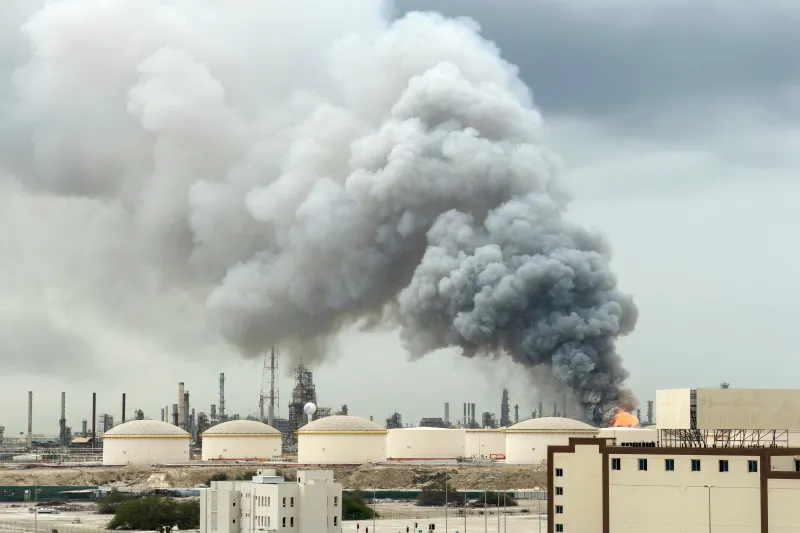
In late March, both Israel and Iran attacked gas fields in the Persian Gulf, the most dramatic escalation yet in the Iran war. By striking upstream energy infrastructure, the belligerents have ensured that the war will have global ramifications lasting beyond the end of the conflict. Even if the recently announced cease-fire holds and the war ends soon, it could take up to five years to rebuild the infrastructure that was lost. And if the cease-fire fails and the war continues, so, too, does the risk of even further destruction. In a world of finite resources, it will be the wealthiest that can afford to pay premium prices for the energy that remains. And it will be the world’s poorest who suffer most.
Indeed, these strikes, along with the broader energy sector disruptions that have accompanied the U.S-Israeli war in Iran, have all but guaranteed an energy supply shock that will drive up inflation globally. Additional strikes on infrastructure that is critical to energy production and distribution would exacerbate such a crisis. This dynamic—excess demand for limited resources—is a classic driver of inflation. Almost immediately after the strikes, U.S. markets began betting that the U.S. Federal Reserve would increase interest rates, its most direct tool for fighting inflation. Amid an already challenging cost-of-living crisis, the American people will suffer consequences: rate hikes will affect borrowing costs on expenses such as car loans and mortgages, increased energy prices will drive up the price of gas and other fuels, and manufacturers of the myriad goods on which people rely will pass higher production costs on to consumers.
But inflation and decisions made by the Fed to fight it matter far beyond U.S. borders, as most countries’ outstanding debts are still denominated in U.S. dollars. This is equally true for those countries that have spent the past 20 years borrowing from China. Put simply, rising U.S. interest rates will determine the debt sustainability of numerous countries. Regardless of the outcome of this war, it’s already clear that many countries will have to pay more for the energy needed to fuel their industries, power their electric grids, and sustain their transportation networks. But states shouldering heavy debt loads, such as those categorized by the World Bank as low-income countries, will also see their financial burdens compound as inflation makes their debt more expensive to repay. This will be true whether they owe those dollars to financial institutions in Beijing, asset managers in London, or multilateral development banks in Washington.
This is a hidden cost of the war—and it will fall hardest on those least able to bear it. In fact, many low-income countries are already struggling with historic levels of sovereign debt; in recent years, the share of countries in debt distress has more than doubled, from 24 percent in 2013 to 54 percent in 2024. As the geopolitical climate becomes more fraught, massive defaults among developing countries could reverse gains in poverty eradication, global health, and industrialization, creating hardships that fall disproportionately on children and the elderly. Echoes of the major 1980s debt crisis are increasingly noticeable as this war proceeds, and thus the nature of every creditor country’s response is critical to avoiding the mistakes of the past, when resolutions came too late for many in the so-called global South.
BREAKING BANKS
Developing countries have been through this kind of debt crisis before. During the Yom Kippur War in 1973, the Organization of Petroleum Exporting Countries banned the export of oil to countries that supported Israel. The resulting supply shock caused global energy prices to surge by 300 percent in six months, affecting manufacturing, transportation, and household costs across the world. Although the oil embargo was not the sole cause of the runaway inflation that hit many countries, particularly the United States, in that decade, it was a potent addition to the many other inflationary pressures that had been building up to that point. As the former Fed chairman Arthur Burns argued in 1979, the inflation of the 1970s could be traced to a number of factors: “the loose financing” of the war in Vietnam, the devaluations of the dollar in 1971 and 1973, the worldwide economic boom of 1972–73, the crop failures and resulting surge in global food prices in 1974–75, the “extraordinary” increases in oil prices, and the abrupt slowdown in productivity. In other words, the OPEC embargo struck during an already powerful economic storm, not unlike the “polycrisis” that some argue is evident today.
Although developing countries were generally not direct targets of the OPEC ban, those that were non-oil-producing suffered from the quadrupling of fuel prices. The World Bank estimated that trade losses reached around one-half of the average value of exports and imports in countries like Brazil and South Korea, and industrial activity in those countries was dampened. By the mid-1970s, developing countries without oil exports were trying to finance their growing balance-of-payments deficits by borrowing more money in commercial markets and from multilateral institutions such as the International Monetary Fund (IMF). A second oil crisis hit the global economy during the Iranian Revolution in 1979, further hiking prices. By this point, U.S. inflation exceeded one percent per month—a jolting increase from the Fed’s usual target of two percent per year—and was tackled only when Paul Volcker, who took over as Fed chairman in August 1979, raised interest rates to a staggering 20 percent. The fact that almost all the borrowing by low- and middle-income countries was being financed in U.S. dollars meant that debt servicing costs across the developing world increased dramatically.
Volcker’s rate hikes were particularly damaging because they hit developing countries with a one-two punch. First, they caused the U.S. dollar to rise in value relative to global South currencies, meaning it would cost a borrower country more of its local currency to make dollar-denominated repayments. Then, they caused the floating interest rates on such debt, which fluctuate periodically, to spike. This resulted in higher interest payments for the estimated two-thirds of developing countries with loans that were tied to floating rates. Borrowers in developing countries would not see interest rates as low as they had been in the early 1970s until the international financial boom of 2005 to 2008.
What began as a slow trickle of debt defaults in the mid-1970s in countries like Jamaica, Turkey, and Zaire was suddenly recognized as a systemic problem when Mexico, despite its notably large economy, declared in August 1982 that it was unable to repay its U.S. dollar–denominated debts. By the end of that year, roughly 40 countries were overdue on their interest payments, and by the following year 27 of them were negotiating to restructure their outstanding loans. When a country defaults, it often makes an already perilous financial situation worse. It can devalue the local currency, for instance, leading to further inflation that erodes the buying power of citizens. It can also eviscerate the country’s credit rating, making it harder to refinance and forcing its government to restructure debts in a way that brings painful compromises.
As this debt crisis unfolded, Western creditors called on the IMF to renegotiate debts on their behalf, but the intervention arguably made things worse for many countries: by prescribing how debtor countries should redirect spending toward debt repayments, the IMF, with backing from the World Bank, eviscerated many countries’ budgetary discretion. Nascent industries were kneecapped, and the vital provision of social services halted, as countries tried to honor restructured debt repayments. The diversion from productive investments also made it harder for countries to earn the money they needed to service their restructured debts. The result was deeper economic crises in the world’s poorest countries.
During this period, which is often referred to as the “lost decade,” some countries’ annual interest payments were equivalent to their economies’ entire annual GDP. In sub-Saharan Africa, it took over 20 years for GDP per capita and investment levels to recover to pre-crisis levels. The custodial financial institutions that had been established at the Bretton Woods conference during World War II lost a lot of credibility; developing countries viewed them as out of touch at best and punitive and exploitative at worst. These perceptions were not lost on China, a global South debtor at the time, which today continues to stress the lack of conditions on its own lending to developing countries.
The crisis was eventually resolved through debt forgiveness, the IMF’s Heavily Indebted Poor Countries initiative, and the innovative financial mechanism known as Brady bonds, which allowed developing countries to replace portions of their existing sovereign debt by issuing new securities backed by U.S. Treasury bonds. Western lenders, having learned their lesson, subsequently shied away from the infrastructure lending that had dominated their portfolios in the 1960s and 1970s. Many development institutions pivoted from loans to grants and prioritized programs that focused on health, education, and governance. But developing countries still needed money to build roads, ports, and other infrastructure required for economic growth. Private-sector and Chinese lending took off in the early 2000s to fill this gap.
GOING UP
At the turn of the century, many global South economies were growing again, buoyed by a commodity boom and relatively stable international trade. Crucially, debt resolution had also improved their credit ratings, allowing many countries to start borrowing again from commercial banks or to guarantee commercial bank loans taken out by favored domestic institutions. Even more significantly, many middle-income countries, such as Ecuador, Zambia, and Sri Lanka, started issuing bonds in Western financial markets for the first time. Private-sector lending to developing countries dipped around the time of the 2008 global financial crisis, but private creditors in wealthier countries quickly regained their footing in the 2010s as they sought out higher returns amid a low-interest-rate environment in Western markets. There was also great optimism about how many emerging economies appeared to weather the financial crisis better than wealthier countries. Between 1985 and 2024, although the share of private lending for middle-income countries remained roughly the same at just under 60 percent, the ratio of that lending from commercial banks fell from 74 percent to 21 percent, while bonds rose to 79 percent of private loans.
At the same time, China emerged as the largest bilateral lender for both low- and middle-income countries, and just as with private-sector lenders, most of that lending was in U.S. dollars. The early 2000s was a time when China’s recently industrialized economy was looking to boost exports around the world, and lending was a means of supporting the flow of Chinese goods and services to developing countries, primarily in construction sectors. Lending to global South partners also appeared to offer a virtuous cycle: offering money to global partners who really needed the support for infrastructure projects made Chinese banks look good, and those banks simultaneously got a return on investment that was higher than what they earned from U.S. Treasury bonds. Of the $475 billion in outstanding bilateral debts owed by low- and middle-income countries today, Chinese loans account for the largest portion, at just over $147.5 billion, or roughly 31 percent.
This new generation of lenders, however, failed to question the economic security of lending primarily in U.S. dollars. It was only when the COVID-19 pandemic triggered inflation in the United States that the Fed imposed serious interest rate hikes, the first since the 1970s. Borrowers in the global South felt the impacts immediately, and some countries, such as Ghana and Sri Lanka, quickly fell into default.
Partly as a result of these challenges, China recently joined the two most important multilateral debt relief initiatives: the Debt Service Suspension Initiative, launched by the G-20 during the COVID-19 pandemic to ease debt obligations on 73 low- and middle-income countries, and the Common Framework for Debt Treatments, which succeeded it. Progress, however, has been slow because of disagreements over burden sharing. The process of restructuring Zambia’s debts, for example, was delayed while Beijing argued that multilateral development banks should take greater losses themselves and not demand so much of Chinese banks. Meanwhile, China still lacks a mechanism to determine how banks apportion compensation and losses when debtors can no longer service Chinese banks’ international loans, which has led to time-consuming disagreements and negotiations across China’s interconnected financial institutions.
LOOMING DEBT DRAMA
For Chinese banks, the potential losses from borrowers’ defaults would be substantial but resolvable, given that the country still holds large surpluses of U.S. dollars. The greater risk for China is the longer it takes to assign responsibility for losses among the many Chinese financial institutions involved, the longer it will take them to restructure debts. Such delays risk jeopardizing the narrative of cooperation that China has sought to cultivate with its global South partners and leaving borrowers with the same perceptions they had of Western lenders during the prior debt crisis.
Indeed, today’s looming debt crisis risks becoming even more fraught, both for the borrowers and lenders, than it was in the 1980s precisely because it seems poised to drag on for much longer. Compared with the few dozen big commercial banks that held debts in the 1980s, there are far more debt holders today. Thus, in addition to the delays imposed by China’s unresolved internal financial disputes, developing countries may also have to negotiate with the hundreds of Western pension funds, asset managers, hedge funds, insurance companies, and other institutions that now hold the various portfolios of bonds issued by state and private entities in the global South. The more complex a new debt crisis is to resolve, the harder it will be for newly industrializing countries such as Sri Lanka or Zambia to bounce back, meaning their suffering will continue.
Although debt sustainability has been a growing issue for at least five years, the war in Iran has introduced the kind of sudden global economic shock that makes it all but certain that a prolonged debt crisis is coming. The executive director of the International Energy Agency recently declared that the war in Iran is the greatest threat to global energy security in history and that politicians and markets underestimate the scale of the crisis. It will take years for some of the damaged oil and gas fields to resume operations, and although the cease-fire may ease shipping tensions in the short-term, there remains no permanent resolution to the standoff over the Strait of Hormuz. In the meantime, inflation is likely to rise, increasing pressure on the Fed to raise interest rates. The poorest countries will then suffer most as their governments are forced to restructure budgets to meet interest obligations rather than invest in their own economic growth and their populations.
Although some lessons from the previous major debt crisis can be applied to the current one, the more complex nature of today’s debts is likely to extend the crisis and introduce new challenges, including the question of burden sharing across bondholders and Chinese banks. There are no obvious panaceas. The only certainty is that the sooner the war ends, the sooner the world can focus on easing this economic distress.