
The integration of the Ukraine and Iran conflicts centers on the shared operational challenge of Shahed-class munitions. By exporting real-world interception data to the UAE and Saudi Arabia, Kyiv secures its position as a vital security partner, counteracting Russian-Iranian synergy and hedging against fluctuating American diplomatic priorities.
Russian and Iranian drone cooperation has pushed Ukraine and the Gulf States into closer defense technology partnerships.
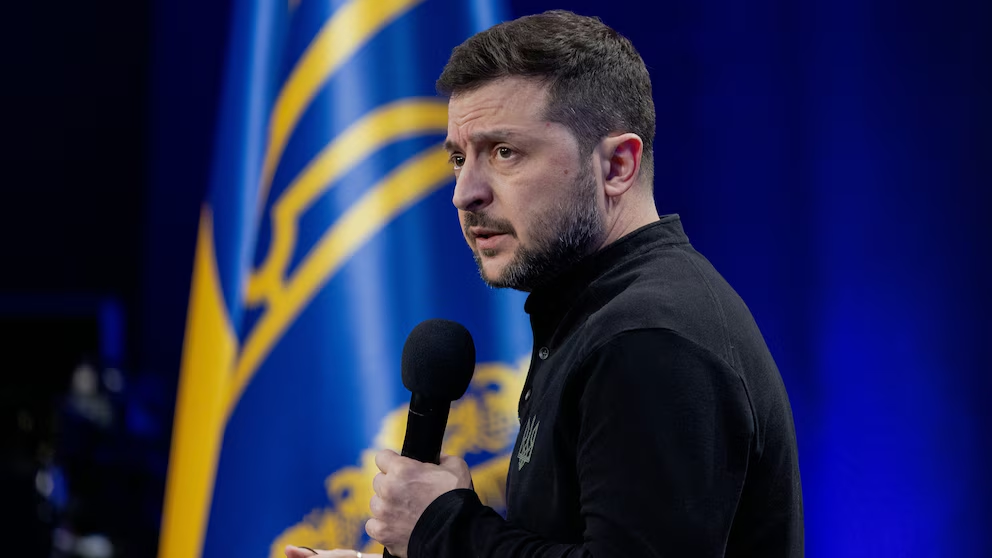
On March 28, Ukrainian President Volodymyr Zelensky traveled to the Persian Gulf for meetings with countries that have been under Iranian drone and missile attacks for a month. In the UAE, he met with President Mohamed bin Zayed Al Nahyan, and in Saudi Arabia, he met with Saudi Crown Prince Mohammed bin Salman. He also went to Qatar. The trip highlights how the conflicts in Ukraine and Iran are linked. In both conflicts, Iranian-designed drones have played a key role. In addition, the meetings show how regional powers, especially those that are partners of the West, can play a key role during wartime.
There has been tension between the White House and Kyiv in the past, and this has also spilled over into questions about US policy toward Europe and Ukraine compared to Iran. This matters because it’s possible to view both the Ukraine War and the Iran War as compartmentalized, in different regions and involving different countries. One could view the Ukraine war as primarily a European war, while the Iran War is linked to the Middle East.
On the other hand, it’s also possible to see the wars as linked in many ways. For instance, Iran and Russia have long been close friends and partners. They have worked together in Syria supporting the Assad regime since 2015, when Russia intervened in Syria. Syria was a longtime client state of Russia, dating back to the Soviet era. When the Syrian Civil War broke out in 2011 after the Arab Spring protests, the Iranians sent forces to Syria. Iranian Islamic Revolutionary Guard Corps (IRGC) Quds Force commander Qassem Soleimani went to Russia in 2015 to encourage Russian President Vladimir Putin to intervene and save the regime of Bashar al-Assad.
Russia-Iran cooperation in Syria is not the only way the two countries have been linked. From missiles and drones to civil nuclear power and air defense (Iran acquired Russia’s S-300 air defense systems in 2016), the countries are deeply entwined.
Russia’s invasion of Ukraine in 2022 has led Moscow to focus primarily on the Ukraine front and devote less attention to the Middle East. Neither the October 7, 2023, Hamas attack on Israel nor the collapse of the Assad regime in December 2024 provoked a serious response from Moscow. Russia has largely sat on the sidelines of the Iran War as well. However, appearances are deceptive. Iran’s drones have proven beneficial to Russia. The delta-wing-shaped Shahed-136 has provided Moscow with cheap, expendable drones to fling at Ukraine and overwhelm its defense. Instead of risking costly aircraft that Moscow may not be able to replace easily, the drones have terrorized Ukraine for years. The onslaught has forced Ukraine to adapt into one of the most advanced operators in counter-drone technology.
When the United States and Israel began airstrikes on Iran on February 28, Tehran responded with attacks across the Middle East, including drone and missile attacks on Saudi Arabia, the UAE, Bahrain, Qatar, Kuwait, Iraq, Israel, Jordan, and other countries. Iran has targeted the UAE more than other countries in terms of the total number of attacks. Naturally, these countries now wish to consult with countries that have also suffered Iranian drone attacks, like Ukraine.
The National in the UAE noted that “Ukraine’s President Volodymyr Zelenskyy on Friday announced a defence agreement with Saudi Arabia, as he offers his country’s experience in fighting Iranian drones to Gulf countries now under fire.” Meanwhile, Zelensky noted on X, after he met with the president of the UAE, that “The President thanked our team for its work here in the Emirates. For Ukraine, this is also a matter of principle: terror must not prevail anywhere in the world. Protection must be sufficient everywhere. That is why we are open to joint work that, in a strategic perspective, will certainly strengthen our peoples and the protection of life in our countries.”
Zelensky added that “unfortunately, have been under daily attack for four years of full-scale war. Ukrainians have developed an appropriate protection system that delivers a significant interception rate against enemy drones and missiles. This systematic approach and integration of experience is exactly what we are offering to our partners.”
Neither region, Europe nor the Middle East, is a vacuum. Weapons used on one battlefield inform decisions on another. At the G7 meeting in France on March 27, the wars in Iran and Ukraine were both a focus of discussion. The United States is now focused more on Iran than Ukraine, which has led to some tensions with European countries and also tough comments about NATO from the White House.
Whenever or in whatever manner these conflicts are resolved, their reverberations will affect the world order. In particular, they will have consequences for President Putin’s push for a multipolar world, with a diminished United States.