
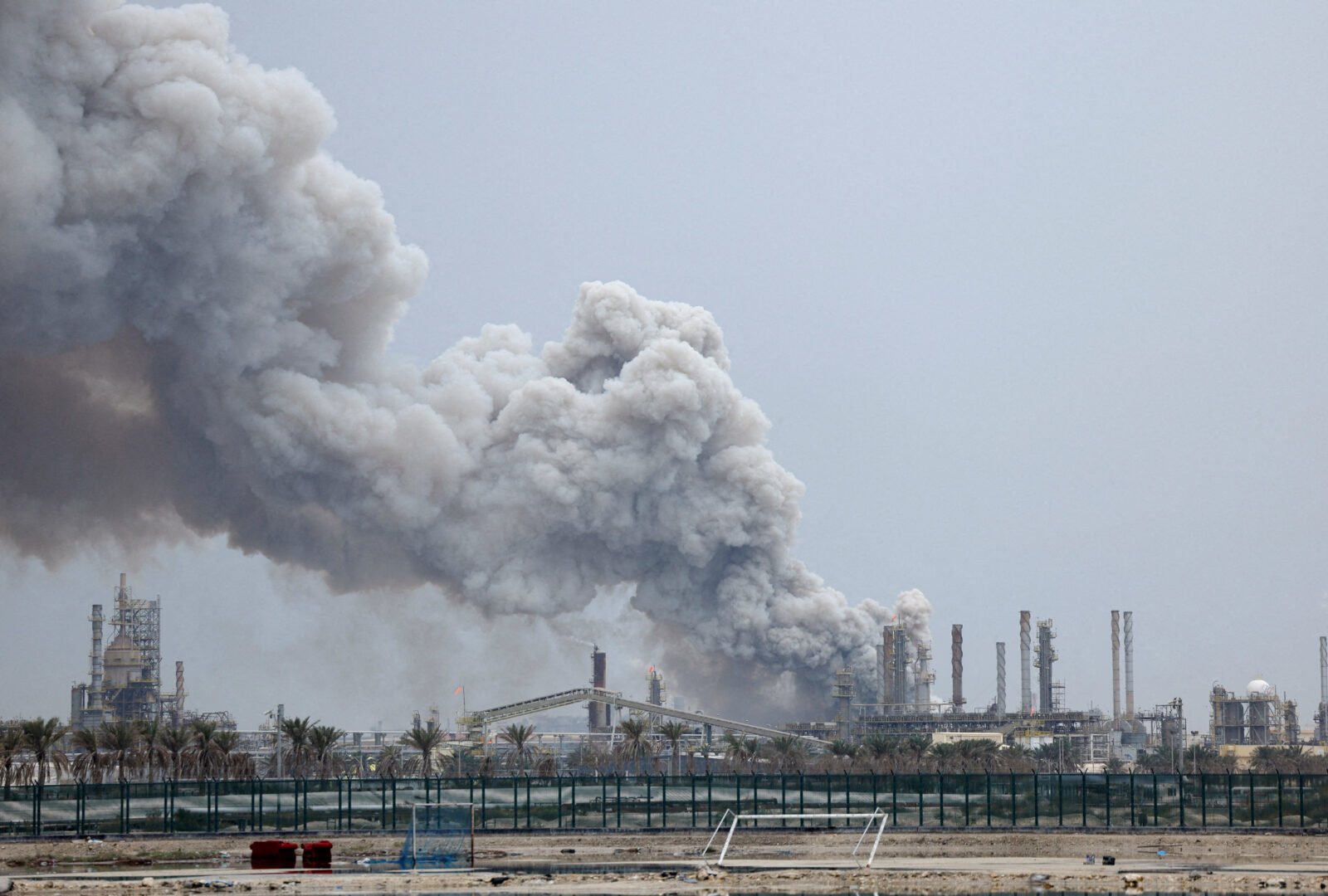
Initial combat operations against Iran cost an estimated $25 billion monthly. While a $200 billion supplemental request is pending, existing defense allocations provide a temporary buffer. Significant fiscal risks remain, as full-scale invasion costs could exceed $650 billion annually, demanding clear strategic exit paths before further congressional appropriations.
Overview
On Feb. 28, the United States joined Israel in launching a war of choice against Iran. The conflict has since become a regional war, with an unclear goal and mission for the US military and US diplomatic efforts. The Trump administration will reportedly request an additional $200 billion in supplemental appropriations to address the costs of the war.
This lack of clarity has made estimating this war’s costs — difficult in any conflict — an even more hazardous exercise than is usually the case. Nevertheless, enough information is available concerning the ongoing war, as well as spending on past US military operations, to provide some preliminary estimates of the costs and to offer some reasonable observations as to how much and how quickly funding must be found to cover them.
These topics are explored in this note by focusing on five specific questions:
Should Congress enact supplemental appropriations for the war?
How much has the war cost in its first month?
How much might the war cost going forward?
Could war costs reach $200 billion this year?
How much would a full-scale invasion of Iran cost?
Key findings from this brief analysis are:
The costs of this war so far are high but manageable. But they could grow dramatically should the war escalate, and they would be extreme in the case of a full-scale invasion.
Given the high base military budget and the additional $154 billion allocated in the One Big Beautiful Bill Act, or OBBBA, which has not yet been expended, there is no urgent need for additional funding for the conflict at this time.
Until the administration can articulate a reasonable and realistic path forward for prosecuting and, ultimately, exiting this conflict, based on clear and attainable strategic goals, Congress should not provide additional war funding.
Discussion
Question 1: How much has the first month of the war cost the Department of Defense?
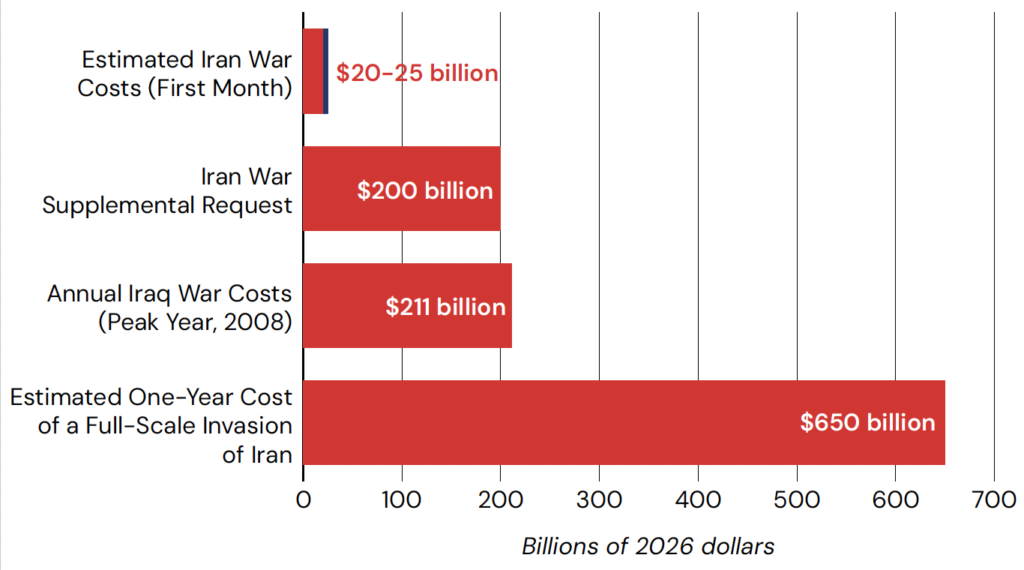
The Defense Department has not yet provided an estimate of war costs to date. However, a reasonable estimate for the costs incurred by the department over the war’s first month is $20–25 billion. The higher end of this estimate is based on an analysis and methodology developed by the Center for Strategic and International Studies.
The lower end is based on an analysis of costs associated with the US air campaign during the 2003 invasion of Iraq.
Question 2: How much is the war likely to cost the Defense Department going forward?
There is far too much uncertainty concerning US war plans, munitions expenditures, and other considerations to provide even a very rough estimate of the likely future costs associated with ongoing US military operations against Iran. The best that can be done is to suggest some rough bounds for potential future costs, depending on how the war develops (see Figure 1).
During the first month of the war, US military operations were largely confined to air and missile strikes, conducted by air and naval forces, as well as air defense activities. These operations were extremely intense over the first week or so of the conflict and involved large numbers of very expensive long-range precision munitions (such as the sea-launched Tomahawk cruise missile), making those first few days extraordinarily costly. Since then — at least into the weekend before President Trump’s April 6 deadline to the Iranian government was set to expire — it appears that the tempo of operations as well as the cost of the munitions used, while still significant, has generally declined.
Assuming that, going forward, the tempo of operations remains more or less what it has been over this recent period, a reasonable cost estimate might be $250–500 million a day, or about $7.5–15 billion a month.
If US military operations were to slow to a lower pace — perhaps reflecting a dearth of useful targets to hit, a pulling back from the brink by both sides, or other considerations — costs might decline still further, to perhaps only a few billion dollars a month.
On the other hand, costs could just as easily grow to higher levels if military operations escalate further — as the administration is indicating they will, if the Iranian government ignores its latest ultimatum. Over the past few weeks, the US military has begun to move a number of Marine Corps and Army units into the region, which could be used to conduct ground operations in Iran. The units include two Marine Expeditionary Units, or MEUs, and one brigade of the Army’s 82nd Airborne Division. It is unclear how these forces might be employed. However, press reports and speculation by outside analysts tend to focus on the seizure of the important oil-exporting terminal of Kharg Island or other islands controlled by Iran closer to the Strait of Hormuz. Altogether, these forces reportedly include at least 7,000 combat troops as well as a significant number of support personnel.
Such an operation would also be expected to be accompanied by far more intensive air operations and missile strikes by supporting US air and naval forces than has been common over the past few weeks. Moreover, depending on the mission and its goals, as well as how the situation develops on the ground, it is possible (perhaps even likely) that the initial deployment of these forces will be followed up with the deployment of substantial additional units; for example, bringing in the other two brigades of the 82nd Airborne. Under these conditions, rather than falling to a monthly cost of $7.5–15 billion in April — as suggested above — those costs might well be expected to remain roughly at, or possibly even significantly above, the $20–25 billion estimated to have been incurred in March.
Question 3: Could the war’s costs reach $200 billion this year?
The White House will reportedly request a $200 billion supplemental appropriation to cover the costs of the US–Israeli war against Iran. Could costs reach that level through the remainder of the fiscal year (which ends on Sept. 30)? In a scenario of extreme escalation, they certainly could. However, they would likely do so only if the war escalates much further than suggested in the hypothetical bounding examples discussed above, and/or lasts far beyond the four-to-six-week period put forward by the administration for the expected duration of the conflict.
The analysis above suggests that even a two-month conflict that includes a modest ground component would likely cost in the range of $50 billion, though possibly less.
Getting to $200 billion would require a dramatic expansion, relative to the assumptions described above, in the scale and/or duration of the conflict.
No effort will be made here to speculate as to what such an escalation and expansion might entail. It could unfold in a variety of different ways — involving larger deployments of air, naval, or ground forces to varying degrees — and timelines that could be measured in several or many months, rather than weeks. However, for context, it is useful to remember that at its peak in 2008, the war in Iraq cost the US about $211 billion in FY2026 dollars, only slightly more than the Trump administration’s current request for the ongoing war against Iran.
Additionally, that year, the war in Iraq included an average of some 160,000 American troops with “boots on the ground.”
Question 4: Could the US military execute a large-scale invasion and occupation of Iran along the lines of the 2003 invasion of Iraq? If so, how much would it cost?
It is very difficult to imagine President Trump deciding to attempt such an invasion and occupation of Iran. But if he does, the budgetary costs will be extraordinarily high. As noted above, in 2008, the peak year of the occupation of Iraq, the US had an average of about 160,000 soldiers with “boots on the ground” in the country. Iran today has more than three times the population that Iraq had then, and it is some four times larger geographically. This suggests that the US military may need at least 500,000 personnel to accomplish a comparable mission; a commitment that would be exceedingly difficult to implement, let alone sustain, for an extended period.
Extrapolating from the cost per troop incurred in Iraq, such a force might be expected to cost some $55 billion a month, or over $650 billion a year. And this may well significantly understate the likely costs. Among other things, the lack (this time around) of relatively safe areas in the Persian Gulf region from which to both stage and support US ground forces could significantly drive up costs.
Question 5: Should Congress enact supplemental appropriations for the war?
Until the Trump administration can articulate clearly what its goals are for the military campaign against Iran, explain how it realistically expects to accomplish them, and show evidence of serious diplomatic efforts being made to bring the conflict to an end, Congress should reject any request for supplemental appropriations to cover the costs of the war. In the absence of a clear strategic plan, providing additional funds at this time would permit escalation of the war to an unsustainable point beyond its current level. Until then, the administration should be required to cover any extra costs for this war of choice, for which it neither sought nor received congressional authorization, from existing Defense Department funds.
This should be manageable because the Defense Department received $154 billion in extra funding in last year’s OBBBA, to be spent over a multiyear period. This is funding on top of the roughly $900 billion provided in the regular defense budget, appropriated annually by Congress. It was only this February that the Defense Department submitted its plan to Congress for how it intends to spend the OBBBA funding.
Thus, the vast majority of that money is still available and could be repurposed to cover any urgent war cost; though doing so might require congressional approval of additional transfer authority in order to ensure the funding could be allocated to those accounts most in need of replenishment as a result of the war.
Any decision concerning a potential supplemental appropriations act to cover US war costs in Iran should also be informed by the White House’s proposed 2027 budget request. The request, submitted on April 3, includes $1.5 trillion for defense, marking an approximately $500 billion increase (roughly 50 percent) from this year. This level of spending is so disconnected from existing defense requirements and plans that the Pentagon has been scrambling for months to figure out a plausible path for executing the proposed jump.