
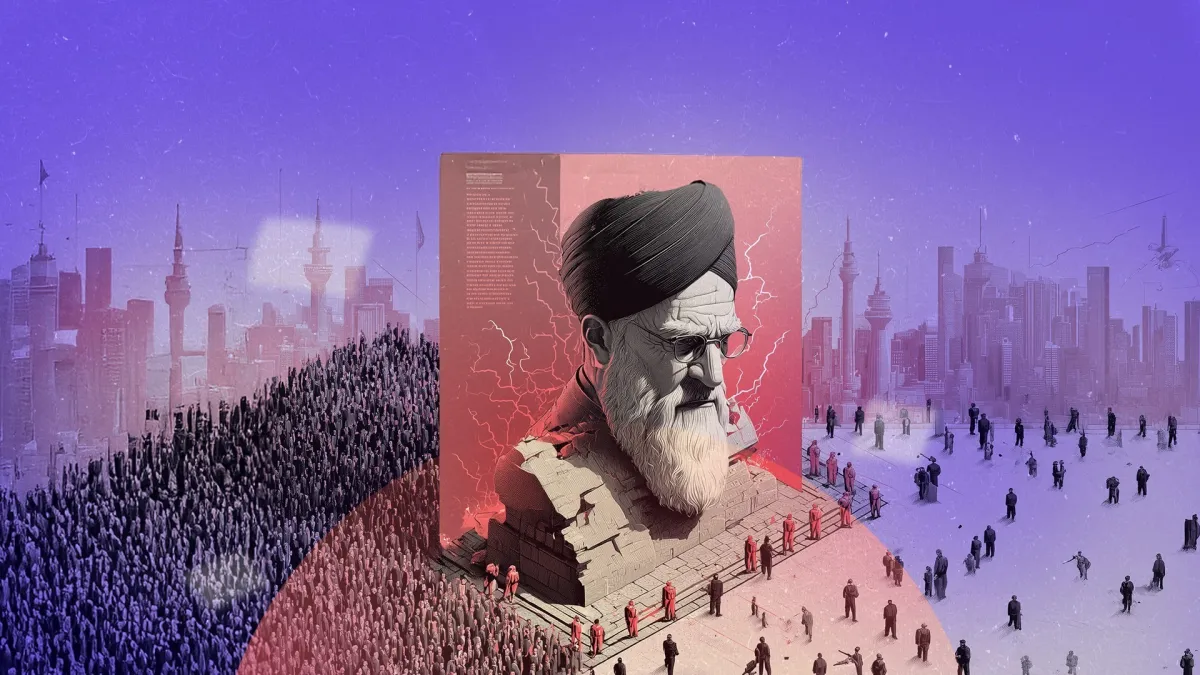
Many Iranians are expressing relief about the bombings – as long as they bring regime change.
Contrary to earlier expectations, the military and political power structure of the Islamic Republic has managed to hold together after two weeks of war. The regime has succeeded in maintaining its repression of the populace even as it has weathered constant bombardment.
Even though the Islamic Republic lost its supreme leader on the first day of attacks by the United States and Israel, it has managed to influence global oil prices by closing the Strait of Hormuz. It has chosen a new leader, launched missiles and drones at Israel and countries in the Gulf, and maintained domestic supply chains for fuel and essential goods. It has also managed to prevent large-scale public demonstrations.
The Islamic Revolutionary Guard Corps and the Basij militias quickly established extensive checkpoints and constant patrols. They make a point of prominently displaying their weapons. Riding heavy motorcycles, they make loud noise intended to intimidate the public. Officials and commanders of the Revolutionary Guards appear on state television and explicitly threaten citizens, warning that they will face severe consequences if they take to the streets.
In the very first hours after the attacks began, the authorities pushed the internet to the brink of total shutdown. According to NetBlocks, only about one percent of Iran’s population currently has access to the internet. Government officials have effectively implemented a form of domestic hostage-taking by severing people’s connections with the outside world – and with each another.
The reaction of a significant portion of people inside Iran, however, has been even more surprising than the resilience of the regime. Many Iranians are expressing satisfaction – even relief – about the bombings. Despite the problems with connectivity, this reporter has managed to establish contact with at least sixty different citizens, and all of them – both those who fear the bombings and those who do not – said they see military intervention as the only way for the country to rid itself of the Islamic Republic.
Numerous independent accounts from Tehran suggest that more residents have decided to shelter in place rather than fleeing to presumably safer locations, as many of them did during the twelve-day war last year. Through experience, Iranians have learned that military sites, rather than civilian buildings, are the main targets of the strikes. Many of those who have stayed home told me that are waiting for a public call from Reza Pahlavi, the son of the former Shah, to take to the streets for a final round of protests aimed at overthrowing the Islamic Republic.
Mohammad-Hossein, a fifty-year-old computer engineer living in western Tehran, said in a voice message: “We have stayed in Tehran and rarely leave the house except for essential shopping. The only thing we are waiting for is the moment when the Crown Prince [Pahlavi] calls on people to protest so that we can go into the streets.” He said that people are afraid of the government’s threats against the populace. “And you may not believe this, but the sound of the bombs is not frightening to us.
“The people want the regime to surrender”
Tahmineh is a twenty-year-old woman. In a voice message, she says: “I believe this war is entirely moral. We are paying the price of freedom. No country in the world has gained freedom cheaply. We will pay that price as well, and afterwards we will build a country better than what we have now, because we know that freedom gives us the chance to grow.”
She draws a comparison between the casualties incurred during the current conflict and the number of protesters killed by the government in January’s mass demonstrations. “Right now just over a thousand people have been killed, most of them military personnel, representatives of the apparatus of repression. In contrast, at least 32,000 citizens were killed during the protests. They had no weapons. There was no violence. They simply went into the streets to chant slogans.”
Tahmineh adds: “The people want the Islamic Republic to surrender.”
Fear of the war ending without regime change
“For us, the sound of fighter jets is frightening, but when the sky falls silent, it is even more frightening.” This is what Sareh, a specialist physician, told me. According to her:
“If the United States and Israel end this war without regime change, it would be a total defeat for us. We have already lost our past. Our youth has been spent in war and protest. And if the mullahs remain, poverty and repression will be our future.”
Other citizens have repeated that point: They do not want the United States to leave Iran without regime change.
With each passing day of the war, this question is becoming more urgent among citizens. The twelve-day war with Israel taught Iranians that the United States and Israel do not deliberately target civilians. But it also taught them something else: That these countries might leave Iran abruptly, abandoning them.
During the previous twelve-day war, just when Iranian citizens hoped that Israel’s next target might be Ali Khamenei, Iran’s dictator, a ceasefire was suddenly declared. That episode has now become an obsessive fear for many Iranians: What if they abandon us again?