
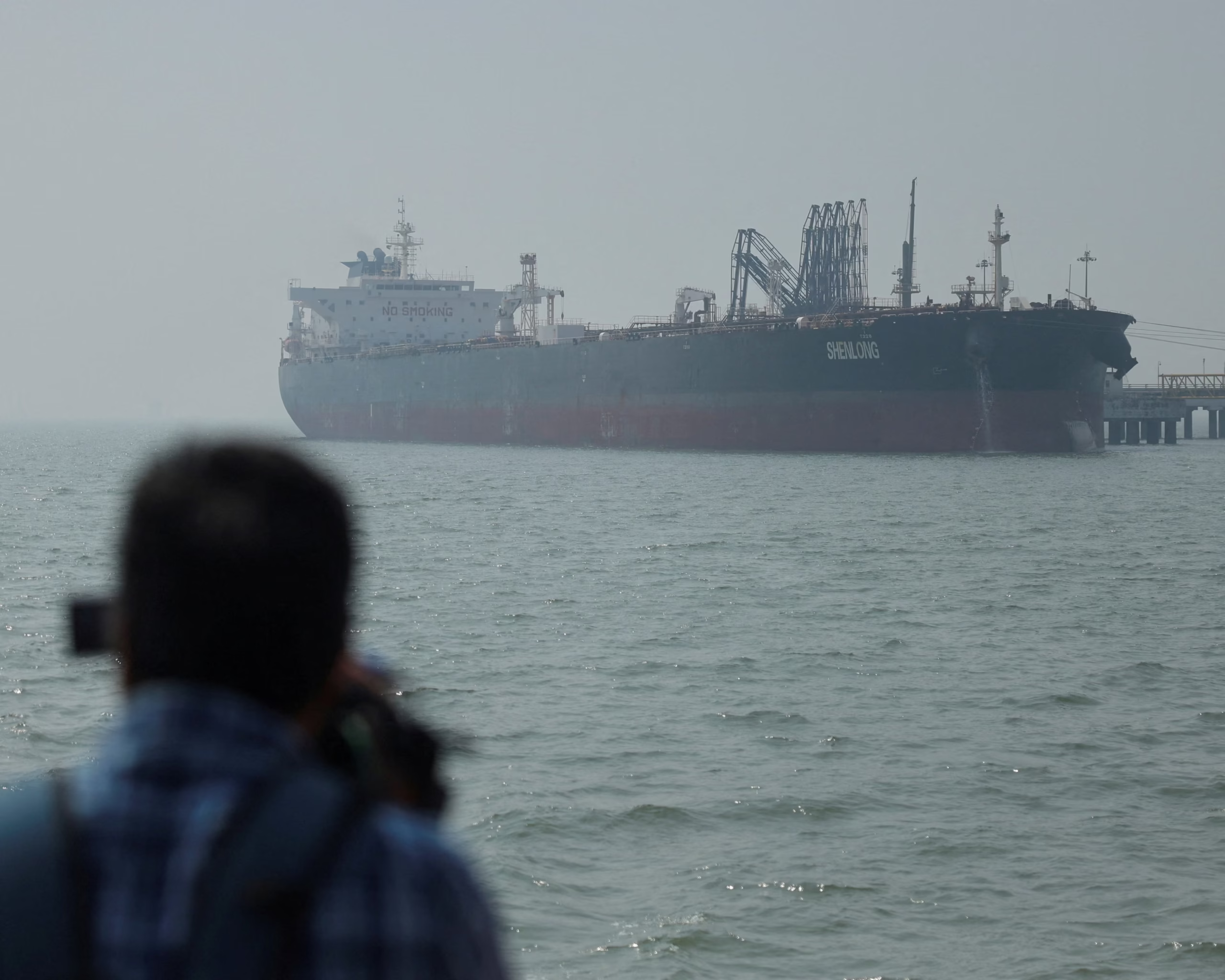
This article evaluates the shift toward predatory resource acquisition under the Trump administration. The authors contrast “lucrative” investment opportunities for U.S. firms with critical warnings of legal overreach, noting that soaring domestic gas prices are driving the current escalatory rhetoric.
President Trump is increasingly using U.S. power and influence in an attempt to gain control of foreign oil and minerals.
Over the weekend, Trump said that, regarding the conflict in Iran, his “preference would be to take the oil.”
While the seizure of oil may not be the administration’s main motivation for engaging in Iran, the remark follows a broader pattern of Trump inserting energy and resource stipulations into foreign relations.
“To be honest with you, my favorite thing is to take the oil in Iran, but some stupid people back in the U.S. say: ‘Why are you doing that?’ But they’re stupid people,” he told the Financial Times in an interview published Sunday.
A White House spokesperson declined to answer The Hill’s questions about what it would do with the oil or what the U.S. has to gain from such a seizure, referring The Hill back to Trump’s prior remarks.
The president’s allies argue that taking over Iran’s oil could be a boon for American businesses.
“Quite frankly, we don’t need Iranian oil. I think what you’d see is opportunities for American businesses to go in and invest in rebuilding the industry, which is essentially what’s happening in Venezuela, which will be enormously lucrative,” said Victoria Coates, vice president of the Institute for National Security and Foreign Policy with the conservative Heritage Foundation.
“I think in a way, it sounds like a threat from the president, but in a way, it’s also a promise,” she continued, pointing to Exxon’s return to Venezuela as a U.S. commitment to opening up business options. Last week, Exxon sent a team to Venezuela to evaluate the country’s oil and gas resources and infrastructure.
Critics, however, argue that the U.S. is not entitled to Iran’s resources.
Amir Handjani, board member of the Quincy Institute, a think tank that promotes foreign policy restraint, described Trump’s rhetoric as “unprecedented.”
“It’s the language of tin-pot dictators. It’s not the language of democratically elected presidents of Western democracies,” said Handjani, who is also an energy lawyer.
After his invasion of Venezuela, Trump repeatedly emphasized his desire to acquire the South American country’s vast oil reserves. Asked whether the U.S. was in the business of nation-building, he said, “No, we’re in the business of having countries around us that are viable and successful and where the oil is allowed to freely come out.”
Energy Secretary Chris Wright later said the U.S. would control Venezuelan oil “indefinitely.” The Energy Department has said that proceeds from its sale will “first settle in U.S. controlled accounts at globally recognized banks” and will later “be disbursed for the benefit of the American people and the Venezuelan people at the discretion of the U.S. government.”
Generally speaking, oil companies have expressed tepid interest in Venezuela, where the situation could present risks but also opportunity.
Interior Secretary Doug Burgum recently visited the country and said its government would give security assurances to mining firms that invest there.
The Trump administration has also centered access to resources in other areas of foreign policy.
In negotiations over continued military support for Ukraine, Trump pushed for a deal in which the U.S would acquire its rare earth minerals. Ultimately, last year, the countries reached a deal opening up opportunities for U.S. investors on Ukrainian minerals and energy.
In June, Trump oversaw a peace deal signing between the foreign ministers of the Democratic Republic of Congo and Rwanda with access to and development of the region’s critical minerals sector a key point of the agreement. Follow-through on a cessation of hostilities has failed to materialize.
Meanwhile, The New York Times reported this month that the State Department was considering withholding aid for people with H.I.V. in Zambia to pressure the country to sign a minerals deal.
And, as the administration has floated taking over Greenland, the president has also stated that a minerals deal would be part of an agreement on the Danish territory’s future.
Trump’s supporters say the moves are part of his America First agenda.
“It’s not a problem to help out, but at the same time, it’s also not a problem to say, ‘Look, at some point it’s not unrealistic to expect something back,’” said Jason Hayes, director for energy and environment policy at the Trump-aligned America First Policy Institute.
Handjani, however, called Trump’s approach “predatory.”
“There are ways for the United States to have influence and have good commercial terms with countries that are friends and allies and neighbors of the United States. The way Donald Trump’s going about it doesn’t lend to traditional diplomacy and traditional negotiation over proper commercial terms. It’s, ‘I’m big and strong. I want it. You need to give it to me. If you don’t, there’ll be consequences.’ So that turns it into a very predatory type of relationship,” he said.
In the case of Iran, Trump’s threats to take control of its oil resources serve as a pressure point in negotiations with the Islamic Republic. More than one month into the war, Tehran has demonstrated an incredible ability to exercise pain on the U.S. and its allies by blocking energy exports through the Strait of Hormuz and using cheaply produced drones to terrorize its Gulf and Arab neighbors.
The moves have sent oil prices soaring and for American consumers also raised prices at the pump. The national average gasoline price reached $4.06 on Wednesday, after hitting $4 a day earlier for the first time since 2022.
On March 20, the administration lifted sanctions on Iranian oil, one of several policy actions it took as part of a broader effort to stabilize the oil market. The sanctions relief is through April 19.
Iran has publicly balked at a 15-point list of maximalist demands presented by the White House to end the war. But the Trump administration says Iran’s private engagement is more productive than its public defiance.
Still, Trump has put out new threats against Iran if it fails to come to a deal — including bombing critical and civilian infrastructure — and is telling other countries to “take the oil” in the blocked Strait of Hormuz.
“I think anyone, at this point, who doesn’t believe that he is fully capable of doing the things he says has not learned the lesson of the last year,” said Coates, who served as deputy national security adviser in Trump’s first term.
“Iran needs to come to the table and come to a good deal for the people of Iran, and that is what the president is offering,” she said.
Some experts argue Trump’s early steps on Venezuela provide a framework for Iran, imposing a naval blockade of tankers carrying Iranian oil.
“The cordon could be established in the Arabian Sea, beyond the range of most Iranian weapons systems that have wreaked havoc in and near the gulf, with minimal risk to U.S. personnel,” Clayton Seigle, senior fellow in the Energy Security and Climate Change Program at the Center for Strategic and International Studies, wrote in an op-ed for The New York Times.
“As with Venezuela, the administration could confiscate Iranian oil shipments and allow commodity trading firms to sell them on the world market, while ensuring that sales proceeds don’t reach the regime in Tehran.”
In an interview with The Hill, Seigle said that U.S. naval forces in the region would have to pivot their mission to enforce a blockade and that might take them away from offensive operations, adding it’s unclear what legal justification might be required for such an operation.
“We need to answer that question and debate it,” he said, adding that Venezuela was framed as a drug enforcement operation given the indictment against captured leader Nicolás Maduro, and it’s not certain what rationale could be applied to Iran.
“I think the administration is considering the whole range of options, and I actually believe the tagline that nothing is off the table,” he said. “With that said, I think that the most extreme things that were tweeted about, like destroying desalination facilities and power generation sites, I feel like that’s a bluff, in the hope that maybe somebody in Tehran might rethink their approach and kind of cave in. I don’t think it’s going to succeed.”