
Iranian Kurds face a risky dilemma. US signals are mixed—Trump encourages then backs off, offering no political commitment. Past betrayals loom. Without guaranteed US support, an uprising risks devastating retaliation, with Kurdish civilians bearing the cost of a transactional alliance.
The Trump administration has given mixed messages about its support for a potential Kurdish uprising, which would face a range of challenges against an uncertain backdrop.
More than a week into the ongoing US-Israeli air strikes on Iran, the war has no clear endgame in sight. In an increasingly complex situation, the US does not appear to have a settled and coherent strategy, with the Trump administration voicing wide-ranging and shifting goals and justifications.
Amid this uncertainty, US President Donald Trump appeared to encourage the Kurdish groups in Iran to rise up against the Iranian regime, before appearing to reverse his position. On 5 March, six days after the US and Israel launched their first strikes, Trump said of a potential Kurdish military action that ‘it’s wonderful that they want to do that, I’d be all for it.’ But just two days later, he told reporters that ‘I don’t want the Kurds to go into Iran…The war is complicated enough as it is.’
In practice, the US and Israel have been heavily bombing targets in Kurdish areas in western Iran. This has been seen as aiming to potentially prepare the ground for Kurdish parties based in the region and across the border in Iraq to launch an offensive against the regime.
The US’s Central Intelligence Agency (CIA) has reportedly been working to arm Kurdish forces, according to CNN citing unnamed Kurdish and US officials. The report said that the Trump administration has been in active discussions with Kurdish groups about providing them with military support, potentially for an offensive that could pin down regime security forces and open up space for a broader opposition uprising. The CIA declined to comment to CNN, while US Secretary of War Pete Hegseth said that ‘none of our objectives are premised on the support of the arming of any particular force.’
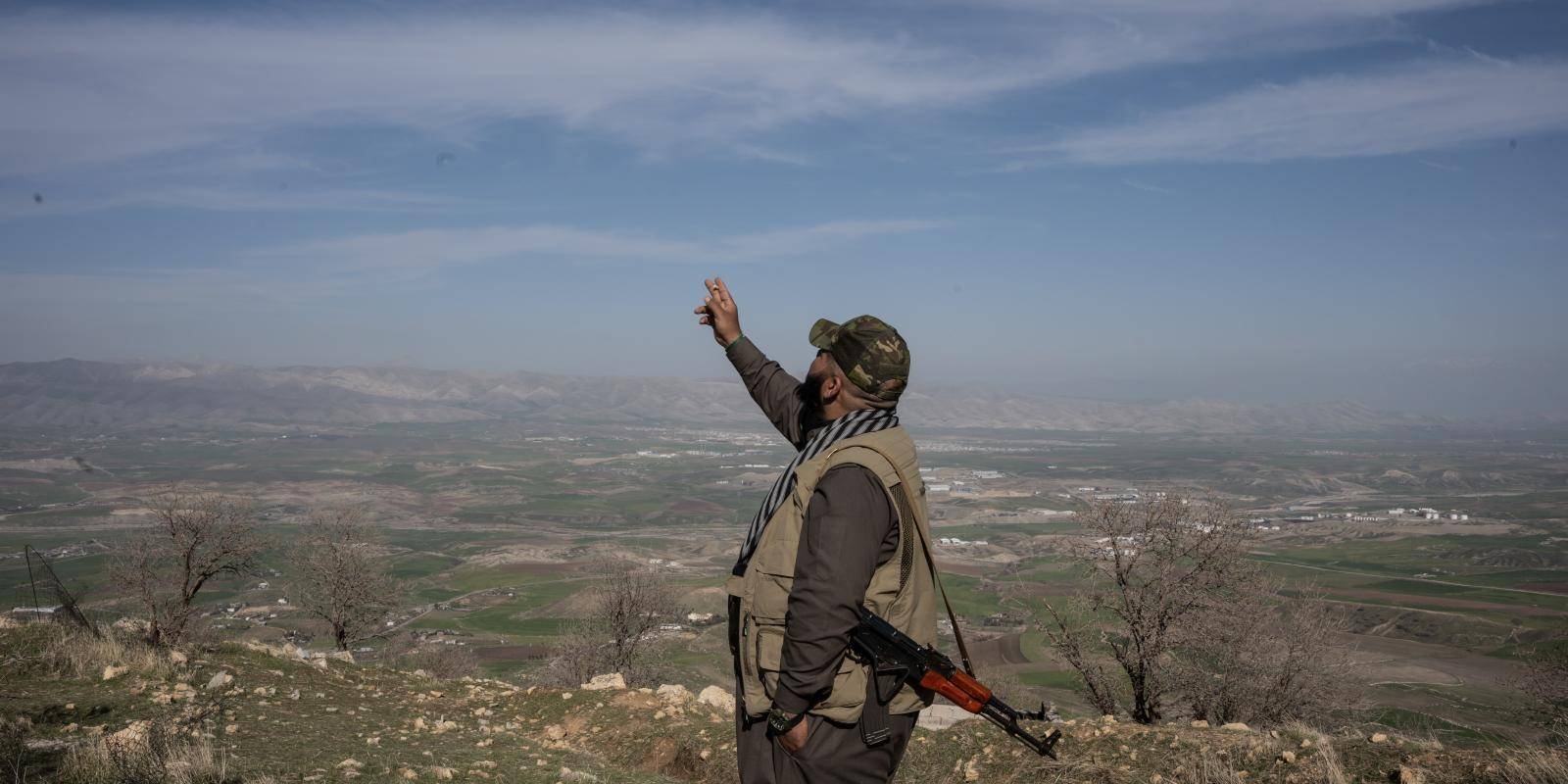
The US previously trained and financed Kurdish fighters in both Iraq and Syria. Based on these experiences, Iranian Kurdish groups face a dilemma. Partnership with the US could make a real positive difference to their goals. But it will be fundamentally transactional. There is little indication that the Trump administration is prepared to include an essential commitment to support Kurdish political goals; its endgame for Iran seems confused at best.
Both Washington and the Iranian Kurds must therefore consider how robust and durable potential US backing will be, particularly in light of past experiences of the US abandoning its Kurdish partners, most recently when the US turned away from the Syrian Democratic Forces (SDF). They also need to ask whether a Kurdish uprising serves their respective interests in the long run.
Kurds in Iran
Kurds are one of Iran’s largest ethnic minorities. There are an estimated 7 to 15 million Kurds in Iran (around 8-17 per cent of its total population). They are concentrated along Iran’s western borders with Iraq and Turkey, one of the most impoverished parts of the country.
Although Iran’s constitution theoretically provides equal rights for all ethnicities, in practice the Iranian government has frequently resorted to violence to suppress expressions of Kurdish cultural, linguistic and political identity.
The Kurdish political landscape is fragmented across various parties that adhere to a range of ideologies and draw public support from different sources. Kurdish public opinion is not monolithic and not all Kurds support Kurdish nationalist parties. These groups also have a poor track record of cooperation and have fought each other at times. But what unites the Kurdish nationalist parties is opposition to the Islamic Republic and a desire to secure Kurdish rights and local self-rule in the context of a future democratic Iran.
On February 22, five Kurdish parties announced the formation of the Coalition of Political Forces of Iranian Kurdistan. These include the Kurdistan Democratic Party of Iran (KDPI), the Komala of the Toilers of Kurdistan, the Kurdistan Freedom Party (PAK), Khabat, and the Kurdistan Free Life Party (PJAK). On 4 March, the Komala Party of Iranian Kurdistan also joined. The coalition’s leadership is largely based in Iraq or the West, though it is also well-organized inside Iran through clandestine networks.
The KDPI is the oldest of the parties, tracing its lineage back to just before the short-lived independent Kurdish Republic of Mahabad was established in 1946. It has the most grassroots support, particularly with traditional nationalists. The Komala factions are more left-wing. The Komala Party of Iranian Kurdistan is the larger of the two and has significant support in certain geographic areas.
PJAK is considered the Iranian branch of the Kurdistan Workers’ Party (PKK), which fought a long insurgency against the Turkish state, and theoretically has more battle-tested cadres. PAK and Khabat are much smaller and have limited appeal inside Iranian Kurdistan.
Challenges
Despite the unification of these parties, major tests lie ahead. The extent of the military forces of these groups and their real battle capabilities are unknown. For years, they have largely been contained in their camps inside Iraq’s Kurdistan Region. Their strength inside Iran is unclear.
Though weakened, the Iranian security forces still have significant capacity for violence and have demonstrated willing to wield it against the vulnerable Kurdish civilian population, as occurred during the January 2026 protests. The Iranian military has already struck Kurdish forces in Iraq as part of its response to US and Israeli strikes.
It is therefore a massive risk for Kurdish groups to launch armed operations against the regime, even with US and Israeli air support. ‘We will not send our forces to the slaughterhouse,’ Komala leader Abdullah Mohtadi recently told German newspaper Die Zeit.
Additionally, it is unclear whether the newfound unity among the Iranian Kurds will endure. Disagreements over strategy, competition for resources, historical enmities and changing conditions could all conspire to undermine their cooperation in the near term. If they are successful in their political aims and establish some kind of local control, the challenges of political and practical governance will quickly become real.
If Kurdish groups do decide to rise up, their success will depend on political balance, military preparation, careful planning for the future and precise timing. While they may be tempted to seize what may be a fleeting moment to strike, the parties are also aware that their timelines do not align with those of the US, and that their immediate aims are more limited in scope.
It also remains to be seen whether other Iranians will revolt against the regime. This will naturally shape how a Kurdish uprising could be perceived elsewhere in Iran. While both the regime and the broader opposition have called out unnamed ‘separatist groups’, the Iranian Kurdish parties have been clear that their aim is not secession, but rather to be part of a multi-ethnic and democratic Iran. In practice, the experience of Kurdish groups in Syria and elsewhere suggests cooperation with other anti-regime factions within a popular front will bring challenges.
Kurdish groups should be wary of relying too heavily on the US for political and military support, especially given the shifting statements from the Trump administration. A lack of overt assistance from the US may indeed simplify calculations for the Iranian Kurds, whose stake in Iran’s future is not dependent on this mercurial White House.