
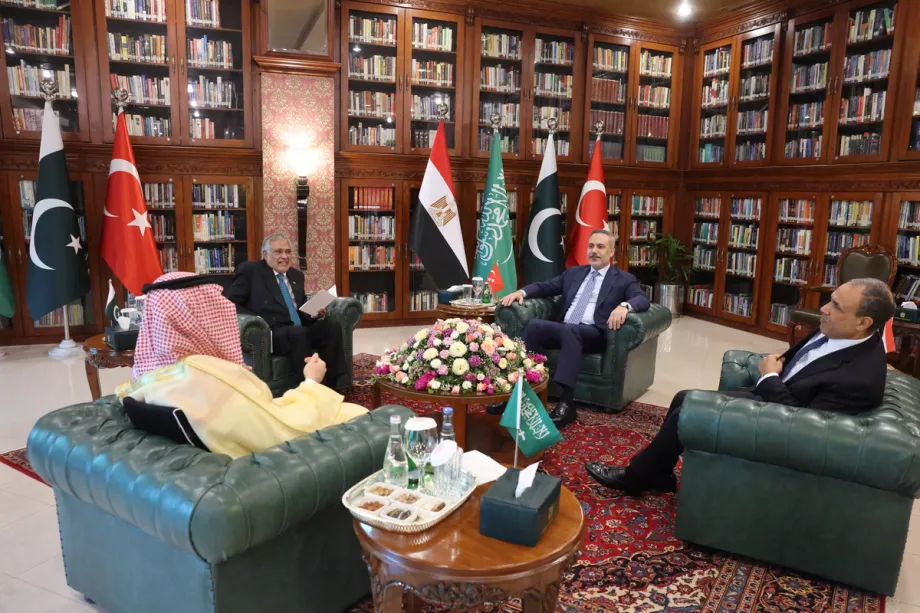
This article evaluates the failure of the “Muslim Quad” and Pakistan’s mediation mirage. Ahmad contrasts Iran’s calculated use of geography as leverage with Islamabad’s “press release” diplomacy, noting that China remains disciplined and skeptical of American strategic volatility in 2026.
Diplomacy occasionally produces documents that clarify reality; more often, it produces documents that elegantly conceal its absence. The China–Pakistan five-point statement on Iran belongs firmly to the latter category — a text so carefully balanced, so impeccably reasonable, that it quietly exposes how little of consequence it contains. Ceasefire, sovereignty, humanitarian access, shipping security, the United Nations — each clause is correct, each sentiment agreeable, and the cumulative effect strategically weightless. This is not policy. It is performance.
That is not accidental. In moments of genuine geopolitical transition, such statements function as diplomatic camouflage — allowing disagreement to masquerade as consensus and indecision to pass for prudence. Pakistan’s recent activism fits this pattern with almost studied precision. Islamabad is eager — conspicuously eager — to present itself as a central broker: useful to Washington, acceptable to Tehran, indispensable to Beijing. The ambition is expansive. The credibility, however, remains stubbornly absent.
Iran is not about to outsource strategic judgment to a state whose governing establishment has elevated inconsistency into a diplomatic method. Pakistan excels at looking busy. It struggles to demonstrate that it matters.
China, by contrast, appears almost allergic to this kind of self-deception. Beijing’s caution is not passivity; it is discipline. It has no interest in underwriting a “peace framework” that can be undone by the next American escalation or Israeli strike — both of which now resemble routine instruments of policy rather than exceptional events. Washington continues to confuse force with strategy, veering between excess and impatience with little regard for consequence. Israel, meanwhile, has normalized escalation to the point of doctrine, treating regional destabilisation as a deliberate tool of policy. The UAE completes the triad with its polished opportunism — projecting efficiency while quietly inserting itself into conflicts it helps complicate. It is a neat division of labour: one destabilizes brazenly, one erratically, and one profitably.
Against this backdrop, the so-called Muslim Quad — Pakistan, Türkiye, Saudi Arabia, and Egypt — resembles less a coalition than a carefully staged photograph.
It is not strategy. It is wishful thinking with a press release.
And by now, the fiction of GCC unity has not merely cracked — it has collapsed in plain sight. This is no longer a matter of interpretation; it is an observable fact. Oman and Qatar have little appetite for performative confrontation with Iran. Saudi Arabia calibrates cautiously beneath its rhetoric. The UAE continues its preferred role as a sleek facilitator of instability. The Gulf is not united. It is a collection of states managing shared anxiety while pursuing divergent interests.
Iran, in contrast, has approached the moment with a level of strategic clarity that its adversaries seem reluctant to acknowledge. It has recognized, with precision, that geography is not merely context — it is leverage. The Strait of Hormuz is not just a maritime corridor; it is a strategic fulcrum embedded in the architecture of global energy flows. Tehran’s manoeuvring reflects a calculated effort to translate that reality into durable bargaining power. This is not reactive behaviour. It is deliberate, layered statecraft — patient, adaptive, and acutely aware that in geopolitics, position often matters more than posture. Any framework that imagines Iran can be sidelined while its geography remains indispensable was always intellectually unserious.
Pakistan, meanwhile, surveys this shifting landscape and imagines itself at the center of it. In Islamabad’s preferred narrative, pipelines will flow, Gwadar will flourish, corridors will bind continents, and Pakistan will emerge as the indispensable bridge between regions and empires alike. The confidence is remarkable. The evidence is thin. A handful of summits, a few carefully staged handshakes, and an excess of optimistic briefings are taken as proof of strategic trust. It is diplomacy as self-belief — earnest, energetic, and only loosely tethered to reality.
Above it all hovers Washington — still powerful, still interventionist, and still strategically erratic. The United States retains the capacity to disrupt regional arrangements even where it lacks the coherence to construct them. That is why China remains cautious, Iran remains sceptical, and the Gulf monarchies oscillate between caution and compliance. The old order has not disappeared. It has simply become unstable — and instability, in geopolitics, rarely remains contained.
Pakistan is enthusiastic — but enthusiasm, in geopolitics, is not mistaken for influence.
The Gulf will not be reordered by those who issue polished statements or host well-attended meetings. It will be reordered by those who understand that in an age of imperial drift, access is not influence, proximity is not power, and diplomacy without leverage is often just theatre delivered with confidence.