
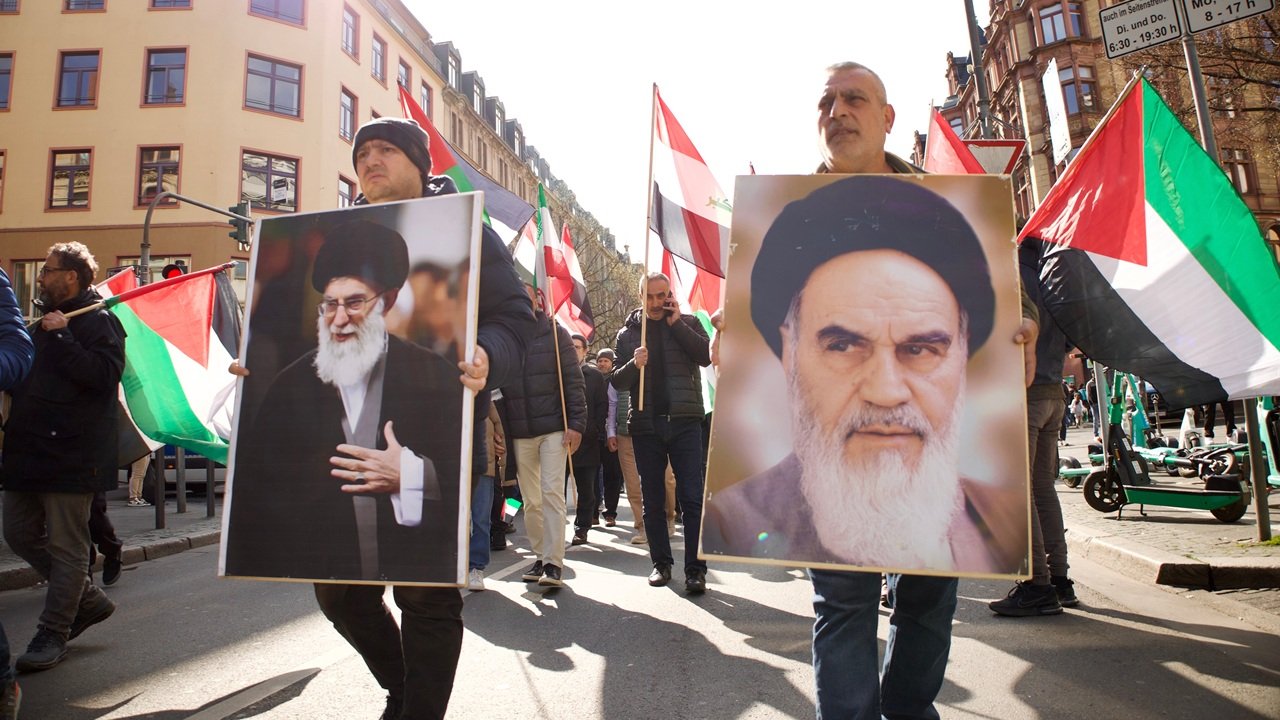
Iran’s regime will never consent to a US-led regional order. Airpower alone cannot break its will. Lasting peace requires regime change, as military victory must be followed by a stable postwar settlement that removes the Islamic Republic’s obstinate vote against American interests.
The current government of Iran has made clear that it will never consent to a US-led postwar order in the Middle East. It must go.
It’s a truism in military circles that the foe gets a vote in the success or failure of your strategy—and will cast it in the negative. The Islamic Republic of Iran has cast its vote against the United States’ wrapping up Operation Epic Fury, the air and naval campaign against the Islamic Republic, very soon. Sure, the joint US-Israeli leadership could declare victory and halt the campaign, content to have set back Iranian aspirations to regional hegemony and nuclear-weapon status. That is not nothing—far from it. But it’s doubtful such an outcome would translate into lasting peace in the Persian Gulf region.
Carl von Clausewitz, the sage of 19th-century Prussia, would nod knowingly at this strategic quandary. Clausewitz depicts martial strength as a compound of physical power and the resolve to use it. A combatant’s “power of resistance,” he writes, “can be expressed as the product of two inseparable factors, viz. the total means at his disposal and the strength of his will” (his emphasis). In other words, strength is a product of multiplying those two factors—not adding them. A strong combatant is both powerful and resolute. Driving one or both variables to zero through military action zeroes out enemy strength as a whole—making it possible to impose terms on an unwilling foe.
By most accounts, Operation Epic Fury has achieved resounding progress on the capabilities side, making great strides toward disarming the Islamic Republic. US forces’ ability to dispatch non-stealthy combat aircraft to bombard regime targets in western Iran is just one mark of success. Modern air defenses have to be suppressed or destroyed to allow older generations of aircraft to fly overhead with impunity. That has happened for the most part, although a carrier-based US Navy F/A-18 fighter did have a close encounter with a shoulder-fired Iranian surface-to-air missile this week.
Even the venerable US Air Force A-10 Warthog ground-attack jet—a platform scarcely known for being unobtrusive—has gotten into the fray. As Joint Chiefs chairman Dan Caine related, Warthogs have assailed armed watercraft in an effort to defang the Islamic Revolutionary Guard Corps Navy, a mosquito fleet designed to hamper shipping through the Strait of Hormuz.
America Can’t Bomb Iran into Submission from the Air
Iran’s military might may be in disarray under the US-Israeli onslaught, but Iranian resolve is another question. Tehran has refused to capitulate, no how many targets are struck or regime leaders killed. That stubbornness speaks to the other half of Clausewitz’s formula. He does portray strength as a multiple of force and will, but he strongly suggests that the latter is the dominant variable. In other words, a foe cannot be forever vanquished, allowing for a durable peace to take root, unless combat first breaks its will. That could mean disheartening the enemy government, society, or military, or preferably all three.
But a military triumph can prove perishable even if grasped. Clausewitz cautions that “even the ultimate outcome of a war is not always to be regarded as final. The defeated state often considers the outcome merely as a transitory evil, for which a remedy may still be found in political conditions at some later date.” Unless the victor is prepared to make a desert and call it peace—as the historian Tacitus wrote of the savage Roman campaign in Britain—the defeated may come back to cast their negative vote afresh.
To name a Persian Gulf-related example of fairly recent vintage, think about Saddam Hussein defying UN sanctions, weapons inspections, and no-fly and no-drive zones for over a decade after a coalition crushed his army in Operation Desert Storm. It ultimately took an invasion 12 years later culminating in regime change in Baghdad—and a gruesome death for Saddam—to finally bring a lasting end to the First Gulf War.
To Deal with an Enemy, Build a Stable Postwar Order
A better and stable peace is possible. In fact, it is the purpose of fighting. The late Henry Kissinger, who knew a thing or two about warfare and diplomacy after researching peacemaking following the Napoleonic Wars, explained how to fashion a lasting peace. First you have to win—and perhaps oust the enemy regime. Easy to say, hard to do. But that’s what befell Napoleon’s France. The little emperor ended up in exile, expelled from power. After settling things on the battlefield, the victors met in Vienna and designed an international system both powerful enough by military measures to deter or defeat future challenges and palatable for the vanquished. An agreeable regional order reduced the incentives to overturn the system, while at the same time holding down the costs to the victors of keeping the peace. Deterrence is affordable when the defeated don’t regard themselves as perpetually aggrieved. Peace can endure.
In effect the winners of the Napoleonic Wars readmitted France to the society of European nations, conciliating the new regime in Paris. In so doing they ushered in decades of relative tranquility on the continent. “There was not only a physical equilibrium, but a moral one,” maintains Kissinger in his masterwork Diplomacy. “Power and justice were in substantial harmony. The balance of power reduces the opportunities for using force; a shared sense of justice reduces the desire to use force.”
One hundred years later, there was no such shared sense of justice on Germany’s part after World War I. Hence World War II. Peacemakers should avoid instituting a punitive system.
The Islamic Republic Will Never Cut a Deal with America
Then comes Kissinger’s warning from beyond the grave: “An international order which is not considered just will be challenged sooner or later.” This casts a glum light on the situation in the Gulf.
It is really hard to overthrow a ruling regime from the air, no matter how precise and well-aimed the blows are. Controlling events on the ground is just not in the nature of air—or sea—power. People on the ground exercise control. Conceivably the air campaign will embolden the Iranian people to rise against a regime many of them loathe for good reason. And then it might be possible to devise a peace settlement and a regional order Kissinger would endorse.
But it is almost unfathomable that the current regime—should it survive the aerial pummeling—would ever consent to any Middle Eastern order presided over by the United States and its allies, Israel in particular. The mullahs’ vote on any peace settlement that curbs their ambitions will remain No.
So let’s wish US and Israeli aviators and rocketeers—and their potential Iranian allies on the ground—the best of good fortune. Military victory is the only plausible route to regional harmony.