
Gulf states have the capability to join—Saudi and UAE air forces are formidable—but risks are immense. Joining could escalate Iranian strikes on critical infrastructure, entangle them in Israel’s unpopular war, and sever future diplomacy. Defense-only is exhausting, but offense could backfire catastrophically. A rock and a hard place.
Saudia Arabia and the UAE have capable air forces that could complement Israeli and US strikes on Iranian missile and drone infrastructure. But the risks are considerable.
Despite getting struck repeatedly by Iranian missiles and drones, the Gulf Arab states have shown remarkable restraint in the war between the US/Israel and the Islamic Republic. Collectively, so far, they have chosen to pursue a defensive strategy.
The chances of the Gulf Arab states reconsidering and going on the offensive are low. But they could go up should Iran escalate its attacks against critical infrastructure and civilian areas, causing casualties and more serious economic damage.
As always with states contemplating the use of force, it’s a matter of willingness and ability. Some Gulf Arab states – namely, Saudi Arabia and the UAE – are capable of joining the fight against Iran using their formidable air power assets. But would doing so make a difference in the war, or be strategically wise? Neither is clear.
Saudi capability
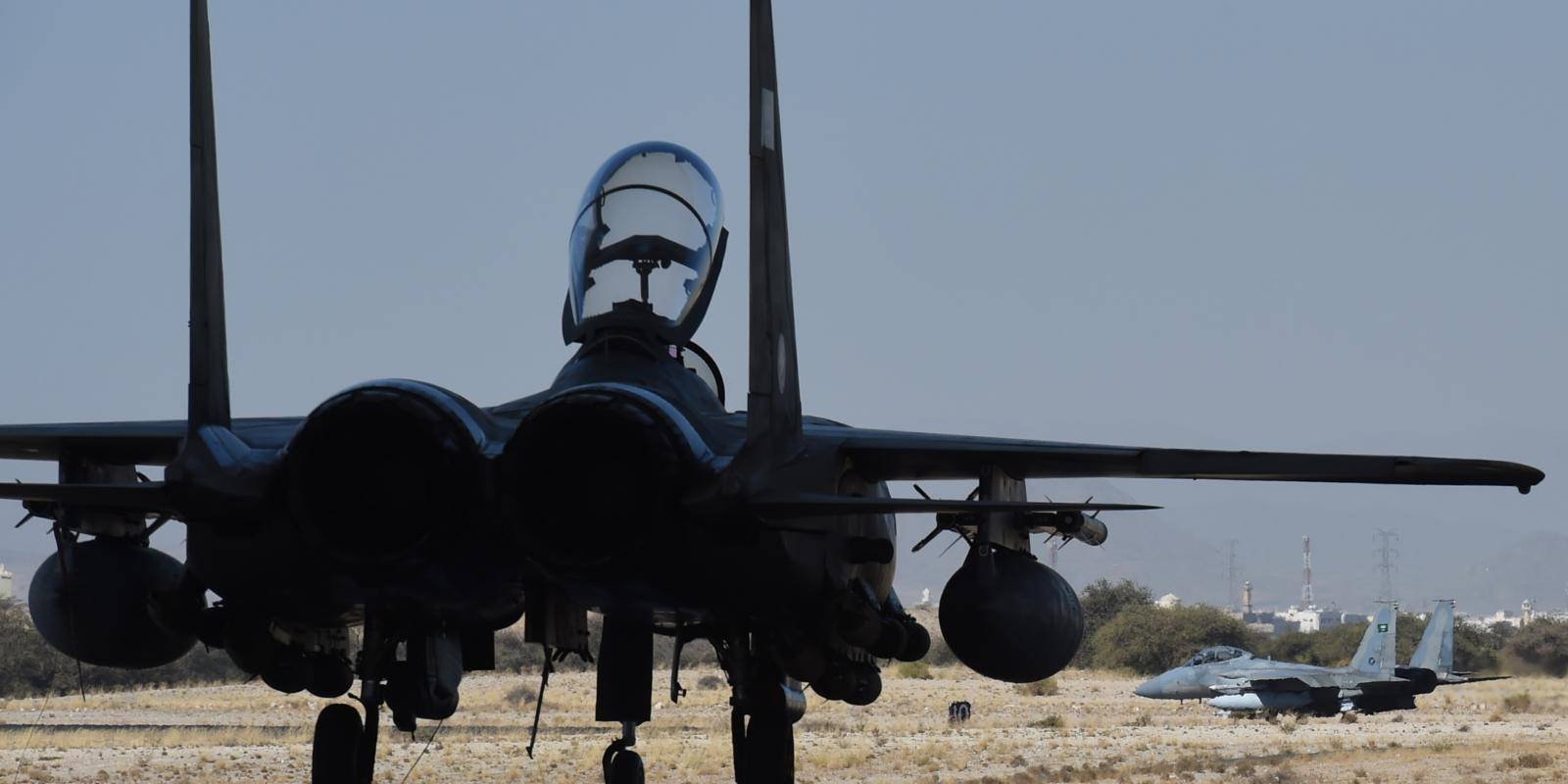
The Royal Saudi Air Force (RSAF) operates 449 aircraft including some of the best air power platforms in the world, such as advanced versions of the American F-15, Eurofighter Typhoon, and Tornado, armed with a variety of missiles. And it performs a range of missions – aerial and ground combat, airborne early warning and control, electronic intelligence, and tanker and transport operations. The Kingdom has a slew of Chinese drones too.
The Saudi aerial arsenal is superior to Iran’s in terms of modernity, flexibility, and lethality – and is in fact the envy of many advanced air forces around the world including those of NATO countries. However, it is how the RSAF has employed this tremendous equipment that leaves much to be desired.
Combat experience
The RSAF has some experience in conventional air and ground combat. During the 1980-1988 Iran–Iraq War, the RSAF played primarily defensive and deterrent roles, especially against the Iranian military.
The RSAF didn’t pursue offensive strike missions inside Iran or Iraq. Rather, it was merely entrusted with defending Saudi airspace and regional maritime security.
For the most part it did well, establishing an air defence identification zone over parts of the Gulf (also known as the ‘Fahd Line’) to secure its airspace. This was during a tense period in the Iran–Iraq War where the belligerents targeted each other’s merchant shipping and in particular oil tankers.
One famous incident in June 1984 saw two Saudi F-15s intercept a small formation of Iranian F-4 Phantoms near Arabi Island in the Gulf. The Saudi fighters reportedly shot down either one or two of the Iranian aircraft, which were allegedly crossing into or near the Saudi air defence identification zone. Iran responded by dispatching 11 more F-4s into the skies over the Gulf, but after a brief standoff they returned home.
The RSAF’s first extensive operational experience was in Desert Storm in 1991, flying combat missions from day one. That mattered a lot symbolically and politically, although less so operationally for the US campaign. The RSAF flew 6,852 sorties (ranking second to the US Air Force) and struck Iraqi targets in Kuwait and southern Iraq.
Saudi crews engaged in air-to-air combat and achieved several kills, which was an impressive achievement. But two Tornado jets were shot down either by an Iraqi Mig-29 or by Iraqi air defences during low-level strike missions.
After Desert Storm, Saudi Arabia began to deepen its security cooperation with the United States, with the RSAF a major beneficiary. Today, the RSAF and the US Air Force engage in bilateral drills with various mission sets on a periodic basis, including regular participation in the famous US Red Flag exercise in Nevada.
The RSAF’s most recent combat experience, during the Yemen intervention of 2015-2022, was not successful. In its campaign against the Iran-backed Houthis, it struggled tremendously with its targeting techniques, causing significant collateral damage and bringing heavy international opprobrium against Riyadh.
But that would be the wrong example to consider. In Yemen, the RSAF had to locate and strike mobile targets that were hiding among civilians and inside mountains. Even the most capable NATO air forces face difficulties with such dynamic targeting.
In Iran, the RSAF would be tasked with striking fixed and open targets. And Iranian air defences have been massively degraded by US and Israeli fighters.
The UAE Air Force
The UAE Air Force has less operational experience than Saudi Arabia, but it fared better in Yemen and other conflict zones. And UAE pilots train intensively, participating in Red Flag since 2009.
The UAE has utilized US military assistance over the years more effectively than any other US Arab partner. That showed in combat operations in Afghanistan, Libya, Syria, Iraq, and especially in Yemen.
Against the Houthis, the UAE’s F-16 Block 60 fighters (more advanced than US F-16s) were more lethal and precise than any in the Saudi-led coalition, leveraging superior intelligence with the help of NATO-certified Emirati Joint Terminal Attack Controllers on the ground, which the Saudis didn’t have.
If Riyadh and Abu Dhabi give the order to their militaries to retaliate against Iran, their air forces are capable of operating as part of a US-led coalition – striking military facilities and energy installations in Iran and flying back to their bases.
But what would their objectives be? And what are the risks?
Willingness
For the Gulf Arab states, the immediate goal of fighting back would be to force Iran to stop its attacks against them, and in the long term to establish a modicum of deterrence against future Iranian strikes.
After all, if Gulf Arab states continue to rely exclusively on defence, they are essentially signalling to Tehran that it can cause them tremendous harm without suffering any consequences.
Equally, playing defence will exhaust their defensive systems well before Iran runs out of drones and missiles. The US can replenish Gulf defences, but Israel is a US priority and according to reports it is facing a shortage in interceptors.
Economic strain is also an important factor: it costs Iran a lot less to wage war with cheap missiles and drones than it does the US, Israel and Gulf Arab states to defend against them. Economic attrition is core to Iran’s strategy in this conflict.
For these reasons, going onto the offensive makes strategic, economic, and operational sense for Gulf states.
Risks
However, the risks are considerable.
First, it could lead to more intense Iranian bombing of the very assets the Gulf Arab states are trying to protect including oil fields, airports, data centres, and desalination plants.
Second, President Donald Trump could yet decide to stop military operations against Iran and declare ‘victory’, leaving Israel and the Gulf Arab states alone in the fight and reducing the likelihood of the Iranian regime falling.
Third, joining the war against Iran will tremendously complicate if not completely sever relations between Iran and the Gulf Arab states. Those relations were never built on trust to begin with, and Iran will have a lot to answer for whenever the dust settles, but a direct military confrontation will deepen mistrust.
Fourth, going to war is never an easy proposition for any nation, let alone politically fragile ones as the Gulf Arab states. Internal political stability is paramount for those authoritarian countries. Fighting an external enemy could strengthen patriotism. But some countries like Bahrain, Kuwait, and Saudi Arabia have to worry about entities and cells that can be activated by Iran and threaten their internal security.
Perhaps the greatest security risk in joining the war is that it would mean choosing to fight alongside Israel. Even before the war in Gaza, any such move would have been politically perilous for a Gulf leader. Choosing to join this fight, alongside Prime Minister Benjamin Netanyahu, could fatally undermine leaders’ credibility with swathes of their populations. That factor more than any other may enforce restraint.
Stuck between a rock and a hard place
If Iranian strikes against the Gulf Arab states escalate, a defence-only approach to security could quickly become unsustainable. But if the Gulf Arab states decide to join the US-Israeli campaign, it could backfire.
This is an incredibly hard decision, fraught with risks, and one the Gulf Arab states feel they have to make on their own – with little confidence that Washington can be counted on as it once was.