
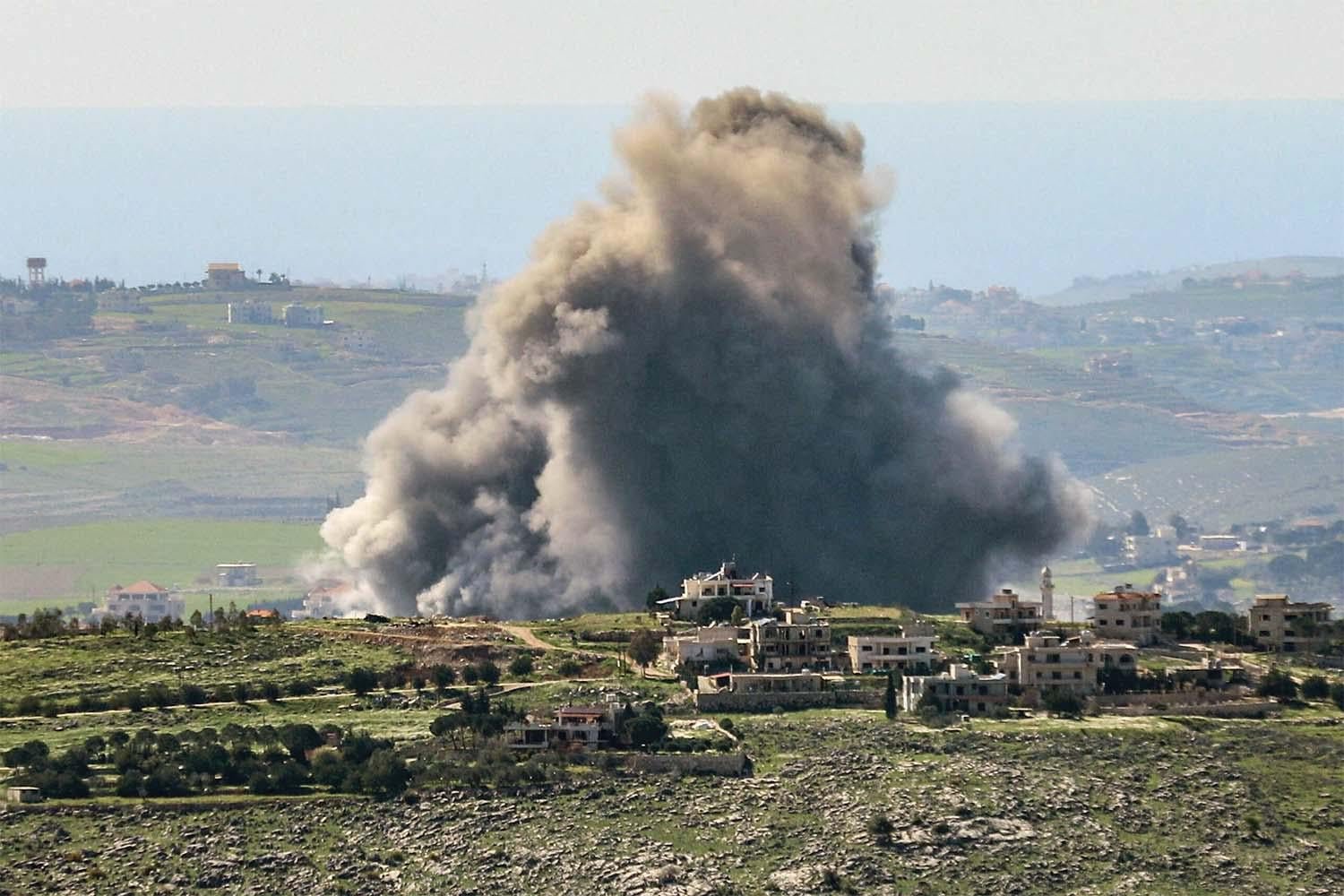
If the so-called “support war for Gaza” led to Israel’s return to southern Lebanon, the new war that Iran’s Islamic Revolutionary Guard Corps (IRGC) has chosen to wage from Lebanese territory has resulted in an even broader Israeli presence.
Israel has now decided to expand the area under its control in southern Lebanon and establish a “buffer zone.” This is the direct consequence of Iran’s decision to drag Lebanon into a war targeting the Islamic Republic — a conflict Lebanon was expected to avoid.
The consequences will not stop at the expansion of the occupation zone. The number of displaced people from southern Lebanon — and even from parts of the Bekaa Valley — is likely to grow. The question arises: is the goal, from Tehran’s perspective, to push Lebanon into an internal crisis from which it may never recover by turning the south into another Gaza?
Today, few are speaking about the Gaza Strip itself — about the return of its residents or the reconstruction of the territory. Gaza’s tragedy has largely faded from international attention amid the sweeping developments reshaping the Middle East, particularly following recent events involving Iran. These developments signal the emergence of a new regional balance of power, one fundamentally different from the order that arose after the 2003 US invasion of Iraq, which ultimately handed Iraq to the Islamic Republic on what critics describe as a “silver platter.”
Lebanon now faces a new reality. The question is whether the country can still avoid — or escape — the catastrophe toward which Iran’s Revolutionary Guard has pushed it. There is growing concern that rebuilding Lebanon may become nearly impossible, much like the situation in Gaza, especially given the consequences of its involvement in a war aimed at supporting the Iranian regime.
The decision to launch rockets from southern Lebanon — reportedly made in Tehran — comes at a time when the region is undergoing its most dramatic transformation since 1979, the year Iran’s Islamic Revolution reshaped the country’s political system and its regional role.
350,000 Displaced
In numerical terms, the scale of the disaster Lebanon appears to be heading toward — if it has not already arrived — is stark. As a result of the earlier “support war for Gaza,” around 110,000 people were displaced from southern Lebanon and roughly 30 villages were destroyed, if not more.
Now, critics say Hezbollah, acting at the request of the Revolutionary Guard, appears prepared to raise the number of displaced people to around 350,000, while the number of destroyed villages could exceed 50 — all in what they describe as an effort to support Iran.
The decision to fire rockets from southern Lebanon — a move believed to have originated in Tehran — comes at a moment of profound upheaval across the region. It coincides with the formation of a new regional balance of power emerging from the war in Gaza that began on 7 October 2023, a conflict the Islamic Republic sought to exploit through its network of allied groups in Iraq, Syria, Lebanon and Yemen, but ultimately failed to do so.
It remains unclear how a group that functions primarily as a sectarian militia tied to an external power can launch a new war without considering the predictable consequences. For many observers, the only explanation is that the Revolutionary Guard is pushing Lebanon toward collective self-destruction alongside Iran.
The State Fears Hezbollah
Before rockets were fired from southern Lebanon, the Lebanese state reportedly received clear warnings from Israel. The message was that Hezbollah’s entry into Iran’s war would have catastrophic consequences for the country.
Despite those warnings, the group surprised the Lebanese public by launching rockets.
There appears to be no explanation for what happened other than the Lebanese state’s inability to assert its authority. The state still appears to fear Hezbollah. Evidence of this emerged in discussions within the Council of Ministers between Prime Minister Nawaf Salam and Army Commander Rodolphe Haikal.
The key question now is whether the cabinet’s declaration — which described Hezbollah’s military and security activities as “outside the law” — could represent a turning point for Lebanon and signal a break from the political logic established by the controversial 1969 Cairo Agreement, which allowed armed groups to operate from Lebanese territory.
If implemented, such a decision could help break the barrier of fear surrounding Hezbollah — a group critics accuse of systematically weakening Lebanon’s state institutions since its emergence.
For the Lebanese government, the challenge now is to demonstrate that it can enforce the cabinet’s decision and begin addressing the consequences of the crisis that has struck the country.
In reality, the Lebanese state finds itself facing a new and critical test. It must confront a group widely accused by its opponents of placing the interests of the Islamic Republic of Iran above those of Lebanon — and even above the interests of Lebanon’s own Shiite community.
For this group, critics argue, the fate of Iran’s Supreme Leader is inseparable from its own leadership. Dealing with an organization that views confrontation — even self-destruction — as a strategic objective, and that considers Lebanon part of the Iranian political sphere under the authority of the “Wilayat al-Faqih,” remains an enormous challenge.
A Clash of Interests
Ultimately, the dilemma facing Lebanon is stark: how can the interests of the country and its people — including the Shiite community and the residents of the south — be reconciled with those of a party that appears willing to risk Lebanon’s stability in defense of an Iranian regime critics describe as deeply weakened?
Nothing illustrates the perceived fragility of that regime more, according to its critics, than its continued attacks against Arab Gulf states, often justified by the presence of US forces in the region.
The irony is that the Islamic Republic — or what remains of it — appears willing to confront Gulf countries while avoiding confrontation with neighboring Azerbaijan, a country where both American and Israeli influence is widely believed to be present.