
Syria’s transitional authorities have insulated the country from the Iran war through effective foreign policy. However, unresolved internal conflicts—exemplified by Sweida’s Druze tensions and Israeli strikes—persist. Lasting stability requires inclusive national dialogue, not external deals alone.
2025’s National Dialogue failed, its outcomes unpublished. But without a new effort to resolve internal conflicts, the country will remain vulnerable to external intervention.
Syria’s transitional authorities have achieved notable foreign policy gains. President Ahmed al-Sharaa’s government has restored diplomatic ties, eased sanctions and insulated the country from the military spillover of the ongoing war in Iran.
Yet recent events expose the limits of this outward-facing stabilization strategy. On 19 March, Israeli forces carried out an airstrike on government forces in Sweida, following clashes between government forces and Druze factions – demonstrating how Syria’s unresolved internal conflicts can still draw in external actors.
Rather than addressing the root causes of the Sweida conflict through a domestic process, the authorities have sought to resolve them through deals brokered with other countries.
At its most effective, this approach can contain escalation. But it leaves the underlying tensions intact. Without a credible national process to address internal divisions, Syria’s transition will remain fragile, and vulnerable to repeated external intervention.
From battleground to buffer
Syria now stands out in the Middle East for an unexpected reason. While neighbouring countries are increasingly entangled in the fallout from the war on Iran, Syria has, for now, avoided direct involvement – remaining largely insulated from its effects.
This shift is striking given Syria’s recent history. For over a decade, the country served as the central arena where regional and international rivalries played out. Today, by contrast, it has repositioned itself as a neutral actor.
This outcome is the result of the al-Sharaa government’s highly effective foreign policy. Since the fall of the Assad regime in December 2024, the transitional authorities have recalibrated Syria’s external relations by restoring diplomatic ties, engaging regional actors and limiting the presence of foreign-aligned armed networks. Such measures have reduced the risk of Syria being drawn back into wider conflict dynamics.
President al-Sharaa made this clear in his address following Eid prayers on 20 March, arguing that Syria’s changing position reflects a more effective management of regional and international relations. In this sense, foreign policy has become a central pillar of efforts to stabilize the country – helping to shield Syria from external shocks at a moment of heightened regional volatility.
Containment without resolution
But recent developments in Sweida highlight the limitations of that strategy.
Violence escalated in July 2024, when Damascus deployed forces to the province. The government presented the move as an effort to restore order after clashes between Druze and Bedouin groups.
Locally, however, the intervention was widely seen as an attempt to impose central authority following months of stalled negotiations over governance and security arrangements. Subsequent confrontations – and reported abuses – deepened mistrust between local actors and the authorities.
Rather than addressing the drivers of the conflict through inclusive local dialogue, the authorities have sought to contain it, through external, elite-level agreements. Damascus agreed to a roadmap with Jordan and the United States to address the issue in September 2025, while parallel efforts to limit Israeli intervention intensified.
The approach failed to resolve the crisis. Implementation of the Jordan–US roadmap stalled, rejected by de facto local authorities who had been excluded from its negotiation. The result has been a pattern of recurring tensions and periodic violence – conditions that continue to invite external intervention and complicate Syria’s negotiations with Israel.
The Israeli airstrikes of 19 March followed alleged clashes between Syrian government forces and a Druze armed group. Israel framed its attack as an effort to protect the Druze community, though Damascus condemned what it called ‘interference in internal affairs with the aim of undermining security and stability’.
While its motives remain contested, what is clear is Israel’s willingness to intervene whenever Syria’s local conflicts intersect with its strategic priorities. As such, no amount of diplomatic balancing on Syria’s part can fully shield it, if domestic conflicts remain unresolved.
Dialogue deferred
Crucially, the issues at the heart of the Sweida conflict are not local anomalies. Questions of governance, security, representation, power-sharing and the identity of the state are national in scope. Addressing them through closed-door bargaining – whether with domestic elites or external actors – risks producing outcomes that lack legitimacy and durability.
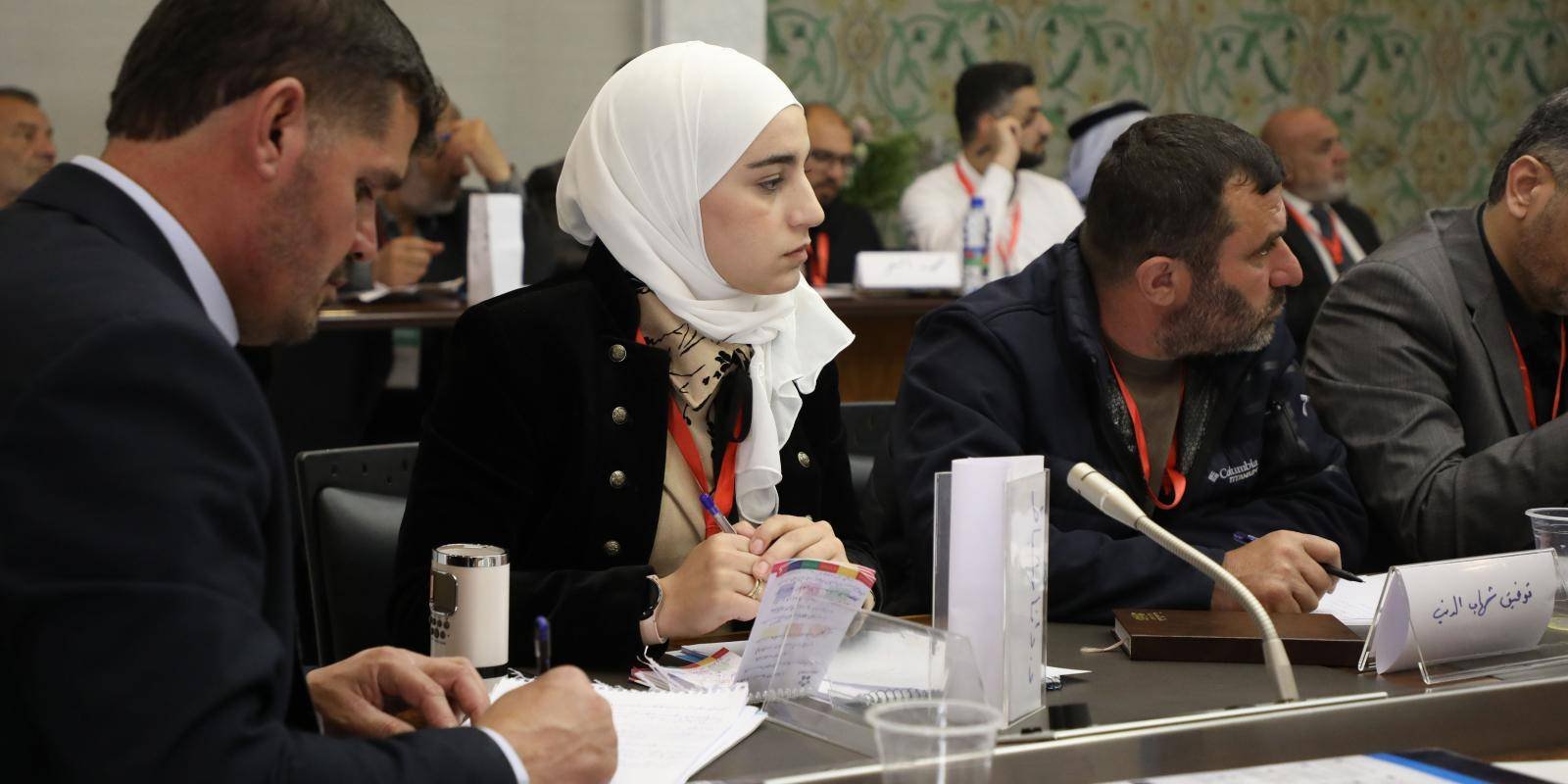
This is where Syria’s stalled national dialogue becomes central. Launched in February 2025, the process was intended to provide a platform for addressing precisely these questions. Instead, it was rushed, narrowly structured and insufficiently consultative.
More than a year later, its outcomes remain largely unpublished. Beyond general statements, Syrians still lack a clear account of what was discussed, what priorities emerged, or what conclusions were reached.
The result is not just a missed opportunity, but a widening gap between the transitional authorities and society.
A path to consensus
Without an inclusive national framework, Syria’s political actors will continue to approach negotiations as a zero-sum game – where compromise is seen as loss rather than a route to shared stability. Reversing this dynamic requires widening participation beyond political elites to include civil society, displaced communities, refugees and the diaspora.
Even if an earlier opportunity to launch a credible national dialogue was missed, it is not too late to try again. A renewed process could offer a peaceful pathway to address the core questions shaping the emerging state. If conducted transparently and inclusively, it could help build national consensus and prevent negotiating parties with narrow agendas from claiming to speak for their constituencies.
Substance will be critical. Any renewed dialogue must confront the issues that continue to drive conflict – governance, power-sharing, participation, justice, economic reform and the role of security institutions. These are not technical matters; they lie at the heart of Syria’s future political order.
Process will matter just as much. Consultation must be tied to outcomes, with clear mechanisms to translate any agreements into policy. Transparency is essential – without clear understanding of how decisions were reached, trust cannot be rebuilt.
The most immediate step is also the simplest. The outcomes of the previous dialogue should be published. Doing so would signal intent, restore credibility and lay the groundwork for a more meaningful and inclusive process.
The real test
Syria’s foreign policy success has been significant, but it cannot, on its own, secure stability. A transition built primarily on external positioning rather than internal cohesion will remain inherently fragile. Lasting stability depends on the state’s ability to resolve domestic disputes, build a shared national vision and establish a political order that commands legitimacy across the country’s diverse society.