
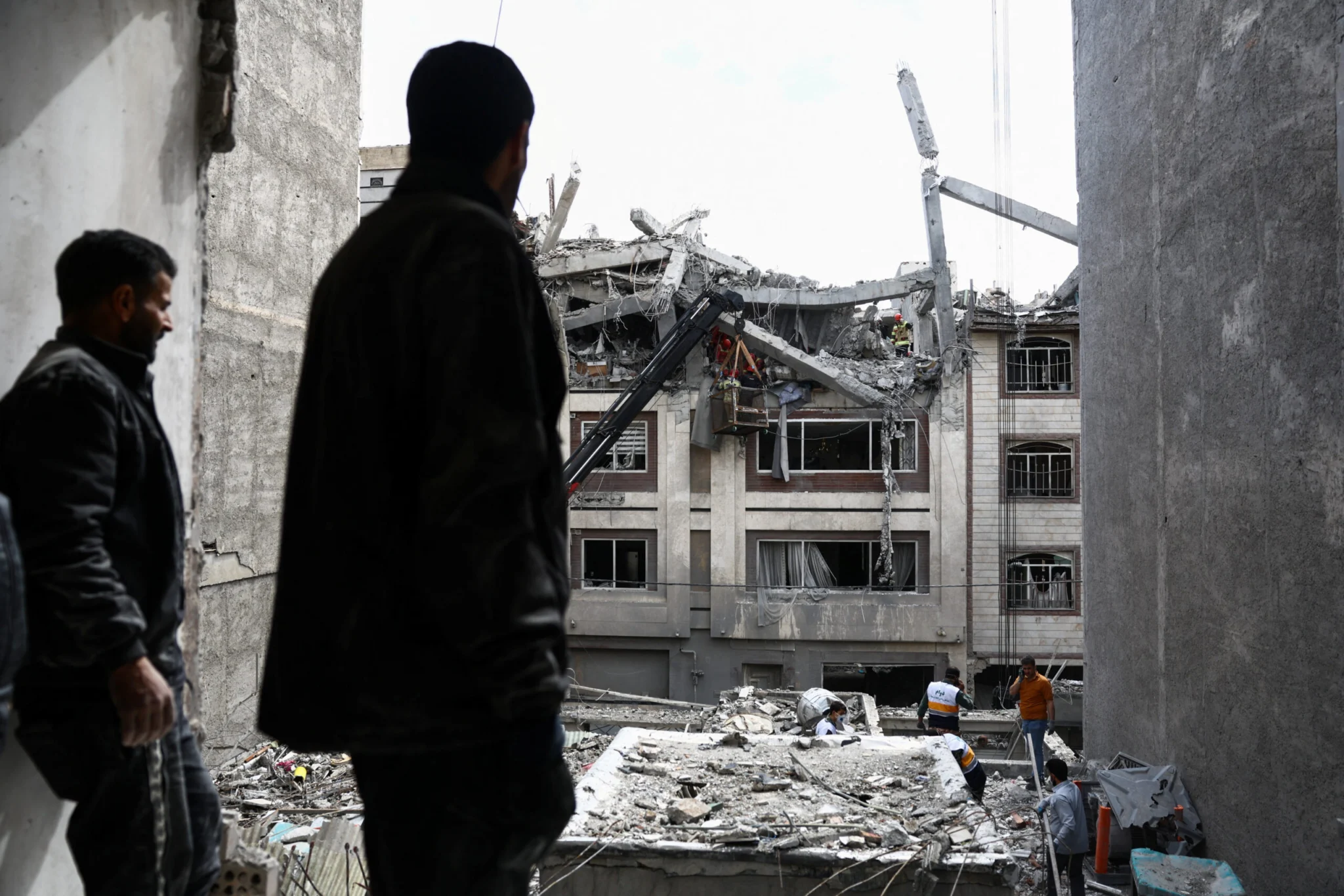
One month into the Iran war, the regime survives despite decapitation strikes. U.S. military coordination is unmatched but unsustainable. Gulf states face enduring threats. Israel maintains public support. Global economy remains hostage to Hormuz. A Taiwan crisis could dwarf this conflict.
One month ago, US and Israeli forces launched a military campaign against the Iranian regime that has had profound, globe-spanning consequences ever since—from energy markets to the global economy, and from the Gulf and broader Middle East to Romania, Sri Lanka, Russia, and China.
With scenarios for the conflict’s next phrase ranging from diplomatic off-ramps to military escalation, we asked Atlantic Council experts to identify their biggest takeaways from the war so far.
The Iranian regime
One month into the Iran war, the Iranian regime is bruised, battered, and (perhaps irrationally) bullish about its future. The regime’s apparatus has withstood the decapitation of its leadership and more than 15,000 strikes on its capabilities and infrastructure. At the same time, the regime has executed a premeditated and effective response that has imposed significant costs on US Gulf allies and energy infrastructure. The de facto control of the Strait of Hormuz by the Islamic Revolutionary Guard Corps (IRGC) has been its most potent weapon, inflicting significant pain on the global economy that has netted the regime unilateral concessions from the United States to relieve stress on financial markets.
Internally, the regime appears stable. The Islamic Republic has proven to be much larger than any one individual. There has not been any significant domestic uprising to date. Most notably, there have not been any defections among political and security elites. The most hardline voices within the system have been empowered. All these factors have led many within the regime to believe it is winning the war despite the conditions of the battlefield.
Yet there are significant challenges ahead for the regime that extend beyond the war. It’s increasingly clear that after rejecting talks with the United States, Iran has no clear plan for what comes next. A reported US offer was nowhere near viable, but the rejection of that offer increases the likelihood of US ground troops invading Iranian territory. A messy situation looks primed to get much worse.
Assuming the Iranian regime does survive the war, it still faces a long-term existential crisis. The regime cannot provide the economic or political opportunities its population craves. To stay in power, Iran will either need to consistently and systematically repress dissent or make significant changes to the Islamic Republic’s core ideologies. Those changes seem unlikely to happen in the short term. Therefore, surviving this war will only delay the next crisis.
US military capabilities
The United States can execute fast, precise, and integrated multi-domain operations at scale, but it can’t sustain this kind of high operational tempo over time.
Headlines have highlighted new technologies, such as the US military’s use of LUCAS (Low-Cost Uncrewed Combat Aircraft Systems), PrSM (Precision Strike Missiles), and an artificial intelligence–driven battle management system.
The real story, however, is the joint integration of these and other capabilities across at least six combatant commands and thousands of soldiers. The United States is delivering coordinated strikes faster than ever while simultaneously working with allies and partners to effectively defend against Iranian attacks. No other military in the world has demonstrated this level of proficiency. Adversaries can acquire new technologies, but they can’t buy talent and the type of command-and-control culture that empowers US soldiers to act together seamlessly.
Sustaining these capabilities, however, is a perennial challenge. Demand for munitions exceeds available supply, and as Diana Maurer of the US Government Accountability Office noted in her testimony this month: “DOD has been unable to sustain its weapon systems to meet its goals across all domains and faces challenges providing logistical support to US forces, especially in contested environments.”
This is why it’s a national security imperative to invest in domestic capacity. The United States must be able to sustain its military in a longer high-end fight—a topic of Forward Defense’s ReForge Commission.
—Joe Costa is the director of the Forward Defense program of the Scowcroft Center for Strategy and Security at the Atlantic Council. Previously, he served as US deputy assistant secretary of defense for plans and posture in the Office of the Secretary of Defense.
The Trump doctrine
One month into the war with Iran, Trump’s actions have us rethinking his “peace through strength” doctrine. Until this point, it was pretty clear that Trump was okay with short, sharp, decisive actions like we saw with the strike to eliminate Iranian IRGC general Qasem Soleimani in the first Trump administration; Operation Midnight Hammer, which targeted Iranian nuclear sites; and Operation Absolute Resolve, which removed strongman Nicolás Maduro from power in Venezuela. We also know that Trump is uncomfortable with long, drawn-out military campaigns with no end in sight, such as in Iraq, Afghanistan, and Ukraine.
So while I am not surprised by the airstrikes against Iran, I am surprised by the scale of the campaign and by the fact that it now appears Trump is on the verge of sending in ground forces. Some commentators had previously remarked that we were never going to see Trump send the 82nd Airborne Division to the Middle East. But that’s exactly what he did this week.
It is still my prediction that, consistent with Trump’s “peace through strength” doctrine, the US president will ultimately declare victory and end the conflict soon rather than allow himself to get into an extended military quagmire.
—Matthew Kroenig is vice president for geostrategy and fellows and senior director of the Atlantic Council’s Scowcroft Center for Strategy and Security.
The Iranian opposition
Amid conflicting messages from the Trump administration about the goal of continued US and Israeli military strikes on Iran (is it for regime change or to only weaken the Islamic Republic’s nuclear and ballistic-missile capacity?) the Iranian opposition has found itself needing to urgently define the path forward.
This weekend, a group of hundreds of ideologically diverse opposition activists are meeting in London as part of the Iran Freedom Congress to discuss Iran’s future and a pluralistic vision for guiding a transition. Critically, they are not positioning this as a challenge to any other opposition figure, including Reza Pahlavi, the son of the deposed shah. Rather, it is intended to “broaden the tent” to ensure that diverse voices are represented in any democratic process moving forward. Pahlavi has also made efforts in recent weeks to expand his reach by holding meetings with a wider set of activists and bringing Nobel Peace Prize laureate and Iranian jurist Shirin Ebadi on to chair a transitional justice committee. Ebadi’s involvement is significant not only for her deep global reach and connections to figures leading transitional justice processes in other countries, but also for the fact that she once supported the 1979 revolution that unseated Pahlavi’s father.
While this show of unity was celebrated by some, it has also been critiqued by others who have even called for Ebadi to be stripped of her Nobel (which is a technical impossibility). Meanwhile, still others contend that no movement for human rights and democracy can move forward without an immediate cease-fire, that the bombs only weaken the civil society that is seeking an end to this regime, and that a meaner, harsher regime may be left standing once the strikes end.
In short, much is yet to be determined but will become clear over the next few weeks—including in light of reports from some on Pahlavi’s team that Iranians have organized a ground game that will be activated soon.
The Gulf states
However the Iran war ends, it will not eliminate all of Iran’s attack capabilities. The Iranian regime’s apparent resilience and resolve suggest that the war will not change Iran’s intent to terrorize the region and assert leverage over the Strait of Hormuz either. The United States and Israel may feel comfortable with the dent the war has put in Iran’s long-range missile capabilities and nuclear program, especially as Trump seeks an exit that will quell global markets and relieve political pressure at home. But the threat to Iran’s Gulf neighbors will remain.
Iran’s attacks on all six members of the Gulf Cooperation Council (GCC) provide an unprecedented opportunity for its member countries to deepen their diplomatic, security, and economic integration in ways that could profoundly strengthen their resilience. GCC solidarity in the immediate aftermath of the attacks demonstrated the potential of such unity, including a historic UN Security Council Resolution.
One month in, however, longstanding fissures are re-emerging, including around how and when to end the war and what the region should look like after the bombs stop. And it appears there is still a rift between Saudi Arabia and the United Arab Emirates that will jeopardize Gulf unity going forward.
Gulf countries do not have a simple solution for navigating heightened security and economic threats after the war. While there may be frustration with the United States, Russia and China’s responses to the war make it clear that there is no replacing US security support. And while the war’s disruption to oil and gas production reinforces Gulf countries’ efforts to diversify their economies, the disruption to air travel, shipping, and investor confidence underscores that no sector is completely safe.
The Gulf solution to these threats is likely to be intense diversification: deepening security partnerships with a range of different partners, reducing strategic redundancy through new trade and energy corridors, and embracing a range of industries that are less vulnerable to disruptions to the movement of goods and people, such as advanced technology.
—Allison Minor is the director of the Project for Middle East Integration with the Atlantic Council’s Rafik Hariri Center & Middle East Programs. She previously served as US deputy special envoy for Yemen and as director for Arabian Peninsula affairs at the National Security Council.
Israel
While US and Israeli forces engage in an unprecedented, combined military campaign in Iran with considerable operational achievements—a high point in bilateral military cooperation—views on the conflict diverge considerably among the American and Israeli publics.
In contrast with US polls that indicate around 60 percent opposition to the war, support for the war effort began and remained high in Israel, with initial polls indicating well over 80 percent support, and over 90 percent among Jewish Israelis. More recent polling suggests slight slippage, as four weeks of being sent to bomb shelters by missile attacks wears on the population, but an overwhelming majority still support continuing the war. That steady backing is understandable, considering the Iranian regime’s long-held and oft-stated commitment to Israel’s destruction, and its hostility expressed in sponsoring terrorist organizations, attacks on Israel with ballistic missiles, and pursuit of a nuclear program that could enable Iran to possess a nuclear weapon.
The global interests that animate so much of the American debate around the war—the fear of overstretch in regime-change wars, the global economic shock caused by the closure of the Strait of Hormuz, and the impact on strategic competition with China and Russia—feature far less prominently in the Israeli discourse.
While Prime Minister Benjamin Netanyahu remains a divisive figure in Israeli politics, his political opponents have nearly universally expressed backing for the campaign in Iran. They have echoed his hope that the campaign will weaken the regime to the point that the Iranian people will overthrow it. But that consensus has not translated into a meaningful boost for the prime minister in polls ahead of a crucial election later this year. In a sense, the Israeli consensus, surrounding the need to strike a dangerous foe at its weakest point and take advantage of the opportunity presented by Trump’s willingness to join the fight, exists alongside, and distinct from, Israel’s longstanding polarized politics.
The global economy
We’ve learned two connected things about the global economy in the month since the Iran war started. The first is that the markets matter for the military. Strikes have consistently ramped up on Friday evenings and over the weekend, while statements about deescalation have often coincided with Sunday evening (when Asian markets open) or Monday morning. This is not a coincidence. There is a direct line of communication between the White House and Wall Street. But Tehran understands this dynamic as well: Many Iranian statements have been crafted precisely to sow confusion in markets at key moments.
But neither market sentiment nor media rhetoric can overcome the hard reality of oil and gas not being transited through the Strait of Hormuz. Time and again, the reality of the closure has rippled throughout the global economy. In the first week, gas prices dominated concerns. In the second, it was helium, a key component for chip-making throughout the world. In the third week, it was fertilizer and the potential strain on the global food supply. Just like the COVID-19 pandemic, the war has reminded us that for all the discussion about resiliency and artificial intelligence, the global economy is still incredibly reliant on a few strategic chokepoints, and the Strait of Hormuz is one of the most vital.
—Josh Lipsky is the chair of international economics at the Atlantic Council and the senior director of the GeoEconomics Center. He previously served as an advisor at the International Monetary Fund.
Global energy markets
Geopolitical risks are and will remain an enduring feature of energy markets, but the next energy crisis could dwarf even the Iran war.
In recent history, Russia’s full-scale invasion of Ukraine in February 2022 sent world energy and food prices soaring, further amplifying inflation already triggered by the COVID-19 pandemic’s effects on global supply chains and revenge consumption. In 2026, the US–Iran war could become the world’s largest energy crisis in living history, with the head of the International Energy Agency warning that the current supply shock could outstrip the two oil crises of the 1970s combined.
While energy-related geopolitical risks are inherently unpredictable, they are generally not unforeseeable. The COVID-19 pandemic was sui generis, but Russian President Vladimir Putin credibly threatened a full-scale military action in Ukraine in early 2021, and analysts have been warning about Iran’s ability to shut down the Strait of Hormuz for decades.
Another, greater foreseeable geopolitical risk looms over global energy markets. If the People’s Republic of China (PRC) attempts to coercively absorb Taiwan, probably via quarantine or blockade, Beijing will likely trigger the greatest geopolitical and energy crisis in history. Both the United States and the PRC are nuclear-armed, of course, but both also hold critical leverage over global energy supply chains.
If the PRC initiates hostilities, Beijing would use its monopoly across critical minerals, including graphite for batteries and possibly petrochemicals, while potentially exploiting cyber vulnerabilities embedded in its energy exports. The United States would seek to constrain the PRC’s imports of crude oil, iron ore, and other commodities, although Beijing is assiduously mitigating its Malacca Dilemma and reducing oil-import exposure via electric vehicles and other measures.
Just as Russia’s full-scale invasion of Ukraine and Iran’s closure of the Strait of Hormuz were foreseeable risks, a cross-Strait crisis, while not inevitable, must be prepared for—starting now.