
This article examines the strategic “calculation” behind Houthi restraint and the devastating consequences of its end. Todman details how a closure of the Bab al-Mandab would neutralize Saudi Arabia’s East-West pipeline, deprive Egypt of vital Suez Canal revenue, and force a global economic contraction that the Trump administration may be fundamentally underestimating.
On April 1, President Trump announced that the United States’ strategic objectives in the war with Iran were “nearing completion.” He threatened to send Iran “back to the stone ages” if it did not make a deal within three weeks, and said “we have all the cards, they have none.”
Yet, Iran does have other cards to play. A few days before President Trump’s address, the Houthis entered the fray in the Middle East. After months of signaling their readiness to escalate, they launched missiles toward Israel. Iranian officials had warned that their Yemeni proxies would be activated if the United States and Israel escalated further or if Arab Gulf states entered the war. But despite these threats and the Houthis’ past willingness to target international shipping, they have not attacked maritime traffic through Bab al-Mandab so far this year.
Following Iran’s effective closure of the Strait of Hormuz, Bab al-Mandab is the Middle East’s most critical maritime chokepoint. A coordinated or sequential disruption of both straits would constitute an unprecedented shock to global trade and energy markets. The Houthis’ reticence suggests either constraint or calculation: They may be weakened after sustained U.S. and Israeli strikes in 2025; they may be holding back due to incentives from an external actor like Saudi Arabia; or they may simply be waiting for a moment of maximum leverage as the conflict evolves.
The risk is that the Houthis’ restraint proves short-lived. President Trump continues to signal a willingness to escalate further against Iran, deploying thousands more ground forces to the region while continuing to threaten strikes on critical energy infrastructure. If these threats materialize and the Houthis attack Bab al-Mandab in response, it will shake economies across the world.
Bab al-Mandab is a vital artery connecting European and Asian markets and a newly important corridor for Saudi energy exports. At its narrowest, it is an 18-mile-wide maritime chokepoint between Yemen and Djibouti. Before 2023, approximately 9 million barrels of oil per day transited Bab al-Mandab, alongside a substantial share of global container shipping.
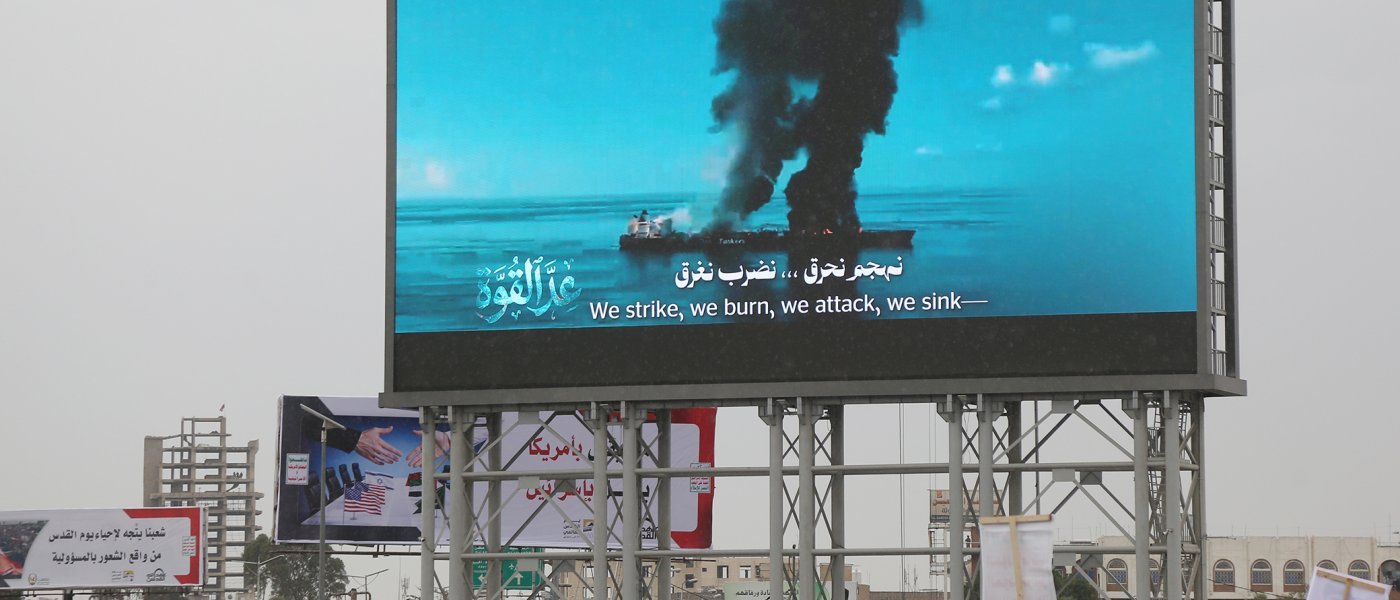
The Houthis have demonstrated both a willingness and ability to block this chokepoint before. In response to Israel’s invasion of Gaza following the October 7 attacks of 2023, Houthi attacks on commercial shipping caused traffic through Bab al-Mandab to drop sharply. Oil flows declined by over half to roughly 4 million barrels per day. Shipping companies responded to the instability by rerouting vessels around the Cape of Good Hope, extending transit times by weeks and sharply increasing costs for key global supply chains.
Attacks on shipping in Bab al-Mandab would be particularly consequential for Saudi Arabia. The Kingdom has used its East-West pipeline to mitigate the effects of Iran’s blockade of the Strait of Hormuz. The pipeline pumps crude oil from Saudi Arabia’s eastern coast to the Red Sea port of Yanbu, bypassing the Strait of Hormuz. However, this pipeline has a capacity of approximately 7 million barrels per day and is already operating near its maximum.
A Houthi attack on Bab al-Mandab would wreck Saudi Arabia’s mitigation strategy. Not only would Saudi exports from the Red Sea face disruption, but the East-West pipeline itself could become a target for Houthi missile and drone attacks. The downstream effects would be felt most acutely in Asia, which is the destination of 75 percent of oil exports from Saudi Arabia. Higher oil prices would exacerbate inflation, strain public finances, and complicate economic recovery efforts across Asian economies and beyond.
The closure of Bab al-Mandab would have profound implications beyond energy. Egypt is a case in point, even though it has not yet been embroiled in the conflict directly. The Suez Canal is an essential lifeline for Egypt’s economy, typically handling around 30 percent of global container traffic and generating billions of dollars in transit fees. In 2023, it generated $9.4 billion in revenue.
Therefore, a sustained disruption to Red Sea shipping would sharply undercut Egypt’s foreign reserves. This would come at a particularly precarious moment. The Egyptian pound has depreciated significantly, inflation remains elevated, and the government is struggling to maintain subsidies for fuel and basic goods. Energy shortages have forced the government to implement rationing measures, including banning businesses from operating after 9 p.m. and issuing a partial remote work mandate for public and private sector workers. Rising food prices are hitting the poorest in Egypt hardest, with the cost of basic staples like potatoes and tomatoes increasing by more than 30 percent in just the weeks since the conflict began.
A compounding economic crisis in Egypt could have important spillover effects. Egypt has a population of 117 million and is often described as “too big to fail.” Yet, worsening living conditions could fuel unrest, threaten the stability of the regime, and spark waves of outward migration.
Egypt is just one of the many countries around the world that would be plunged into crisis if the Houthis try to block Bab al-Mandab. If faced with an even more serious escalation from the United States, the Iranians could well decide that the Houthis hold the key to their survival. Should Iran choose to play this card, the costs of the war for the global economy will rise considerably, and some governments will have to resort to even more drastic measures to weather the storm.