
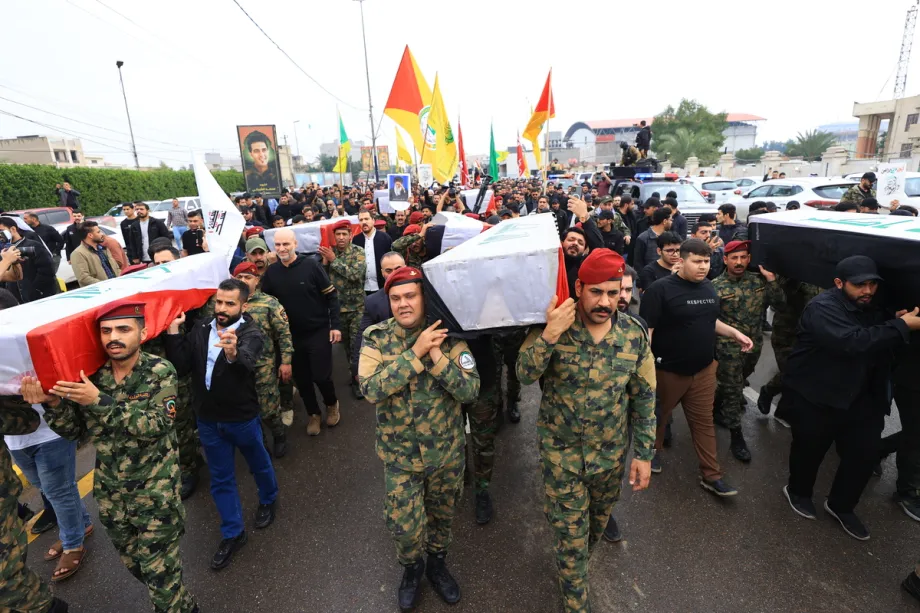
U.S. airstrikes degrade Iran-backed Popular Mobilization Forces in Iraq, but fragmentation into nationalist militias makes them harder to control. Baghdad is trapped between Washington and Tehran. Iran’s proxy grip loosens, yet airpower alone cannot stabilize Iraq—raising risks of a prolonged escalation cycle.
American airstrikes have battered the Popular Mobilization Forces. But in Baghdad’s alleys, the militias are waiting.
For months, a war has been unfolding across Iraq with little of the fanfare that once accompanied American military campaigns in the region. There are no embedded journalists photographing convoys rolling through the desert, no prime-time presidential addresses. Instead, American warplanes and drones have been systematically dismantling the infrastructure of the Popular Mobilization Forces. American forces have carried out repeated airstrikes on P.M.F. headquarters in Baghdad, Mosul, and Anbar Province, assassinating senior commanders and reducing fortified compounds to rubble. The targets have included logistics networks, weapons depots, and command-and-control nodes that Iran’s Islamic Revolutionary Guard Corps spent the better part of a decade constructing. General Michael Kurilla, Admiral Cooper’s predecessor at CENTCOM, had for years warned that Tehran was systematically “militarizing” these groups to serve as a forward-deployed deterrent against the United States and Israel.
A PROXY NO LONGER?
What American planners may not have fully anticipated is that the P.M.F. factions have spent those same years evolving. They are no longer a monolith under Tehran’s command. P.M.F. commanders, speaking through intermediaries and in rare on-the-record interviews with Arabic-language outlets, are emphatic on this point. “We are Iraqis first,” one senior figure told Al Jazeera. “The Americans think they can erase us, but every strike only deepens our resolve.” It is the kind of defiance that American commanders have heard before in Iraq — and that has rarely proved hollow.
Michael Knights, a senior fellow at the Washington Institute for Near East Policy who has spent two decades tracking the P.M.F., argues that American strikes are producing an unintended consequence. “The P.M.F. is fragmenting under pressure,” he said. “Some factions remain loyal to Tehran, but others are recalibrating as nationalist actors. This makes them harder to eliminate — they are embedded in Iraq’s political and social fabric.” That fragmentation, paradoxically, may be making the problem worse. A unified P.M.F. answerable to Iran is at least a known variable. A constellation of semi-autonomous Iraqi nationalist militias is something far harder to deter or negotiate with.
THE IRAQI DILEMMA
Baghdad watches all of this with barely concealed alarm. Prime Minister Mohammed Shia’ al-Sudani’s government is caught in an excruciating bind: too dependent on Washington’s security guarantees and financial architecture to openly condemn the strikes, yet too enmeshed with P.M.F. political factions — who hold seats in parliament and run government ministries — to endorse them. Iraqi parliamentarians from P.M.F.-aligned blocs have denounced the operations as a violation of Iraqi sovereignty.
Hayder al-Khoei, an Iraqi analyst at University College London who advises Western governments on Iraq policy, described the dilemma precisely: Former Ambassador Ryan Crocker, who negotiated the 2008 Status of Forces Agreement with Baghdad, has long argued that Washington tends to underestimate the fragility of its relationship with the Iraqi state — and to overestimate how much pressure that state can absorb before it fractures.
TEHRAN’S LOOSENING GRIP
Karim Sadjadpour, a senior fellow at the Carnegie Endowment for International Peace who has studied Iranian strategy for two decades, frames Tehran’s predicament this way: “Iran created Frankenstein. The P.M.F. was designed as an instrument of Iranian power projection, but it has developed its own interests, economy, and political identity. Iran can still influence these groups, but it can no longer control them reliably.” That loosening grip has strategic implications: an Iran unable to restrain its proxies is also an Iran less able to offer Washington a credible off-ramp.
Analysts at the Institute for the Study of War have been tracking what they describe as a “regenerative” capacity within the P.M.F. ecosystem.
one senior researcher there noted. It is a bleak assessment, but not a novel one.
THE LIMITS OF DOMINANCE
The deeper question Operation Epic Fury raises is not whether the United States can inflict punishment — clearly, it can — but whether punishment alone can reshape Iraq’s security landscape in durable ways. Retired General Joseph Votel, who commanded CENTCOM from 2016 to 2019 and oversaw the final campaign against the Islamic State, has cautioned against what he calls “the illusion of decisive action.” “Airstrikes are a tool, not a strategy,” he said in a recent forum. “Every commander knows you don’t win in Iraq from the air.”
Colin Clarke, a senior research fellow at the Soufan Center who studies militant networks in the Middle East, argues that the current campaign may be creating the conditions for a long-term escalation cycle.
he said. The history of American targeting campaigns in Iraq bears that observation out.
Admiral Cooper’s metrics of success — grounded aircraft, idle warships, diminished missile launch rates — measure Iran’s conventional capabilities. They do not measure the temperature in the streets of Karbala, or the calculus of a P.M.F. battalion commander in Anbar who has just watched his superior’s funeral draw ten thousand mourners. The silent war in Iraq is less about defeating Iran outright than about reshaping a security landscape that three American administrations have tried and failed to stabilize. As the strikes continue, and the funerals multiply, the real test may lie not in the target lists reviewed each morning in Tampa, but in Baghdad’s alleys, where P.M.F. commanders blend into civilian life — waiting for the next strike, and the next chance to retaliate.