
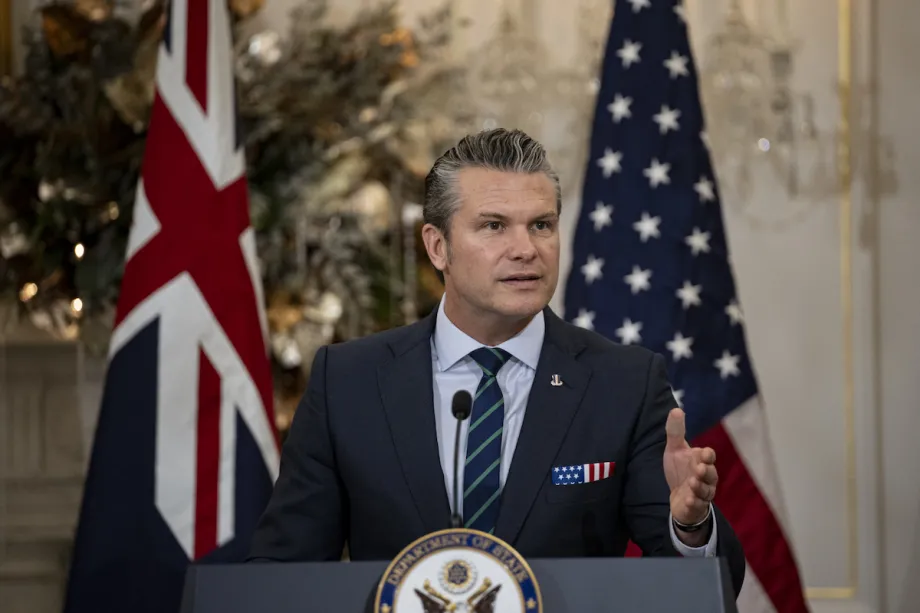
Ghouri analyzes the institutional weight of Hegseth’s medievalist framing. By invoking “end-times” prophecy in Pentagon briefings, the U.S. is handing Tehran a propaganda victory, allowing hardliners to recast national defense as a sacred moral obligation. This “theological exceptionalism” alienates NATO allies and validates extremist narratives across the Muslim world.
‘Deus vult’ (God wills it) was the rallying cry of medieval crusaders. Its reappearance, symbolically and rhetorically, in the US defence secretary Pete Hegseth’s public language should alarm anyone who believes war must remain bounded by law rather than theology. The Independent reports that Hegseth has repeatedly framed the Iran conflict in explicitly theological terms, portraying it as a confrontation between “good and evil,” invoking Christian scripture, praising Crusader symbolism, and describing God as aligning with US military action against Iran. Experts interviewed in the Independent’s report stress that such religious framing by a sitting US defence secretary is “completely, totally unprecedented” in modern US history. Michael Weinstein of the Military Religious Freedom Foundation characterises the messaging as casting the conflict as “Jesus versus Muhammad”, rather than a conventional interstate conflict governed by international law.
Hegseth’s rhetoric is not merely personal religiosity, but official-level language used in public briefings, prayers, and Pentagon settings, lending it institutional weight. It has filtered down through the chain of command, with US service members alleging that senior officers framed the Iran war in explicitly biblical terms, invoking divine plans, Armageddon, and end-times prophecy, raising formal complaints about a collapse of the separation between state power and religious authority.
What makes this rhetoric troubling is not its outward religious association but what it does to how war is understood. When political leaders speak of war as God’s will or a battle between good and evil, war stops being about laws, limits, and responsibility. Instead, it becomes something seen as unavoidable and unquestionable. In the modern world, wars are meant to be justified using clear rules, such as self-defence, protection of civilians, and respect for international law. Religious language pushes those rules aside. If a war is framed as sacred, asking for restraint sounds like weakness, and calling for peace can look like betrayal. This way of speaking also makes compromise far harder. The real danger, however, is that war itself is being placed beyond accountability.
What does such religious language, pulling the conflict away from legal justification and into the realm of faith, mean for Iran and the wider Muslim world? For Iran, it feeds dangerous narratives of total, faith-based conflict. For many Muslim societies, it confirms fears that international law is applied selectively.
Implications for Iran
Iran’s political system is itself ideologically religious, but it has long framed its confrontation with the US in anti-imperial and legal-sovereignty terms, especially in UN forums. However, overt Christian-war rhetoric from US leadership hands Iranian hardliners powerful propaganda.
It allows Tehran to credibly argue, domestically and internationally, that the conflict is not about nuclear non-proliferation or regional security, but about religious domination. This narrows the space for diplomacy, since compromise with what is portrayed as a divinely mandated enemy becomes politically toxic within Iran.
When war is framed as metaphysical rather than political, it encourages a zero-sum logic. As a sacred struggle, resistance is no longer justified in strategic terms alone but elevated into a moral obligation, where enduring hardship and rejecting compromise become signs of faithfulness rather than policy choices. Iranian leaders and allied militias can present resistance not merely as national defence, but as a religious obligation, echoing the very language used against them.
Historically, conflicts framed in sacred or religious terms tend to last longer, prove harder to de-escalate, and become less responsive to legal and humanitarian constraints, because opponents are recast as cosmic enemies and war itself is transformed from a political instrument into a moral obligation. This dynamic has been documented in conflicts involving Iraq, Afghanistan, and Palestine, where religious absolutism undermined negotiated settlements.
Implications for the broader Muslim community of states
For many Muslim‑majority states, the resort to religiously charged war rhetoric by a Western military power accelerates the collapse of the “rules‑based order” narrative itself, reinforcing the perception that international law binds weaker states. In contrast, great powers abandon legal justification when force serves ideological or civilisational ends. Western powers have traditionally justified the use of military force in secular legal terms, by pointing to UN Security Council authorisation, invoking collective self-defence under Article 51 of the UN Charter, or appealing to humanitarian necessity to prevent large-scale civilian harm. Religious-war language undermines these legal justifications. Invoking divine sanction instead of international law risks eroding the US’s credibility as a guardian of a secular rules-based international order.
This erosion is already visible in allied responses. Canada’s prime minister has described the Iran war as a “failure of the international order” even while offering conditional support absent UN authorisation. At the same time, Germany’s chancellor has openly downplayed the relevance of international legal classification itself, signalling a retreat from the very rules-based framework Western states long claimed to defend. That credibility gap has widened further because several NATO countries have openly opposed the war itself, with governments such as Spain, France, and Italy refusing to grant airspace or base access for strikes on Iran and publicly distancing themselves from US-Israel led operations on legal and strategic grounds.
For Muslim-majority states, many of which operate within pluralistic constitutional and legal orders, these developments reinforce long-standing suspicions that international law is applied selectively. They strengthen the narrative that Western uses of force are shaped as much by cultural or religious bias as by legal principle, particularly when wars proceed without UN authorisation yet are framed in civilisational or theological language.
It also complicates Muslim-majority states’ own struggles against extremism, since Western wars framed in civilisational or religious terms risk validating extremist propaganda, undercutting local governments’ efforts to defend cultural diversity, legal pluralism and non-violent political order against claims of an inevitable religious conflict.
Even when formally directed at Iran’s present regime, religious war rhetoric is unlikely to remain contained. Hegseth’s theological framing of the US-Israel led war against Iran is already alienating the US non‑Christian service members. Globally, it is recasting Islam as a civilisational adversary rather than a diverse global faith. This has familiar social consequences. Historically, periods in which Western conflicts are framed in religious or civilisational terms have correlated with surges in Islamophobia, intensified surveillance of Muslim charities and institutions, and renewed pressure on Muslim communities at home and abroad to “prove” political loyalty in ways not demanded of other citizens. This is of serious concern for Muslim-minority states allied with the US (e.g. Jordan, Indonesia) and for Muslim citizens within Western democracies. The post-9/11 experience shows how quickly this spillover can occur: the “war on terror” led to sharp increases in Islamophobic violence, religion-based surveillance of Muslim charities and mosques, and sustained political pressure on Muslim citizens to demonstrate loyalty, leaving lasting scars on Muslim communities that persist decades later.
If the religious legitimation of force becomes normalised, other states may increasingly justify violence through civilisational or theological claims, hollowing out the universal character of the prohibition on the use of force even where it is formally retained. In legal terms, this risks weakening Article 2(4) of the UN Charter in practice and normalising forms of theological exceptionalism in warfare. This was precisely the logic that the post-1945 international legal order was designed to extinguish after the catastrophes of the first half of the twentieth century.
Bottom line
The cumulative effect of Hegseth’s theological rhetoric on the US-Israel war with Iran is stark. For Iran, it empowers hardliners, closes off diplomatic exit ramps, and recasts the conflict as existential rather than negotiable, making compromise appear both illegitimate and dangerous domestically. For the wider Muslim world, it confirms fears of an emerging civilisational confrontation, erodes confidence in the neutrality of international law, and risks normalising religious identity itself as a geopolitical fault line rather than a protected and plural social reality. This rhetoric actively reshapes the legal, ethical, and symbolic architecture of war, with consequences that will outlast this conflict and reverberate far beyond Iran alone.