
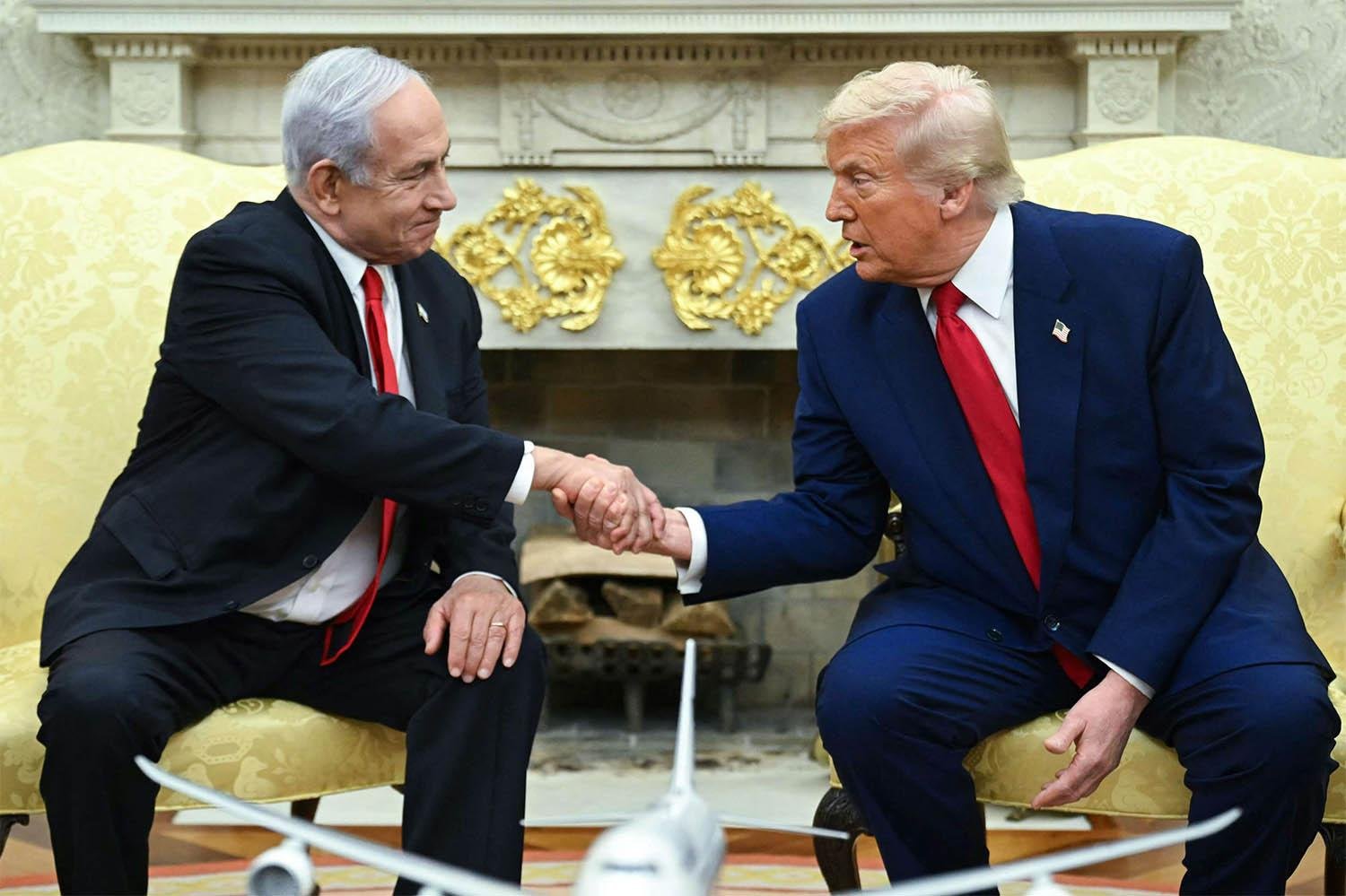
War decisions hinge on Trump’s personal temperament. Israel seeks Iran’s collapse to erase October 7’s legacy. U.S. midterm pressures may constrain escalation, leaving conflict’s end uncertain.
The decision of war and peace in Washington has become increasingly tied to the personal temperament of the president—someone who may decide, in a single moment, to halt a war based on a phone call or a sudden shift in his own private assessment.
No serious political observer can overlook the powerful internal psychological driver shaping decision-making in Israel. There is a clear and urgent desire to wipe away the scars of October 7—a moment of historic failure that no one managed to prevent despite repeated promises of security and deterrence. That rupture created a deep need for an alternative event, something large enough and dramatic enough to overwrite the collective memory of that defeat.
This is where the push toward escalating confrontation with Iran, and even the ambition to dismantle its political system, begins to take shape as a strategic option. Through such a confrontation, Israeli decision-makers appear to be seeking a new place in history: not as leaders marked by failure, but as architects of a transformed regional order and saviors of a shaken national image.
The insistence on prolonging the war—and moving from the Gaza front to the Lebanese front, and ultimately toward direct threats against Iran—is not simply the product of objective military logic. It is also a calculated attempt to reclaim lost prestige, link multiple fronts into one larger campaign, and complete what is seen as the final link in a chain aimed at securing full Israeli dominance across the region.
Trump: A Volatile Actor in Contrast with the American Institutional State
On the other side of the equation stands what may be called the “Trump factor”—a variable that does not operate according to the traditional rules of political predictability. Historically, American foreign policy was crafted within institutional corridors, and analysts could anticipate its direction by observing how those institutions functioned and interacted.
Today, however, we are looking at a far more unsettling reality: the clear marginalization of institutional influence in favor of individual, impulsive decision-making.
The decision of war and peace in Washington has become increasingly tied to the personal temperament of the president—someone who may decide, in a single moment, to halt a war based on a phone call or a sudden shift in his own private assessment. This level of volatility makes it extremely difficult to define any clear timeline for when the war might end, even though the ultimate authority to stop it remains, in essence, an American decision above all else.
Diverging Motives: Deterrence Versus Destruction
There are fundamental differences between Washington and Tel Aviv in how each approaches the Iranian file. While Democratic administrations have traditionally leaned toward containment, the Republican approach—and particularly Trump’s approach—has tended to revolve around deterrence.Yet even within that framework, the goals are far from identical.
Israel is not simply seeking to deter Iran; it is seeking disorder inside Iran and, ultimately, the collapse of the system itself. The belief driving this strategy is that the road to Beijing passes through Tehran—that breaking this axis is the only way to secure long-term strategic dominance and enduring security.
By contrast, the American approach, even under a hardline Republican administration, may not necessarily go as far as fully dismantling the Iranian system. Instead, Washington’s aim may be more limited: to produce a regime that is compliant, cooperative, or at least constrained by American deterrent power.
The notion that a system like Iran’s can be brought down from the outside without a deep understanding of its internal structure may appear simplistic, even naïve. Yet despite that, Israeli leadership appears to have successfully persuaded—perhaps even strategically manipulated—Trump into embracing approaches that serve the Israeli vision of weakening and fragmenting Iranian power.
Domestic Pressure and the Countdown to Decision
The most immediate source of pressure on decision-makers in Washington today comes not from the battlefield, but from inside the United States itself—specifically, the looming midterm elections.
This is the factor weighing most heavily on Republican strategists. Within that camp, there is a growing concern that a prolonged war could undermine the positive political outcomes Trump hopes to secure. In that sense, the issue is no longer purely military or even purely geopolitical; it has become inseparable from electoral calculations and the preservation of domestic political momentum.
That is why we are likely looking at a decisive period stretching over the coming weeks, possibly into mid or late April, during which the balance between the president’s personal temperament and the demands of electoral strategy will determine the next phase.
The ability to influence the course of the war is no longer tied solely to developments on the ground. It is increasingly dependent on whether internal American pressures can restrain the military momentum being fueled by personal ambition in Tel Aviv.
Conclusion
In the end, we are facing a political landscape shaped by a struggle between two competing impulses: the personal desire to rewrite history, and the strategic imperative of managing global influence.
With Trump’s erratic decision-making and the erosion of the traditional institutional role in Washington, the world finds itself increasingly vulnerable to the moods of leaders and the short-term intersections of power, ego, and interest.