
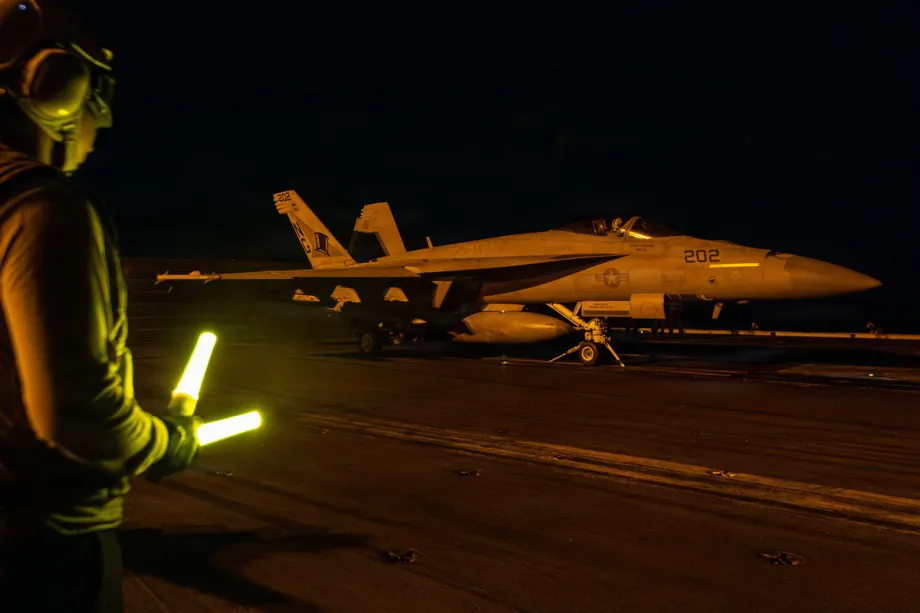
Trump’s doctrine commodifies war as negotiation leverage. Security becomes transactional, instability reinforces dependence, and civilian costs are secondary. Reliance on the “American umbrella” now functions as bargaining chip, not protection.
The explosions now echoing across Iran, Lebanon, and parts of the Gulf are not merely the sounds of another Middle Eastern war. They also reflect a particular political mindset—one that views conflict not as a last resort, but as a negotiating instrument.
To understand the current escalation, it is necessary to look beyond the traditional language of diplomacy and security. Instead, one must try to grasp the worldview of the man currently occupying the White House: Donald Trump.
In Trump’s political universe, war is rarely framed in moral or humanitarian terms. It is understood through the logic of leverage, bargaining, and deal-making. The vocabulary of tragedy gives way to the vocabulary of transaction.
When a reportedly US-backed Israeli strike hit a primary school in eastern Iran days ago, killing dozens of children, the international community expected the usual diplomatic rituals—statements of concern, expressions of regret, perhaps a call for restraint. None of these appeared in any meaningful form.
But the silence itself is revealing.
For a leader shaped by the culture of high-stakes real estate deals, apologizing carries a strategic cost. An apology suggests responsibility, and responsibility weakens bargaining power. In the logic of transactional politics, maintaining dominance requires projecting certainty and refusing moral vulnerability.
A Marketplace View of the World
Traditional theories of international relations assume that states seek stability, balance of power, and predictable alliances. Trump’s worldview challenges that assumption.
Emerging from the world of property speculation, he appears to see the international system less as a community of states and more as a competitive marketplace. Countries resemble assets. Alliances resemble contracts. Conflicts become negotiations conducted with far higher stakes.
In this framework, the world resembles an auction house rather than a diplomatic order. The objective is not long-term equilibrium, but extracting maximum concessions.
There are, therefore, no permanent allies or permanent enemies—only profitable deals and costly arrangements waiting to be renegotiated.
Security itself becomes a commodity.
The Commodification of Security
For decades, the United States presented itself as the guarantor of international stability. Yet under Trump, that guarantee increasingly takes the form of a paid service.
The Gulf states illustrate this dynamic clearly. They are treated less as strategic partners and more as clients in a protection relationship.
Security commitments are discussed in financial terms. Military presence becomes leverage. Political loyalty becomes a transactional asset.
In such an environment, instability can paradoxically serve strategic interests. Persistent tension reinforces dependence on external protection, ensuring that the market for security never truly disappears.
War as Negotiation
Trump’s approach to confrontation with Iran reflects this logic.
In the language of business negotiation, it is a strategy designed to increase the price of compromise.
The danger is clear: when war becomes part of the negotiating process, the human cost becomes secondary to perceived strategic advantage.
Civilian deaths, devastated cities, and regional instability risk becoming collateral variables in a geopolitical calculation.
The Risk of Personalized Power
This approach introduces another danger: the personalization of international politics.
As Financial Times columnist Edward Luce has warned, global stability becomes fragile when geopolitical decisions are driven less by institutional consensus and more by personal instinct and political calculation.
Policies may shift suddenly. Alliances may be reconsidered overnight. Strategic decisions may be shaped by electoral pressures or personal political narratives rather than long-term planning.
The result is a world in which unpredictability itself becomes the central feature of global politics.
A Difficult Regional Lesson
For many states across the Middle East, the unfolding crisis offers a harsh reminder.
Reliance on external security guarantees has always carried risks, but those risks become far greater when the guarantor views security primarily through a transactional lens.
The so-called “American umbrella” may ultimately function less as a shield than as a negotiating tool.
If there is a lesson emerging from the current conflict, it may be that regional stability cannot be permanently outsourced. Durable security requires internal resilience, regional cooperation, and independence from the shifting calculations of global power brokers.
Perhaps the Real Question Is This
What if the explosions shaking the Middle East are not only the result of geopolitical rivalry?
What if they are also part of a negotiation strategy?
If that is even partly true, then the region is not simply witnessing another war.
It is witnessing the moment when war itself becomes a business model.