
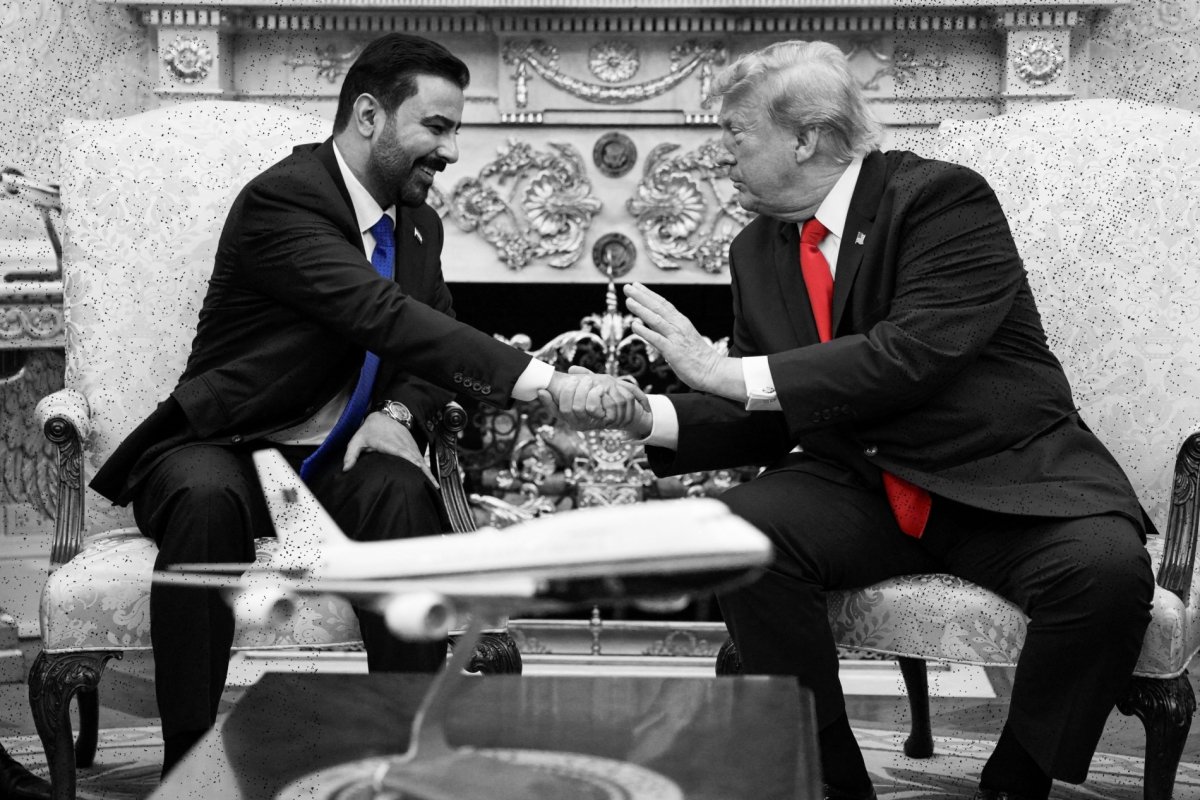
This analysis examines the al-Zaidi Washington visit as both a diplomatic reset with the US and a domestic gamble, exploring the anti-corruption push it enabled, Iraq’s balancing act with Iran, and a proposed regional trade corridor.
Foreign trips by Iraqi prime ministers are rarely just diplomatic formalities — they’re read at home as verdicts on who really backs the government. That’s what makes the al-Zaidi Washington visit worth close attention: a political outsider with no prior office chose the White House over Tehran for his first trip abroad, then used the resulting goodwill to escalate a domestic anti-corruption campaign that directly threatens Iraq’s entrenched political class.
The visit produced warm rhetoric from Trump, fresh MOUs with American companies, and a glimpse of a broader US-backed regional corridor meant to reduce dependence on the Strait of Hormuz. But it also exposed the balancing act al-Zaidi still has to manage — a government trying to satisfy Washington without fully alienating Iran-aligned factions at home. That tension isn’t resolved yet.
Al-Zaidi Washington Visit: The Setup
Iraqi Prime Minister Ali al-Zaidi’s visit to Washington earlier this month was an effort to move the US-Iraq relationship “from managing crises to creating opportunities”. That phrase appeared in an article he wrote for The Washington Post on the day of his arrival, before meeting US President Donald Trump at the White House. The article was titled Why I Am Going to Washington.
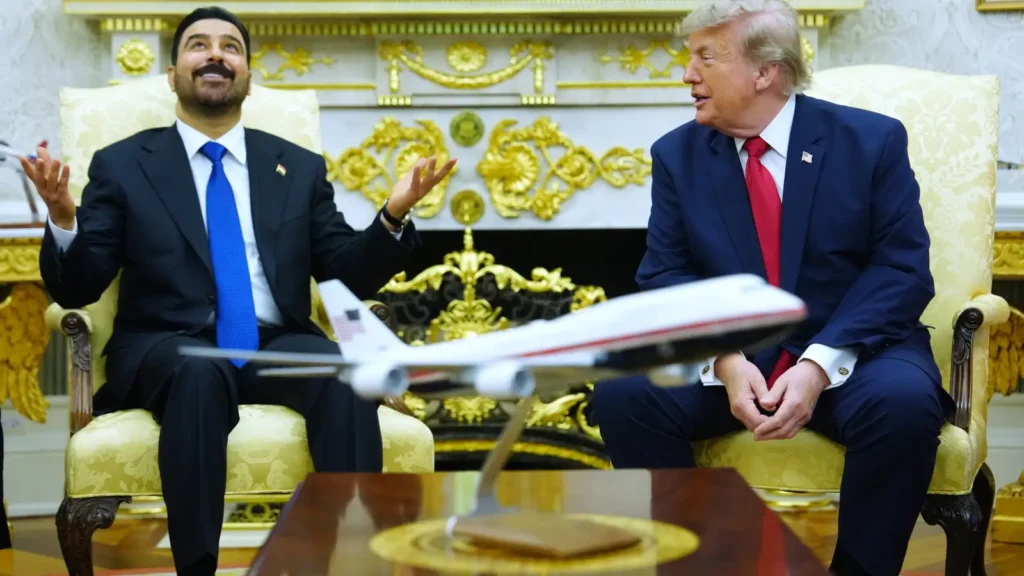
Al-Zaidi surprised many with the way he conducted his political conversation with Trump, a president who can dispense with diplomatic niceties when hosting foreign guests. A businessman by background, the Iraqi premier has no political experience, nor has he ever sought any, yet he managed to keep the discussion focused on reshaping the partnership between Baghdad and Washington. Asked why this was his first foreign visit, he said Iraq was burdened by severe financial and economic crises, that confronting challenges of such magnitude required a strategic partner, and that the United States was Iraq’s most important strategic partner.
Before travelling to Washington, al-Zaidi had launched a forceful campaign in Baghdad against political figures and senior state officials accused of corruption. At the White House, he briefed American decision-makers on the measures he had taken over corruption and the fight against militias in Iraq. The two are linked. Money amassed through corruption and weapons bought with that money present a huge challenge. Al-Zaidi’s choice to confront the leaders of the ruling political class is therefore an enormous gamble.
Domestic Stakes of the Al-Zaidi Washington Visit
Changing landscape
Before meeting Trump, al-Zaidi made skilful use of the American president’s remarks welcoming his appointment to form a government, so secured parliamentary confidence for a cabinet in which only half the ministerial posts had been filled. Appointments to several ministries subject to political dispute were postponed, as were portfolios expected to go to armed groups within the Coordination Framework (CF) whose participation in government Washington opposes.
Al-Zaidi has shown that his government is broadly aligned with American expectations, but has continued to offer armed factions within the CF grounds for hoping that Washington’s objections might eventually be lifted, since their participation in government was only deferred, while their allocated ministries were not filled with others. The first test after al-Zaidi’s visit will therefore concern the government’s relationship with the armed groups. The idea proposed had been that the CF factions relinquish their weapons in return for political representation. Is this still viable?
Following his meeting with Trump, and the signing of Memoranda of Understanding with major American companies, al-Zaidi now feels more secure in pursuing political measures that will rattle the establishment, whose leading figures will fight hard to protect the privileges and accumulated gains secured over recent years by means of corruption and weapons.
In Baghdad, there had been a perception that al-Zaidi’s government is opposed to Washington, so the visit had an important public relations purpose: to persuade Iraqis that the al-Zaidi government enjoys American acceptance. This is important, because most of his predecessors have operated on the belief that the strength of their governments depends largely on the strength of their relationship with Washington.
Iran’s Shadow Over the Al-Zaidi Washington Visit
Some observers try to simplify Baghdad’s relationships with America and Iran, but they are complex and intricate. For instance, al-Zaidi attended the recent funeral of Iran’s Supreme Leader Ali Khamenei (who was killed in US-Israeli bombing in February) just days before travelling to the White House. Their warm handshakes vividly captured the tangled geography and competing political interests that shape Iraq’s foreign policy.
Al-Zaidi’s government will have to navigate these complexities and may plan to manage a hybrid security apparatus strained by internal rivalries and vulnerable to foreign intervention. Yet Washington’s desire to redraw the contours of the partnership is evident. Dealing with Iran has become more complicated since the war, given the difference in rhetoric between the Revolutionary Guard and official representatives.
Baghdad will seek to persuade Tehran that Iraq should serve as a point of convergence, not confrontation, but this will first require Iraq to bring order to its own political and security affairs—no easy matter in a country where numerous parties, factions, and leaders usurp the state’s authority over foreign policy.
Trump said that relations with Iraq had “moved from being poor to becoming extremely good,” and spoke of a “long-term relationship,” but a message attributed to Ali Akbar Velayati, an advisor to Iran’s Supreme Leader, circulated on social media, criticised al-Zaidi’s US visit. It reportedly began with the phrase: “To God we belong, and to Him we shall return,” before describing the visit as regrettable, ill-timed and harmful to “the jihad of the Iraqi people”. While the message may not be authentic, it reflects Iranian political thinking about Iraq-US relations. Many in Tehran think the Iranian capital should have been al-Zaidi’s first foreign visit, not Washington.
What the Al-Zaidi Washington Visit Unlocked
A new model
US envoy Tom Barrack has been instrumental in reactivating the partnership between Baghdad and Washington. He described al-Zaidi as “young and bold” and spoke of “a new model emerging on the horizon,” one founded on alliances of connectivity and integration among the states of the Middle East, with a new strategic corridor linking Mesopotamia, the Levant, Türkiye, and the Gulf. In time, he said, such a corridor could reduce dependence on the Strait of Hormuz.
Barrack said the project would be driven by major American companies through a wave of economic diplomacy and investment, with a Memorandum of Understanding between the Iraqi and Syrian governments to rehabilitate a crude oil pipeline between the two countries. This would replace the 70-year-old Kirkuk-Baniyas pipeline, which is no longer considered suitable for rehabilitation. The pipeline could help deepen regional interdependence, while American companies will help build it.
Barrack’s plan envisages the US overseeing an economic partnership among Iraq, Syria, and Türkiye, which would become partners in shaping ‘a new Middle East’ in which Syria and Iraq could transform, in Barrack’s words, “what once appeared to be a landscape of chaos into a realm of opportunity”. Such a strategic partnership will require strong governments in Ankara, Damascus, and Baghdad.
Political Risk After the Al-Zaidi Washington Visit
Holding apples
The difficulty facing Iraq’s political forces, particularly the Shiite parties, lies in their desire to shape relations with Washington to suit their own interests. While on the one hand they would like to denounce America as the “Great Satan,” they are simultaneously unwilling to risk severing ties with the world’s superpower. This duality of outlook and conduct will burden every Iraqi government.
The so-called ‘Shiite crescent,’ comprised of armed militias that answer to Iran, will have no meaningful place in the new Middle East, so Iraqi politicians must think seriously about economic partnerships capable of restoring Iraq’s position as an active state, free from subordination to rival blocs competing for influence through religious and sectarian ideologies.
Iraq can be a US ally and partner while staying friendly with Iran, but it cannot be a strategic ally of both at the same time. Such a posture is the political equivalent of trying to hold two apples in one hand. Better to hold one than drop two.