
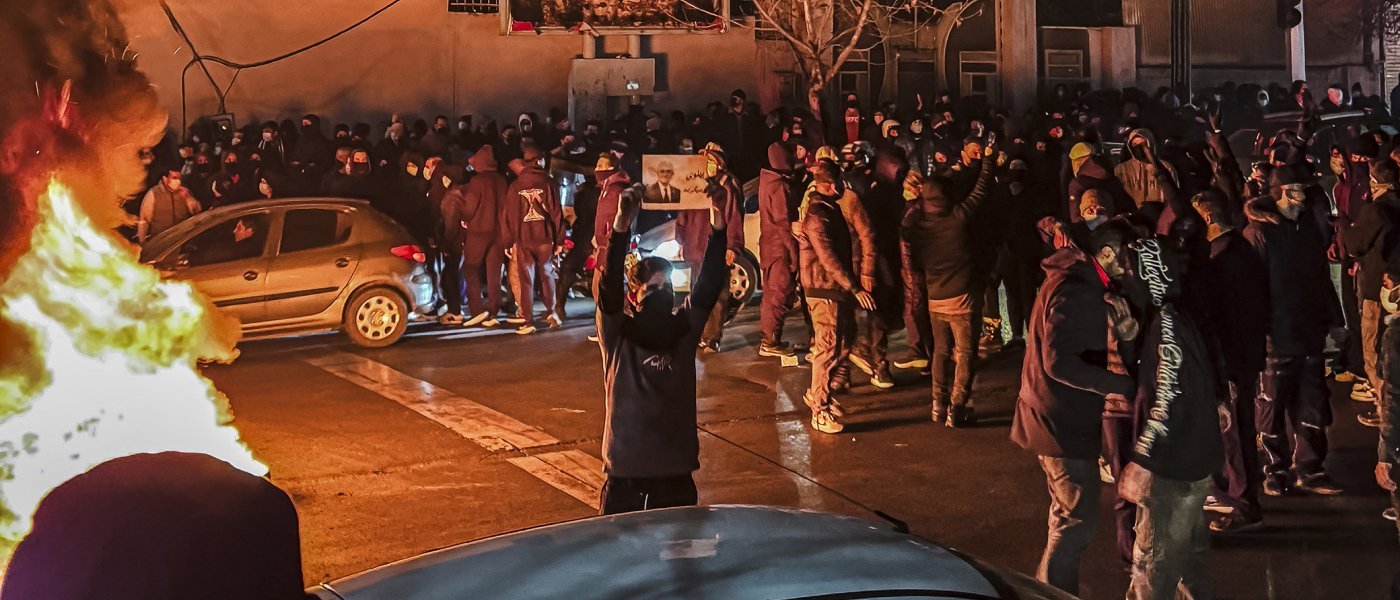
President Trump is weighing options to intervene militarily, but that is a risky bet. Striking military sites could have little impact on crackdown on the street, and may even dissipate the protests. A broader attack targeting the security forces suppressing demonstrations would have to involve city centers and risk civilian casualties, which could in turn send protesters home. The impact of targeting Iran’s leaders is also unclear: It could clear the slate of current decisionmakers similar to what the United States has pursued in Venezuela, but that may not benefit protesters,
Facing concurrent external and internal threats, the Islamic Republic is rattled, but Supreme Leader Ayatollah Khamenei has remained defiant. He still has a firm control over government and security institutions, and the state is showing the will to use deadly force to suppress the protests. In a public speech, he blamed the protests on foreign agitators, and vowed that the Islamic Republic would not retreat. His senior lieutenants have attributed crowd violence to armed terrorists under the direction of Israel and the U.S., and said protesters could be tried for the crime of “war with God,” which carries the death sentence.
The energy and intensity of the protests has not subsided, and reflects the depth of seething anger that many Iranians harbor toward leadership. The majority of the population does not subscribe to the revolutionary values that it blames for the country’s isolation and dire economic conditions. The protests are a fight for a future in which Iran would be a prosperous member of the international community.
Popular anger has been steadily growing since President Trump imposed maximum pressure sanctions on Iran in 2018. Government revenue has steadily declined, and shortages have proliferated, spiking inflation and unemployment. More of Iran’s trade has shifted to black markets, aggravating mismanagement, corruption, and income inequality. Powerful economic networks have gained control of vast areas of the economy. In the process, most Iranians have become poorer and angrier. That was already in full display in 2022 when pursuant to the death of a young woman, Mahsa Amini, at the hands of the morality police, young Iranians sparked a mass uprising.
Despite growing popular anger, the political class and state institutions have remained tightly arrayed behind Khamenei’s leadership. Iran’s rulers were long confident that, thanks to the aura of regional power, and given the stakes the West had in negotiating limits to Iran’s nuclear program, there would be no outside intervention to support protesters.
That all changed in fall of 2024 and summer of 2025. First, Israel battered Iran’s principle regional ally and deterrence against Israel, Lebanon’s Hezbollah, in summer and fall of 2024. Then, Iran lost its foothold in Syria with the fall of the Assad regime in December 2024. Those strategic setbacks opened the path for Israel to attack Iran in June 2025. During the ensuing twelve-day war, Israel killed dozens of Iranian military commanders and nuclear scientists, struck military sites, and then, along with the United States, bombed Iran’s main nuclear facilities, severely damaging the program.
The Islamic Republic survived the war, but it looked battered. Its aura of power and security was punctured, and before the world and its own people, it looked vulnerable. During the war, Israel had called on Iranians to topple the Islamic Republic. The population instead rallied to the flag. That display of national unity proved consequential, but was not a reconciliation between state and society. It would not be long before popular anger would once again manifest itself.
The trigger was a calamitous deterioration of Iran’s economy. According to the economist Djavad Salehi-Isfahani, between December 2024 and December 2025, the Rial had lost 84 percent of its value; 16 percent in December 2025 alone. Over that same one-year period, food prices had risen by 72 percent. On December 28, merchants angered by the collapse of the currency shuttered their shops. They were soon joined by irate crowds decrying the poor state of the economy.
The Islamic Republic has witnessed periodic episodes of economic protest dating back to the 1980s. None posed an existential threat to the regime, which may be why the government initially stood back as the most recent protests unfolded. Likely, the authorities were also conscious that cracking down could reverse the fragile entente that rallying to the flag had established between state and society during the twelve-day war.
The government’s attitude started to change as protests grew larger and went beyond venting economic grievances. However, President Trump’s warning that Washington was “locked and loaded” to intervene to “rescue” the protesters if the government used violence gave Tehran pause. It also put them in a quandary: let the protests continue unchecked and risk a serious challenge to the Islamic Republic, or clamp down and risk a U.S. attack. Iranian military forces were then monitoring the buildup of U.S. forces and war materiel in the Gulf, and hence took Trump’s threat seriously.
On January 3, 2026, U.S. Special Forces abducted Venezuela’s president. That audacious act was further proof that President Trump stood ready to use military means to break adversarial regimes. However, it soon became clear that Trump was not pursuing regime change in Venezuela; and therefore is not likely to do so in Iran either—rather, he is using protesters as pawns to escalate pressure on the Islamic Republic. He could punish Iran if it clamped down on the protests, but that operation would likely be limited.
On January 9, under the cover of an internet blackout, the Islamic Republic started its deadly crackdown. But even if Iran’s rulers survive this uprising, it could prove to be a Pyrrhic victory. The bloodshed will create an unbridgeable chasm with the population. The crackdown will neither resolve Iran’s debilitating economic situation nor restore its lost aura of power. The Islamic Republic is in a tightening vise from which it cannot escape.
https://www.csis.org/analysis/how-will-trump-administration-respond-violent-protests-iran