
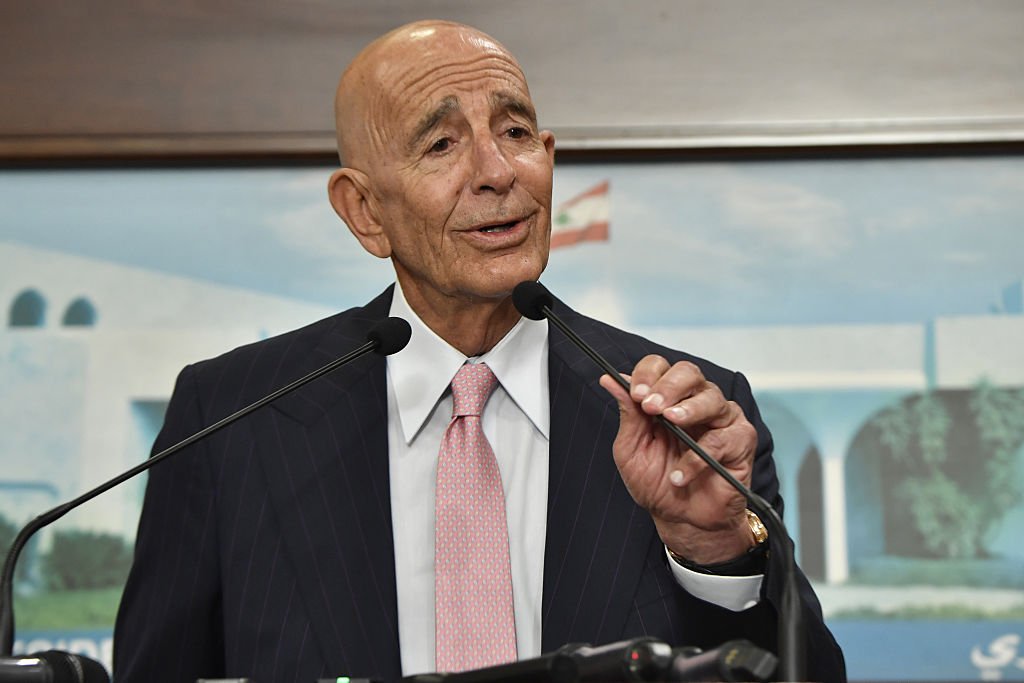
US envoy Tom Barrack embodies the Western strategy of managing crises in the ‘new Middle East’, not resolving them, writes Mahmoud Khalaf Al-Deiri.
The Middle East is no longer shaped by grand speeches or open wars. Today, it is managed through quiet conflict engineering, calculated control of chaos, and long-term crisis management rather than resolution. In this context, U.S. envoy to Syria Tom Barrack emerges as one of the key strategists working behind the scenes, not as a sovereign decision-maker, but as a “policy architect” contributing to reshaping the region under a new logic: no decisive victories, no final defeats, only fragile, sustainable balances.
Barrack does not appear in the media spotlight, nor does he speak in loud ideological terms, but his influence is visible in actions, not statements. He is part of a Western political school that sees the Middle East as no longer rebuildable on the strong nation-state model and that managing fragmentation is more realistic than attempting to end it. Accordingly, Barrack treats states not as unified political entities but as separate security, economic, and social files, each with its own tools for control.
His significance comes not only from his official role but also from the timing of his presence, arriving at a moment when Western policies have shifted from direct military intervention to non-confrontational influence and from “radical change” projects to “low-cost attrition” strategies.
Managing stalemate and collapse
In Syria, Barack’s role represents a qualitative shift in Western strategy. Syria is no longer seen as a project to topple a regime or as a state ready for political reconstruction. In this view, it has become a long-term frozen case.
he goal is not to end the conflict but to prevent any party from achieving full victory, maintain multiple centres of influence, and use sanctions as a political engineering tool rather than a moral instrument.
In the eastern Euphrates region, no alternative authority was established to replace the state. Instead, a controllable model was created, linked more to the economy and security than to sovereignty. Elsewhere, the Syrian regime is treated as a reality to be contained, not legitimised; to be weakened, not overthrown.
Syria has thus become an open laboratory for managing fragmentation, where conflict is allowed to continue within limits, without being permitted to explode or reach a conclusion.
Lebanon presents an even harsher approach. The goal is not to save the state but to prevent total collapse. Economic failure, institutional decay, and the erosion of the middle class are permitted, while one red line is maintained: avoiding a full-scale civil war.
Lebanon is no longer a state to be governed but a crisis to be managed. Sequential collapses are used as pressure tools, without providing radical solutions or upsetting existing power balances. Even the issue of non-state actors’ weapons is approached through long-term containment, linked to wider regional balances.
Here, Lebanon functions as a messaging arena: internally, signalling that no quick solution exists; externally, showing that chaos can be controlled at low cost.
Iraq
If Syria is the fragmentation laboratory and Lebanon the model of managed collapse, Iraq appears to be the next arena for influence engineering. A state exhausted by wars, reliant on a fragile rentier economy, with multiple armed actors and deep social divisions, Iraq presents an ideal environment for Barrack’s approach.
The likely scenario does not point toward direct confrontation with Iranian influence but rather the gradual dismantling of power sources, using the economy and energy as pressure tools, and leveraging protests without allowing them to escalate into a full-scale revolution.
In this view, Iraq is not a state to be restored but a balance to be maintained. No total collapse, no genuine recovery, only a middle ground that keeps all actors dependent on external mediation.
Barack’s approach does not aim to redraw the Middle East’s borders but to redefine the meaning of the state itself. Here, the state is not sovereignty or a social contract but the ability to maintain security, provide minimal services, and prevent widespread chaos.
He does not create new maps; he sets power ceilings, regulates the rhythm of conflict, and decides when issues are left to cool or reignited. The Middle East, under this framework, is not a collection of states but a series of manageable files.
Barrack’s strategy rests on one central assumption: radical solutions are costly and uncertain, while crisis management is cheaper and more sustainable. Yet it raises a profound ethical and political question: is this engineering producing stability or merely prolonging chaos?
These policies may prevent major explosions, but they produce exhausted societies, generations without horizons, and states without meaning. Engineering that ignores humanity and justice may maintain calm, but it sows seeds for delayed upheavals. In a Middle East that is managed but not resolved, Tom Barrack is less a peacemaker than a permanent crisis manager.