
Global efforts to defend Iranians’ rights face deadlock as U.S. and EU sanctions struggle against a brutal 2026 crackdown. While President Trump leverages military threats, his focus prioritizes nuclear concessions over humanitarian intervention.
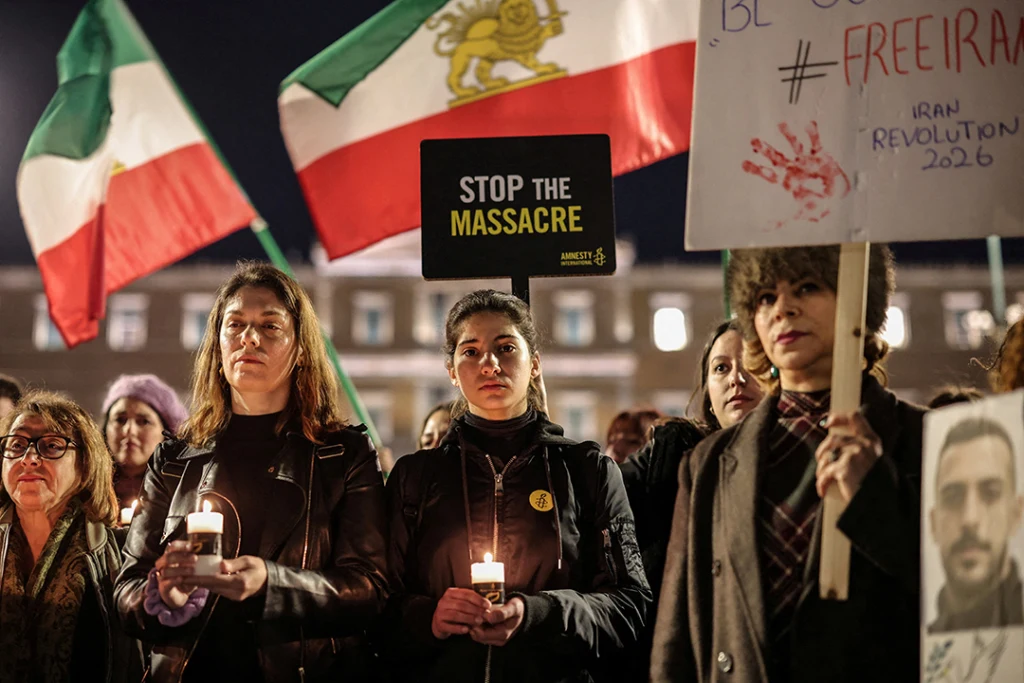
The Iranian government’s move to crush nationwide protests has likely caused the bloodiest crackdown against civilians since the 1979 revolution. The global response, even U.S. military threats, have so far failed to soften the regime’s actions.
The reported scale of death and injuries from the Iranian regime’s crackdown on demonstrators would easily meet what international lawyers call the “gravity test” for crimes against humanity and gross violations of the Iranians’ human rights. Some estimates put the death toll in the tens of thousands, while the official Iranian regime count is 3,117. There are estimates that tens of thousands of protesters were also swept up in widespread detention operations.
The regime’s actions have prompted condemnation from the United Nations’ main human rights body and new sanctions from the United States and European Union, but with little apparent effect. Of more immediate concern to Iran’s leaders is the surging U.S. military presence in the region and threats from President Donald Trump. However, his latest statements steer clear of the dire human rights situation in Iran as the basis for a possible use of armed force.
How has the United Nations responded to the recent domestic violence in Iran?
In response to the extreme violence inflicted upon the Iranian people, condemnations have been leveled at the Iranian regime in recent weeks by UN Secretary-General António Guterres, in the UN Security Council, and at the UN Human Rights Council. On January 11, Guterres expressed his shock at the violence and emphasized the need to respect and protect the rights held by Iranians, under international law, to freedom of expression and of peaceful assembly. His words spoke the truth, but with little consequence.
On January 15, the United States called for an emergency session of the Security Council, the UN’s enforcement arm. U.S. Permanent Representative Mike Waltz said that the violence and repression of the Iranian regime “has repercussions for international peace and security.” Iran’s Deputy Permanent Representative Gholamhossein Darzi accused the United States of “steering unrest in Iran towards violence.” With China and Russia supporting the Iranian regime’s interests, and with the other three permanent members of the Security Council (the United States, France, and the United Kingdom) condemning the regime’s repressive tactics, deadlock once again paralyzed the Council.
The Geneva-based UN Human Rights Council took the most direct action on January 20, when a resolution was adopted (by a vote of twenty-five to seven with fourteen abstentions) that strongly condemned the violence and human rights violations in Iran, while also extending the mandates of an independent fact-finding mission and the work of the UN’s top human rights expert on Iran. The United States is not among the current members of the Human Rights Council, as the Biden administration decided shortly before the 2024 presidential election not to run for reelection to a three-year term in the body. This has deprived the United States of voting power and leverage in the Human Rights Council to strengthen global condemnation of Iran and of demonstrating the value of a strong U.S. response.
What sort of leverage does the United Nations have in such circumstances?
The enforcement of human rights relies on persuading or shaming governments to uphold fundamental international norms that protect the human rights of individuals and of groups. Yet given its own statements before the Human Rights Council and the sympathetic nations in the room aligned with the views of member state China on human rights, the Iranian regime shows no sign of being influenced by that body’s strongly worded resolution. But the majority vote in the Human Rights Council serves the critical function of publicly confirming the illegality of Iran’s assault on the human rights of its people and keeping high-beam headlights focused on all that transpires in that country in the coming months. This act of solidarity with the Iranian people is one more pressure point on the regime.
What can be done beyond condemnations to protect human rights in Iran?
On January 29, the Council of the European Union (EU) imposed new restrictive measures against a group of fifteen Iranians and six companies and other entities in Iran deeply engaged in direct human rights violations (such as violent repression of peaceful protests and arbitrary arrest of political activists and human rights defenders) or disinformation campaigns using the internet. The EU Council has now imposed such punitive actions against a total of 247 individuals and 50 entities related to human rights violations in Iran. It also designated Iran’s Revolutionary Guard Corps as a terrorist organization.
The U.S. Treasury Department’s Office of Foreign Assets Control wielded its own longstanding sanctions weapon on human rights abuses in Iran on January 15, “taking action against the architects of the Iranian regime’s brutal crackdown on peaceful demonstrators.” Treasury Secretary Scott Bessent announced the sanctions with ambitious words: “The United States stands firmly behind the Iranian people in their call for freedom and justice.” Those sanctioned include Ali Larijani, the Secretary of the Supreme Council for National Security, and eighteen other individuals and entities laundering proceeds of Iranian oil sales to foreign markets. Treasury claimed that such illicit funds help repress the Iranian people and support the regime’s terrorist groups. The Obama administration’s Executive Order 13553 of 2010, which remains in force, and Executive Orders 13876 and 13902, provide legal authority for such sanctions, with one aim being to target Iranian government officials who seriously abuse the human rights of Iranian citizens or residents.
Would military action to protect human rights in Iran be justifiable?
Beyond condemnations and sanctions to enforce human rights in Iran, the United States appears headed toward some form of military threat or confrontation in the weeks ahead. But President Trump’s conditions for ratcheting down the U.S. military threat against Iran are confined to the regime ending its enrichment of uranium and eliminating the current nuclear weapons program, limiting the range and number of Iran’s ballistic missiles, and ceasing Iranian support for such proxy militias as Hezbollah, Hamas, and the Houthis. Improving the human rights situation in Iran remains absent from these conditions.
Whether military action would improve the human rights situation in Iran remains highly problematic, as the outcome politically, economically, and socially is unknown. If the United States strikes first, without any clear provocation by Iranian forces, the United States may try to justify its military action under the legal principle of anticipatory self-defense. One would expect such use of force to remain relatively limited to achieve specific objectives, such as further degrading Iran’s nuclear weapons, air defenses, and ballistic missile capabilities. But there are rules of necessity, distinction, proportionality, and humanity that would apply, and they are not designed to justify regime change or societal overhaul to protect human rights.
Nonetheless, Washington could argue that, given the murderous crackdown and repression against civilians being experienced on such a large scale in Iran, a humanitarian intervention to end the crimes against humanity being inflicted upon the Iranian people is justifiable. The legal doctrine at stake is embodied in the Responsibility to Protect (R2P) principle, unanimously approved by the UN General Assembly in 2005, but any military action to protect a population from atrocity crimes would require an enforcement resolution adopted by the UN Security Council. That remains implausible in the case of Iran, given skepticism of R2P in Washington on top of the political gridlock among the permanent members of the Security Council.
But if the United States decided to take military action for large-scale human rights purposes in Iran—which currently does not appear to be why U.S. naval assets are arriving in the seas near its shores—it would have to argue a pre-UN Charter rationale for humanitarian intervention under international law in somewhat the same spirit as it has employed the Monroe Doctrine for military strikes in the Western Hemisphere. That would be a very tough sell within foreign circles, including among U.S. allies.
Many NATO allies have reacted warily to the U.S. military attacks against Venezuela and alleged drug trafficking boats on the high seas. Keeping the United States on board with support for Ukraine remains paramount. But a humanitarian intervention, particularly if mass demonstrations erupt again and are met with deadly regime force, is not completely without reason. For the alternative would remain acquiescence in the commission of, in the case of Iran, murderous crimes against humanity without any effective remedy to save lives, at least for the foreseeable future. The same, of course, could be said of other parts of the world where massive assaults on civilian populations continue without any action by the Security Council to authorize interventions.