
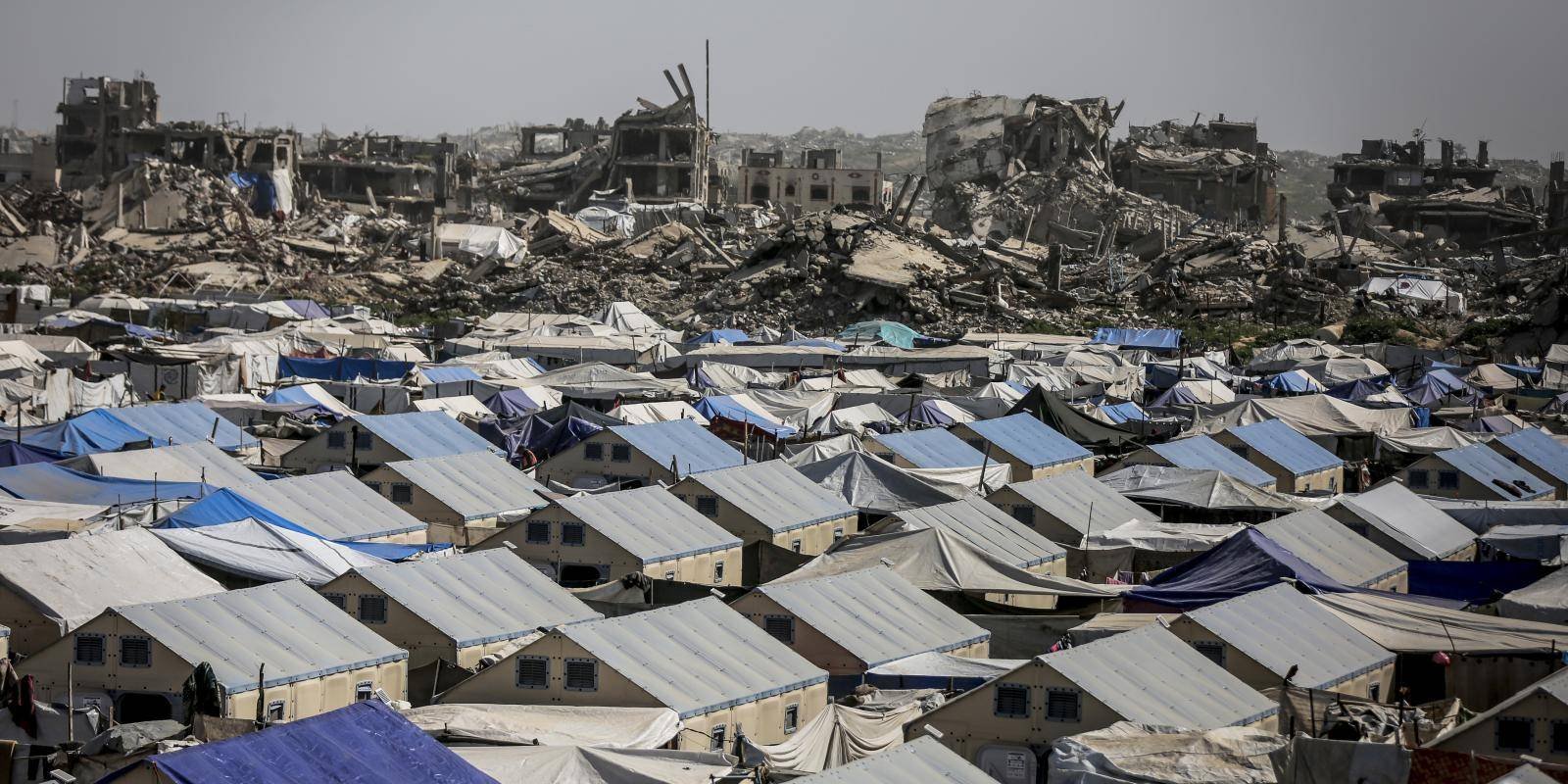
Trump’s plan could doom aspirations for a unified Palestinian state. European and Arab states should pressure Washington before it’s too late.
As US President Donald Trump convenes the inaugural meeting of the ‘Board of Peace’ (BoP) in Washington this week, Gaza will be thrust back into the international spotlight. This gives Arab and European governments a chance to review the framework he has set out to end the conflict in Gaza and adjust their engagement strategies.
Although they are mostly keen to accommodate Trump and help maintain the ceasefire, they risk supporting a process that could close off any prospect of Palestinian statehood and deliver a serious blow to Palestinian nationalism. If Arab and European states do not act, they risk letting Palestine become transformed into the Israeli right’s dream.
The risks of Trump’s Gaza peace plan
In 1993, the Oslo Accords were hailed as a breakthrough and presented as a process that would strengthen Israel’s security and open a negotiated path toward Palestinian statehood.
Instead, they created a system of limited Palestinian self‑rule that stalled progress towards statehood by deferring all core issues and leaving Israel in control of borders, security and territory. The Accords also weakened Palestinian unity by formalizing a fragmented administrative structure in the West Bank and Gaza, which deepened political division rather than consolidating a unified national project.
President Trump’s ‘Comprehensive Plan to End the Gaza Conflict’, which was endorsed by UN Security Council Resolution 2803, risks repeating the same mistakes.
First, the framework places Gaza under a layered external governance system created with minimal Palestinian input or control over the outcomes.
Under the plan, authority is centred in the BoP, chaired by President Trump himself. This authority will be exercised through the Gaza Executive Board (GEB), which does not include any Palestinian or Israeli members, while a temporary International Stabilization Force (ISF) made up of multinational soldiers will provide security.
The plan also establishes a technocratic and depoliticized Palestinian body, the National Committee for the Administration of Gaza (NCAG). But the composition of the 15-member NCAG, while agreed by Palestinian factions including both Fatah and Hamas, was vetted by Israel under US oversight. Fundamentally, it is a body chosen and approved by outside actors, with little, if any, real authority awarded to Palestinians.
Second, UNSCR 2803’s narrow focus on Gaza risks cutting the enclave’s remaining political and economic ties with the West Bank and closing off all pathways to Palestinian statehood.
The resolution itself treats Palestinian statehood as a conditional prospect, noting that a ‘pathway to self‑determination and statehood’ may emerge only if targets embedded in the plan are met. These ambitious targets include the full demilitarization of Gaza, verified security milestones and a functioning governance structure set up under the GEB, ISF and NCAG, as well as successful reform of the Palestinian Authority (PA).
The reference to statehood represents a concession by the US, which has historically opposed its inclusion. But many delegations noted the failure to refer to the standard UN safeguards for Palestinian rights, starting with UNSCR resolutions 242 and 338.
In other words, UNSCR 2803 does not commit the UN or the international community to establishing a Palestinian state and instead institutionalizes and legitimizes the complete separation of Gaza and the West Bank until at least 31 December 2027, when the BoP’s mandate expires. By that point, it will be too late.
Two Gazas
The ‘New Gaza’ plan unveiled by Jared Kushner in Davos last month recasts the entire enclave as a real‑estate redevelopment project. It divides Gaza into designated districts that replace existing neighbourhoods and resemble modern Gulf cities like Dubai.
The plan treats Gaza as vacant beachfront real estate rather than as part of a Palestinian state. It was formulated without meaningful Palestinian consultation and prioritizes the development of economic zones over the needs and rights of Gaza’s population.
Advocates of the plan such as Kushner have presented it as an opportunity for long-term economic development in Gaza, though previous economy-first approaches to resolving the conflict – supported by Tony Blair – have failed in the past.
While Kushner announced that he is planning for ‘catastrophic success’ in rolling out redevelopment across the entire enclave, in practice, reconstruction will likely be dictated by access and control. This means those areas currently under Israeli military authority will likely be the first to see movement.
Indeed, reconstruction is set to begin with ‘New Rafah’, in the part of Gaza controlled by the Israeli military. Meanwhile, many fear that there will initially be little reconstruction in the areas of Gaza not directly controlled by Israel, where most Palestinians live. Israel and its partners will also reportedly decide which Palestinians are allowed to live in the redeveloped areas.
This will effectively result in two Gazas. One will be an inhabitable but sanitized enclave that will be disarmed, depoliticized and tightly supervised. This will likely be run by a Palestinian governor who can work with Israel and the US, such as former Palestinian cabinet minister and national security adviser Mohammed Dahlan. The other, lying outside of the reconstructed areas, will be cut off, marginalized and unstable, though without posing a real threat to Israel.
This could begin a new phase of Palestinian displacement and dispossession, which would likely fuel a new wave of anti-Israeli sentiment not only among Palestinians but also among the wider population of the Middle East.
West Bank annexation
Meanwhile, Israel’s security cabinet on 8 February approved a sweeping set of measures that expand Israeli authority across the West Bank, accelerate settlement growth and remove legal constraints on land seizure. Announcing the decisions, far-right Finance Minister Bezalel Smotrich said ‘we will continue to bury the idea of a Palestinian state.’
The de facto annexation of the West Bank has been accelerating quite openly, and the international community’s condemnations ring hollow. While the Trump administration has expressed its opposition to annexation, Israel will likely surge ahead unless it faces a high cost for doing so.
It is likely only a matter of time until full annexation is realized, and Israel claims sovereignty over the land. After all, Trump recognized Israel’s annexation of the Golan Heights in his first term.
What to do?
UNSCR 2803 is like no other security council resolution – it leaves ultimate power in the hands of Trump, as lifelong chair of the BoP, and his carefully selected Board.
Trump has proven his policies move like a juggernaut, and unless this one is stopped or diverted, Palestinian statehood will disappear in the rearview mirror. Palestinian leaders, Arab and European governments need to coordinate and deliver a common message to Trump.
The PLO, Fatah, the PA and other Palestinian groups must move past infighting and act with urgency, given there is less than two years to deliver meaningful reform and elections.
Saudi Arabia, Qatar, Jordan and Egypt need to work together to help Palestinians unify and strengthen their position, and advocate on their behalf. They should use their collective weight and access to the White House to impress upon Trump the importance of Palestinian statehood to the stability and security of the region and the high cost that it will pay if the Palestinian issue is once again ignored.
European states need to stop equivocating and accept that recognizing Palestine is meaningless if there is no Palestinian state left to recognize. They should move beyond releasing statements and actively encourage Palestinian reform, while working with the BoP to ensure that the NCAG is intimately linked to the PA in the West Bank. They should also consider imposing sanctions or suspending the EU-Israel Associate Agreement, which would remove Israel’s preferential access to its largest trading partner, to dissuade Israel from annexing the West Bank.
Finally, Arab and European states need to stand up to Trump and use hard-nosed diplomacy. If they fail to act, and limit themselves to symbolic gestures, the prospect of a Palestinian state including Gaza and the West Bank will vanish.