
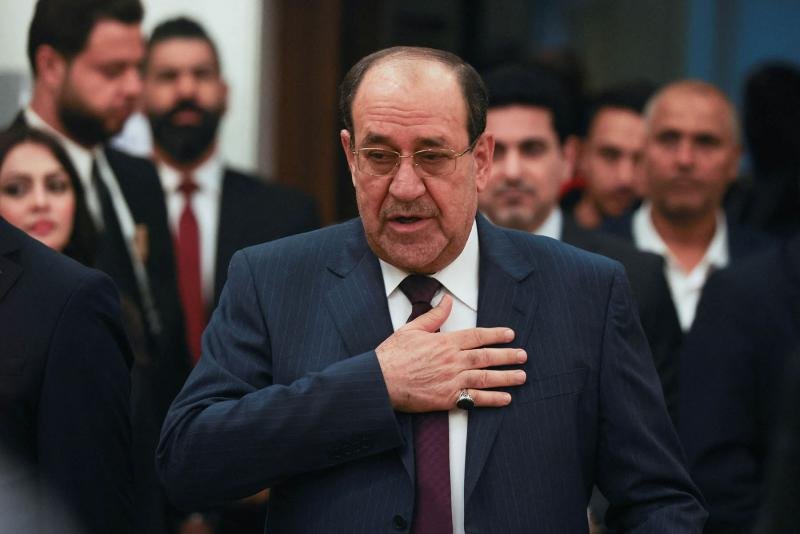
Nouri al-Maliki’s failed bid for a third term exposes Iraq’s enduring struggle between U.S. influence and Iranian power. Trump’s veto, rooted in Maliki’s sectarian legacy and Iran alignment, reaffirms that the American-backed state—not the Iranian proxy—still defines Iraq’s framework.
From civil war to ISIS, and from U.S. ally to Iranian proxy, al-Maliki’s political rise and fall reveal the high-stakes struggle shaping Iraq’s future – and why the American-backed state still endures.
So that Iraq does not return to the cycle of tutelage.
Nouri al-Maliki, leader of the Islamic Dawa Party, failed in his efforts to return to the Iraqi prime ministership for a third term. Yet the most striking aspect is that the failure of the man, who also heads the ruling Shiite coalition, seemed to signal the end of the political career of one of the most controversial and divisive figures in new Iraq.
His first term began amid civil war, and his second term ended with ISIS occupying a third of Iraq’s territory. From his opponents’ perspective, he safeguarded himself from legal accountability through the deep state he had built.
When U.S. President Donald Trump refused to support al-Maliki’s reappointment as Iraq’s prime minister, he was clear in stating his reasons: “His rule was an era of poverty and chaos.”
During his first term, al-Maliki impoverished the Iraqi people, and his sectarian policies plunged the country into some of the worst years of social disintegration—a legacy that persists today. Tens of thousands of Iraqis remain in displacement camps, unable to return to cities devastated by militias linked to the Iranian Revolutionary Guard.
The sectarian patient in isolation
Nouri al-Maliki grounds his political rhetoric in a sectarianism unmatched by any other hawks of Iranian-style Shiite politics. Even Hadi al-Amiri, leader of the Badr Organization and a former fighter in the Iranian Revolutionary Guard during the 1980s war, appears like a mere student in comparison.
From this perspective, Nouri al-Maliki can be seen as the embodiment of sectarianism. In 2006, the United States viewed him as its suitable man, driven by its need to confront the national resistance, which bore a Sunni guise. He embraced that role, even addressing the U.S. Congress. Yet when he sensed U.S. abandonment after President Obama’s 2011 decision to withdraw American forces from Iraq, he turned Iraq toward Iran, raising the banner of defending his sect. The sect has long been, and remains, the comfortable pillow on which he rests his head. When ISIS invaded Mosul, he fled to Iran, seeking and securing its protection.
The American Iraq: where to?
Shiite factions, including the Wisdom Movement and Asa’ib Ahl al-Haq, rejected al-Maliki’s nomination for a third term, fearing it would reopen previously closed chapters in Iraq’s relationship with the United States, which played a key role in establishing and safeguarding the political system.
These fears have only intensified amid escalating U.S.-Iran tensions. Ayatollah Ali Khamenei’s endorsement of al-Maliki’s nomination signaled the start of a new phase, with Iraq potentially becoming a direct member of Iran’s sphere of influence. The United States responded through its Republican president, who warned of a return to the “guardianship square.” Trump made it clear that the U.S. would withhold engagement with the Iraqi government if al-Maliki assumed leadership, specifically indicating that the U.S. Federal Reserve would halt financial support to Iraq.
Considering all these facts, any discussion of U.S. intervention in Iraq’s internal affairs serves to mislead and obscure the reality of the past twenty years—the lifespan of the sectarian regime that al-Maliki, with his extremist tendencies, sought to portray as the foundation upon which the state is built.
What the official Iraqi media fail to mention is that President Trump acted to protect Iraq and its resources when he refused to engage with an Iraqi government that had become an Iranian proxy. Referring back to the strategic framework agreement that al-Maliki himself signed with the U.S. in 2008, everything returns to its origin: the principle of guardianship, which obliges the Iraqi state to operate within the limits the United States allows in its engagement with the wider world.
In this sense, the sectarian state that Nouri al-Maliki sought to establish falls outside the historical framework that continues to govern the new Iraq. The American-backed Iraq still stands, as Trump himself affirmed.