
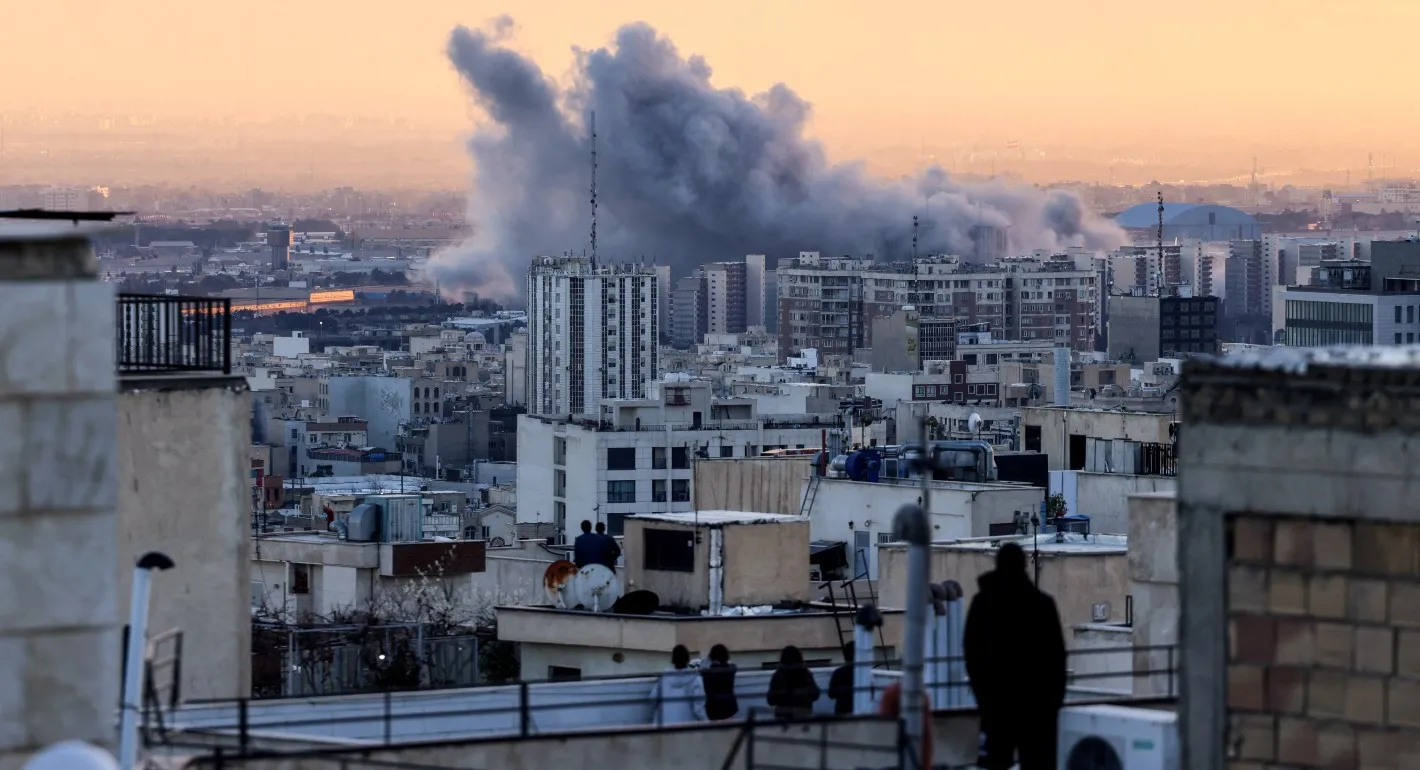
History warns: weakening Iran through bombing won’t bring democracy or stability. Without a clear post-war plan—unlike the 1991 Madrid process—the US risks creating a vacuum, leaving an injured, anti-West Iran and an emboldened Israel with only a military strategy, ensuring future chaos.
As the war on Iran continues to engulf the Middle East, the scope and goals of the United States and Israel in the operation remain murky. President Donald Trump has oscillated between claiming he is not after regime change to later seeming to adopt the Israeli position that regime change was indeed a main target. But without clear objectives, the war will not bring peace to the region—only further instability and violence. The history of the region provides many examples of what happens without clear objectives or shifting goals. It should be a guide to roads to avoid, and those that should be taken, if peace and prosperity are to be the final objectives.
Take the Madrid process as an example. In 1991, President George H. W. Bush realized, even as he assembled a coalition of thirty countries to get Saddam Hussein out of Kuwait, that the introduction of American forces in the region fighting an Arab country would not be popular among many Arabs. As a result, he decided that changing the Iraqi regime was not a desired U.S. objective and limited the scope of the U.S. forces’ presence.
Almost immediately after the successful campaign to liberate Kuwait, the United States put together an impressive effort to bring all sides of the conflict to the negotiating table, both as a way to appease the region and as an attempt to bring it peace—as much of the regional instability stems from the conflict between Israel and its Arab neighbors. The United States presided over what became known as the Madrid process, where the Palestinians, Jordan, Syria, and Lebanon started a negotiations process with Israel to try to bring about a comprehensive solution to the Arab-Israeli conflict, with the United States acting as the main broker among them.
One can argue about the successes and failures of the Madrid process, but there is no question that it ushered in an era of hope, brief as it might have been, where all sides believed a peaceful solution might be finally at hand—particularly as the United States was willing to act not just as a convener, but as a guarantor of the whole process.
The same U.S. administration hoped that the decimation of the Iraqi army in 1991 would result in Iraqis rising against their dictator and ending a brutal regime. The Bush White House decided against putting boots on the ground to march into Baghdad but hoped that change would come from within. Indeed, some Iraqis in the south did rise against Hussein’s regime, only to be murdered, despite the significantly weakened Iraqi system.
Saddam Hussein managed to survive until 2003, when the United States waged an all-out war to depose the Iraqi leader, under false accusations that Iraq possessed weapons of mass destruction, and brought about regime change through a major ground and air offensive. The demolition of the Iraqi regime, together with the total disbanding of the army and the bureaucracy, created a vacuum that Iraq still feels the consequences of today. In other words, weakening or changing regimes without a clear and effective strategy for the alternatives often results in chaos, not freedom.
This is not a Madrid moment, if we are to use history as our guide.
Neither the Trump administration, nor the government of Israeli Prime Minister Benjamin Netanyahu, are interested in any post-war diplomatic initiative to try to bring about peace to the region. In fact, the Israeli governing coalition is likely to be more emboldened by its military hegemony and will continue to keep the region divided, alongside designs to annex most of the West Bank and drive the Palestinians out.
Trump, on the other hand, has not shown any appetite to lead a serious international effort to end the Israeli occupation, establish a two-state solution, and bring peace, prosperity, and stability to the region—beyond lip service. Trump is more likely to declare victory in few weeks over Iran and simply move on, without any understanding of or care for the dangers of power vacuums or the deeper conflict with Israel at stake. Iranians, and people of the region, would then be left to pick up the pieces before the next round of violence, rather than be given hope that the region might finally witness an era of stability and peace.
Iraq 1991 has also taught us another lesson: Weakening central authority through aerial bombardment does not bring regime change, freedom, or democracy to the region. Neither does regime change without a clear plan.
The Iranian regime, much like the old Iraqi regime, is well entrenched in the country, even if it is not popular among many. Changing it is not as easy as killing Ayatollah Khamenei, especially with the presence of the deeply rooted Islamic Revolutionary Guard Corps, in parallel with a strong theocratic bureaucracy. The new Iranian leader is not going to be a democratic leader or the son of the late Shah (who is not exactly popular himself in Iran), but rather a weakened ayatollah or military leader.
Much as in 1991, what we are likely to see next is not regime change but a badly injured and equally anti-West Iran. The conflict will leave behind an angry Iranian population, both among supporters of the regime who will be more anti-American than before and opponents of the system, who will feel that they were let down by the president. That is a formula for more instability and strife rather than one that offers hope for a better future.
Meanwhile, the region will have to contend with an Israel that only has a military strategy of dominating the whole region by force, without any interest in political compromises that will bring about peace or prosperity. The Israel of today has no political project, only a military one that assumes it can keep on surviving by power alone. Annexing all or most of the West Bank is likely to be the next battle, with catastrophic consequences not only for the Palestinians and for Jordan, but also for Israel itself. Ruling as a Jewish minority over a Palestinian majority in what has become an apartheid system cannot be sustainable. Israel’s military power without a parallel vision to have it coexist in the region might prove to be self-destructive. In the meantime, however, Israel’s military hegemony will only lead to further instability and violence in the region.
The Iranian regime does not have many friends among its neighbors, with forces such as Hezbollah, the Houthis, and the Iraqi-armed Shia groups aside. Its targeting of not only U.S. military installations but also civilian infrastructure has turned its relations with Gulf countries even more hostile than before, despite recent attempts at rapprochement.
This is not an argument, therefore, in the defense of the Iranian regime. History, for those who care to heed its lessons, teaches us that regime change without clear objectives and an effective plan might end up achieving the exact opposite of peace and prosperity.