
Trump’s regime-change goal requires ground forces he refuses to commit. Airpower alone—even with two carrier groups—cannot topple Iran. It can punish, but not control. Without boots on the ground, any campaign becomes an indecisive air war.
The Trump administration seems to see three interests at stake vis-à-vis the Islamic Republic:
One, the administration espies a humanitarian motive. President Donald Trump vowed to intercede should the regime slaughter protestors who rose in January. He refrained from explicitly endorsing armed force but did threaten “very strong action.”
Two, Trump has pivoted back to the Iranian nuclear-weapons program since then. He has proclaimed that “really bad things” will happen if Tehran refuses to conclude a “meaningful” agreement terminating its nuclear-weapons aspirations. “They can’t have a nuclear weapon,” said the president, “it’s very simple.” The latest round of nuclear talks convened on Thursday in Geneva.
And three, Washington wants to curb, if not eliminate, the sizable Iranian arsenal of conventionally armed ballistic missiles. Iran lobbed some 550 ballistic missiles at Israel during last summer’s short, sharp 12-Day War, along with around 1,000 drones. But over 1,000 missiles remain, according to Israel Defense Force estimates. Supreme Leader Ali Khamenei has stated vehemently that Iran’s missile inventory is nonnegotiable. “No one can make the slightest encroachment on our missiles,” the ayatollah declared. “Our missiles are not a subject of negotiation and will not be.”
Iran Won’t Give an Inch Through Diplomacy. That Leaves Military Action.
How to solve all three problems in the Persian Gulf? Let’s review them again. The slaughter against which the president warned has happened. By some accounts, security forces massacred upwards of 30,000 protestors on January 8-9 alone. Some allege that the regime may have even deployed chemical weapons to quell the uprising. Untold more Iranians were doubtless imprisoned and face a grim fate. Having issued a threat—and put his credibility on the line—Trump almost has to order military action. Otherwise, few will take his next threat or promise seriously.
Next, it is hard to envision Iran’s clerical rulers foreswearing their nuclear-weapons program, even under severe duress. After all, the mullahs have regarded it as a core national interest for decades. They insist on Iran’s right to use atomic power for peaceful purposes. Complicating matters, this is a right sanctified in international law, specifically by the Nuclear Nonproliferation Treaty of 1968. Tehran has repeatedly invoked that right as cover for efforts to enrich uranium to weapons grade, far beyond the degree of enrichment needed to fuel a power plant. To forsake a core interest—especially at the behest of a hated enemy—is a tough ask for any national leadership.
Nor, as Khamenei insisted, is the leadership likely to surrender the Islamic Republic’s ballistic missiles. With no navy or air force of any consequence, the missile force is Iran’s only martial implement with any real heft. That makes missiles a survival interest for the clerical regime. Ergo, conventional disarmament also looks like a nonstarter. That leaves forcible disarmament. Evicting the regime from power seems to be Washington’s only viable route to punish, denuclearize, and disarm the Islamic Republic.
America Has an Armada in the Middle East—but No Ground Forces
Suppose this diagnosis of the diplomatic impasse is correct. Let’s project how a regime-change campaign would unfurl and what prospects for success it would stand. It’s abundantly clear there will be no major ground component to any campaign. No amphibious ready groups accompany the naval forces in the region, so US Marines will not be landing on foreign shores. (Marine aviators do fly F/A-18 Hornet fighter jets from the carriers USS Abraham Lincoln and USS Gerald R. Ford.) The Army will not be marching overland into Iran through one of its neighbors. It is conceivable there could be some sort of special-operations raid on the Venezuela model, although a raid meant to unseat Iranian rulers would pose challenges of a higher order altogether than mounting a snatch-and-grab operation to apprehend a single bad actor.
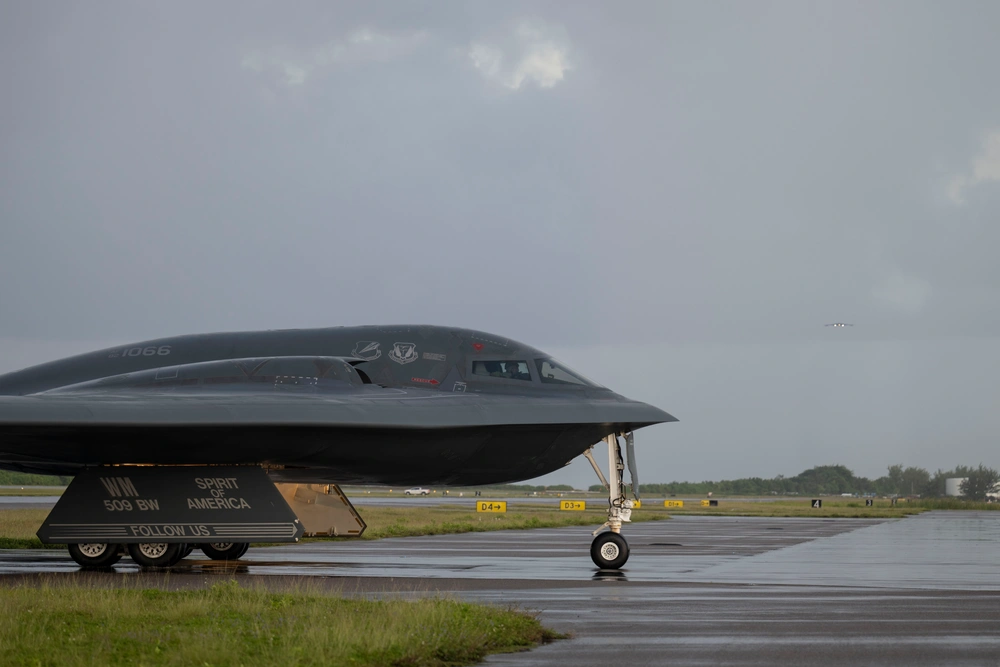
That leaves air and missile power. US Air Force tactical aircraft have been flowing into the Middle East and Indian Ocean in sizable numbers and capability, while questions linger about whether US allies and partners would permit the Air Force to launch bomber strikes from bases on their soil. It is possible to hit Iranian targets from airfields as far away as Missouri, as Operation Midnight Hammer, last summer’s aerial assault on the Iranian nuclear complex, demonstrated. But ultralong distances would severely limit the sortie rate—and thus the ordnance delivered on target—during a more than one-and-done air campaign like Midnight Hammer. With just 19 B-2 stealth bombers in the Air Force inventory, non-stealthy B-52 and B-1 bombers would presumably need to take part in a prolonged bomber offensive to deliver enough firepower. Israeli forces degraded Iranian air defenses last summer. US forces would need to further suppress or destroy them to permit non-stealthy strategic and tactical air power to get into the action.
And then there’s the US Navy contingent. As of February 23, the Lincoln battle group was hovering south of the Arabian Peninsula while the Ford group was prowling the Eastern Mediterranean. Between the two, that’s roughly an additional 150 warplanes of all types, including F-35C Lightning II stealth fighters on board Lincoln. It’s unclear whether the Pentagon will direct Ford to remain in the Mediterranean Sea, presumably to defend Israel—or to proceed through the Suez Canal into the Red Sea, thence to join Lincoln closer to the potential battleground. The latter would substantially augment US striking power.
These are impressive air forces by any standard, but could they alone oust the Islamic Republic?
How Much Difference Does Air Power Really Make?
Whether air power is a decisive implement of war is a question that has vexed strategists since the inception of military aviation over a century ago. Such advocates as Colonel John Warden, a legendary architect of the Desert Storm air campaign, would reply with a resounding Yes! Aviators should go into any conflict presupposing that air power can do it all. In brief, Colonel Warden maintains that air forces can strike directly at hostile centers of gravity such as the political leadership from aloft. In so doing they can yield outsized strategic and political results while holding down the time, cost, and sheer destruction that comes from unleashing warlike means.
Admiral J. C. Wylie, another legendary figure in the strategic realm, would beg to differ from Warden on this point. Admiral Wylie depicts air (and oftentimes sea) power as “cumulative” modes of warfare, meaning air forces strike at many targets dispersed all over the map. He posits, in effect, that no individual attack will stun an antagonist’s leadership or populace into submission, let alone drive the leadership from power. Each is too small in scale, its psychological impact too meager. For Wylie the purpose of military strategy is to control what needs to be controlled on the surface, and the soldier or Marine is the only arm of military might able to control geophysical space. Soldiers go, and stay. That’s control.
Wylie faults air-power proponents for assuming that the ability to bombard things from the heavens equates to control, and thus to strategic success. In a more general sense he maintains that cumulative operations are indispensable enablers for “sequential” operations that pound away repeatedly at the foe and ultimately yield control. But the cumulative approach is indecisive in itself. It is only a difference-maker for the real campaign elsewhere.
The Warden vision of decisive aerial operations nurtures an optimistic view of the prospects for an air and missile campaign to expel the Islamic Republic from power, while the Wylie vision would be far less sanguine. Now, admittedly, Wylie wrote his landmark treatise Military Strategy in the 1960s, in the closing years of the pre-precision-arms age. It may be that he might rethink his appraisal of air power’s potential were he among the quick today. But I don’t think so. He firmly believed that ground forces were the final arbiter of victory—and I agree.
If Wylie prevails over Warden in this debate, any air campaign is likely to be drawn-out by contrast with Midnight Hammer, its strategic and political prospects uncertain. In that sense these contending theories of air power are—apparently—about to be put to the test in the Gulf.