
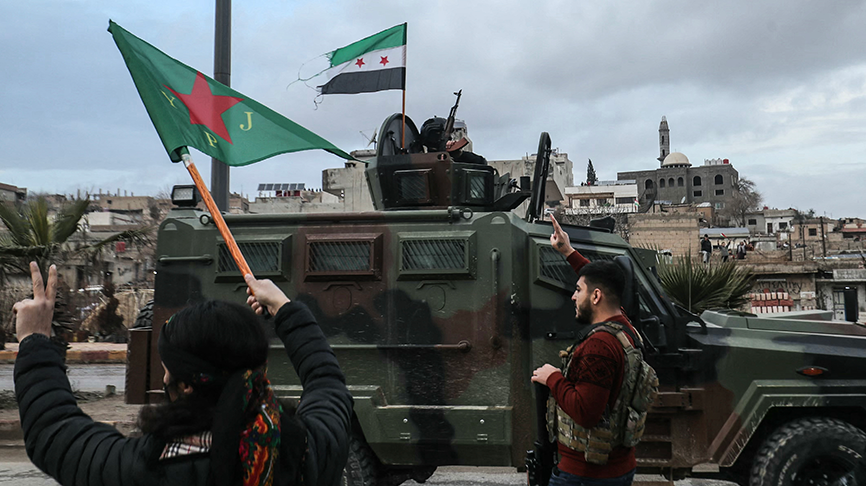
Ahmed al-Sharaa’s government recently consolidated its territorial control by signing an advantageous ceasefire agreement with the Syrian Democratic Forces. Whether it can translate this military success into political stability depends on Syrians’ trust in the new security apparatus.
In just over a month, the military and political balance of power in Syria has shifted decisively in favour of the new authorities in Damascus, as they begin the delicate implementation of the 30 January 2026 deal that will end Kurdish control of northeast Syria. This stunning development was the result of the main Kurdish force’s miscalculations, Damascus’s ruthless opportunism, and shifting American policy amid regional support for centralised governance. The government’s approach to consolidation will now be put to the test: can it deploy sufficient resources and political acumen to convince distrustful constituencies, or will it rely primarily on coercion?
The road to conflict
Since coming to power in Damascus in December 2024, the leadership of Hayat Tahrir al-Sham (HTS) has obtained regional and international recognition as well as the lifting of Western sanctions. These significant achievements have so far failed to translate into meaningful reconstruction and prosperity, as the transitional government remains hobbled by the resistance of armed groups across the country. The most powerful such organisation has been the Kurdish-dominated Syrian Democratic Forces (SDF), which as of December 2025 controlled a few neighbourhoods in Aleppo and, more significantly for Syria’s rehabilitation, the oil- and resource-rich northeast. Since the beginning of their joint campaign against the Islamic State (IS) in 2014, it has also benefited from support and protection from the United States.
Tensions between HTS and SDF preceded the former’s lightning victory against Bashar al-Assad’s regime. They differ over identity, ideology and project: the former is an Islamist Salafi Arab movement rooted in localised jihadism that positions itself as the protector of Sunni Islam and espouses Syrian nationalism; the latter is a Kurdish leftist, nationalist movement backed by the Kurdistan Workers’ Party (PKK), intent on achieving autonomy, if not statehood. Deep distrust between the two sides has only grown, with Turkish-backed armed groups that the SDF spent years fighting along its borders folded into the new HTS-led Syrian military.
Damascus’s quest for political and territorial control was challenged by the decentralised and federal models that Kurdish factions advocated for to fend off Arab political chauvinism. The SDF remained eager to maintain its armed status, territorial control, access to oil revenues and autonomous administration. It is no surprise, then, that an initial agreement reached in March 2025 between the two groups’ commanders was not implemented. In retrospect, this was the climax of SDF leverage: the US had not yet embraced transitional President Ahmed al-Sharaa, and his path to regional acceptance looked complicated.
Shifting US policy
For years, the SDF relied on US support as the best way to keep Turkish pressure at bay, counter rivals in the Syrian arena and expand support among the Arab population. It was successful in doing so largely because the military and counter-terrorism communities in Western countries valued and rewarded its role in the fight against IS. During his first term, US President Donald Trump tried to disengage from the Syrian theatre, but diplomatic, intelligence and military bureaucracies resisted this.
Despite regular US messaging that the relationship was transactional and operational, the Kurdish leadership presumed that its US support would continue post-HTS victory based on Western and Arab countries’ reluctance to embrace a leadership that originated in al-Qaeda. The opposite happened because all these players, first among them the US, were eager for a strong authority on which the management of Syria could be offloaded. SDF demands were increasingly seen as maximalist and out of sync with regional dynamics.
US Special Envoy for Syria Tom Barrack increasingly drove this agenda, seeking to solidify a regional consensus, anchored by Turkiye and Saudi Arabia, in favour of centralised governance on Damascus’s terms. Kurdish attempts to court Israeli support and to link up with the Druze groups challenging Sharaa in southern Syria did not amount to much, in part because of US opposition.
In contrast, the transformed HTS leadership has pragmatically aligned itself with this vision. The message Damascus broadcast to Washington was that the more control over Syria it achieved, the easier it would be for the US to withdraw its forces. There were three corollaries to that approach. Firstly, Washington pushed for a security agreement with Israel, which Damascus remains keen on despite Israel’s maximalist demands. Secondly, Washington asked for a commitment to fight residual Iranian influence, to which Damascus is completely committed. Thirdly, the US asked Syria to join the counter-IS coalition, which Sharaa did despite concerns about capacity and reliability, given the make-up of the new Syrian army.
It was therefore unsurprising that the new authorities’ campaign in the northeast attracted little criticism in the US executive branch, despite allegations of exactions by the Syrian forces. Barrack assessed publicly that the SDF’s role in fighting IS had ‘largely expired’. Trump was quick to call Sharaa on 27 January 2026 and laud his achievements.
The new dispensation of power
The SDF’s complacency in the face of momentous changes was fatal when paired with thinning domestic credibility. Wrongful arrests in Sunni communities in the northeast and a doubling of IS attacks in early 2024 progressively undermined trust in the SDF’s anti-IS narrative. Although marketed to Western audiences as defenders of a democratic model of governance, the SDF has repressed revolutionary and pro-unification sentiment. After years of frustration at SDF economic mismanagement, discrimination and isolation, many Syrians, mostly Arabs but also some Kurds, did not want to miss out on the potential prosperity promised by Damascus.
Despite apparent military parity between government and SDF forces, the former proved considerably more cohesive than the latter. By appealing to Arab tribes, the government was able to chip away at the fragile military structure the SDF had built incrementally since 2014. The SDF’s exclusion of non-Kurds from positions of military leadership, even as Arabs constituted most of its manpower, produced transactional relationships. HTS exploited the resulting grievances to subvert its rival. Using the same tribal connections that facilitated its covert entry into Aleppo in November 2024, the government flipped tribes under SDF control, including the prominent Shammar tribe’s al-Sanadid militia.
Once the SDF was forced to withdraw east of the Euphrates, the government could rely on small units of fighters with personal ties to local communities. Crucially, this included resource-rich areas in the eastern Deir Ezzor province.
In the face of defeat, the SDF tried to evoke global solidarity for the Kurdish community through a nationalist fight for the Rojava region in early 2026. Contrary to the 2014 IS onslaught, this did not generate any real material or political support. This time, global attention was focused on Greenland, Sudan and Venezuela, and most governments were supportive of Damascus’s drive toward centralisation. Exactions by government forces were limited in number and certainly did not compare to IS brutality. Regional Kurdish factionalism weakened the SDF’s standing. Iraq’s Kurdistan Democratic Party intervened to mediate between the SDF and Damascus. The Kurdish National Council, which has opposed the dominance of the PKK’s Syrian offshoot, the People’s Protection Units (YPG), returned to the fore.
Ultimately, the US and regional powers chose to give Damascus the benefit of the doubt regarding assurances it gave to minority groups over protracted support for a militarised Kurdish faction. The reasoning goes that Damascus’s quest for investment and regional integration, contingent on the government’s good behaviour, would compel it to uphold standards for political representation and the cultural and religious rights of minority groups.
The agreement
The ceasefire agreement signed on 30 January 2026 ended the fighting but provides a hybrid and possibly awkward security regime. It contains enough ambiguity to unravel due to lingering mistrust and misperceptions, but enough compromises from Damascus to secure YPG buy-in in the short term. If the YPG retains the capacity to mount an insurgency in northeast Syria, it would, however, be isolated and outflanked by Turkiye if it did so.
A key point of contention between Damascus and the SDF has been how to integrate SDF forces into the new Syrian security apparatus. The SDF wanted to retain its organisation, chain of command and territorial control, while Damascus has pushed for the disbanding of units and the integration of fighters on an individual basis. The agreement allows for small SDF internal security units in Hasakah and Kobani to operate alongside Syrian interior ministry forces with overlapping authority. On the ground, however, this arrangement is facing challenges, notably in Kobani, a comparatively more combustible area than Qamishli.
This reflects a key government limitation: the lack of reliable manpower in sufficient numbers for high-stakes missions. Senior HTS officials trusted by Sharaa have been sent from Damascus to run the northeast, but the government is co-opting local groups once aligned with the SDF for local missions in the short term, including the protection of oilfields, roads and towns across the northeast. In the medium term, such functions would be filled by a reformed national military and private security groups.
The government is unlikely to overturn the deep mistrust among Kurdish communities quickly, if at all. The level of discipline and the avoidance of revenge acts will determine to a large extent popular responses to Damascus. Having acknowledged Kurdish cultural rights, Damascus must now think about sharing oil revenues and empowering local administration.
How Damascus deals with the northeast has direct implications for its plans elsewhere in the country. Violence or failure in the northeast would solidify Alawite and Druze opposition in coastal and southern areas and sour relations with Western countries. A political approach that alleviates local anxieties and ensures discipline among government forces would make it easier for Damascus to reassure Alawite and Druze communities. However, some hardliners in Damascus may interpret their victory in the north as a validation of ‘integration through coercion’ and push for a repeat elsewhere. The central government faces a simple truth: its economic and integration ambitions cannot be met if political instability and insecurity persist along its various borders.