
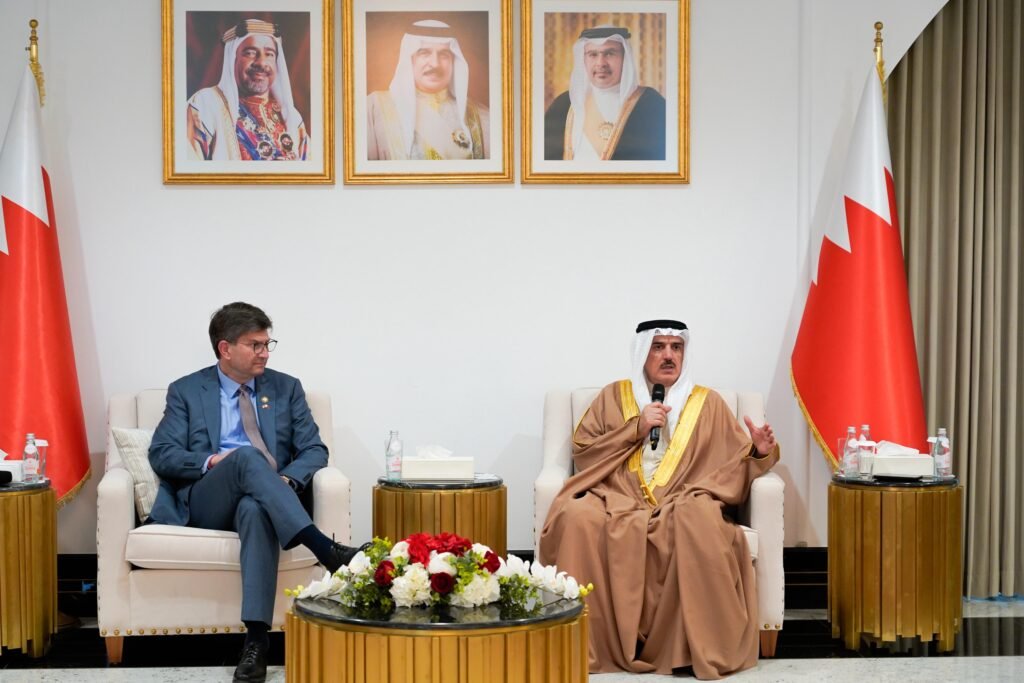
I returned last week from a week in the Middle East with a bipartisan Congressional Delegation organized by the N7 Initiative, a partnership of the Atlantic Council and the Jeffery M. Talpins Foundation.
The delegation’s visit coincided with a historic period of upheaval in the Middle East, as Israel and Iran squared off in a direct military confrontation that is likely to alter the contours of the region for decades to come. Our delegation—led by Representative Brad Schneider, as well as Representatives Don Bacon, Jimmy Panetta, and Zach Nunn—visited the countries stuck in the middle of this confrontation: Saudi Arabia, Bahrain, and the United Arab Emirates (UAE).
Over the past several years, all three countries have simultaneously sought to de-escalate tensions with Iran while expanding their cooperation with Israel to varying degrees, all in an attempt to maintain space for ambitious domestic economic and social reforms. The war in Gaza had already complicated some of these efforts, as Gulf leaders managed growing domestic anger over the situation for Palestinians. But now, the Gulf countries find themselves on the front lines of a conflict that could shatter the delicate balance they have sought to maintain between Israel and Iran, and disrupt their domestic stability.
As the United States, Israel, and Iran navigate a period of unprecedented confrontation following the June 21 US strikes on Iranian nuclear facilities and June 23 Iranian retaliation, these Gulf states could get caught in the crosshairs. The Iranian attacks already targeted a US base in neighboring Qatar, and Bahrain and the UAE were forced to close their airspace amidst the exchange of missiles.
At the same time, Israel’s attacks have weakened the regime that has posed a significant threat to all three Gulf countries, and US President Donald Trump’s attempts to use the confrontation to extract a stronger Iran nuclear agreement could finally remove the potentially existential threat of a nuclear-armed Iran. While Iranian leaders announced that Trump “destroyed diplomacy” following the US strikes, the fragile cease-fire announced by Trump on June 23 suggests there may still be an offramp to a negotiated solution that both prevents an all-out regional war and addresses the Iranian nuclear threat.
The razor’s edge: Realizing the promise of regional integration
This is the razor’s edge on which the region now sits: If the Iranian regime determines that it must choose between its own survival or its nuclear program, and selects the former, it will finally remove a major driver of the reigon’s decades-long destabilizing conflicts and eliminate a key obstacle to continued regional integration.
This is precisely the vision for the Middle East that the congressional delegation and the N7 Initiative came to promote: regional integration that bridges regional fissures, particularly those between Israel and its neighbors, and unlocks the enormous economic and geopolitical potential of the region at the crossroads of Europe, Africa, and Asia.
On the other hand, should the war expand and drag in Arab Gulf countries, push Iran to accelerate its production of a nuclear weapon, and/or lead to widespread instability inside Iran itself, it could disrupt hard-fought progress towards regional de-escalation and integration. While even a fragile cease-fire is a positive step in the right direction, only a comprehensive negotiated agreement can stave off the latter two scenarios and prevent a simmering regional conflict that will threaten positive developments—not just in the Arab Gulf, but also in places like Syria and Lebanon that are taking promising but still nascent steps towards greater stability.
Three takeaways from our visit
The delegation’s visit and conversations with senior officials in all three countries drove home three important points about the path forward.
First, that amidst a fierce political debate in Washington on the US approach to Iran—which is deepening divides between the left and the right, and creating new divides within the Republican party—there is an actionable middle ground. Throughout the trip, the two Democratic and two Republican Representatives consistently delivered a common message: that the United States must avoid getting dragged into another war in the Middle East, and that the outcome of the current conflict must address the threat of a nuclear-armed Iran. Rather than getting sucked into partisan political debates, the delegation focused on articulating these desired end-states and engaging in a dialogue with Middle East partners on the best way to achieve them.
It was clear to me from this dialogue that a negotiated solution presents the best path for achieving both objectives. While pressure may be necessary to secure an acceptable negotiated outcome, uncertainty about the extent of the damage from US strikes inflicted on Iranian nuclear facilities combined with reports that Iran had already relocated its highly enriched uranium stockpiles, underscore the limitations of a purely military approach.
Second, that the United States will only succeed in navigating out of the current turmoil if it learns from its past mistakes and works more closely with its Arab Gulf partners on a negotiated solution, in addition to Israel. One of the weaknesses of former US President Barack Obama’s Joint Comprehensive Plan of Action (JCPOA) was that it was not sufficiently coordinated with these partners on the front lines. Ten years later, Arab Gulf countries are better poised for partnership in these negotiations.