
The speed and scale of last weekend’s U.S.–Israeli strikes on Iran took most European governments by surprise. After leaving Europe in the dark about the capture of Venezuelan leader Nicolás Maduro, the United States launched a major military operation in the Middle East with little to no consultation with its allies in Europe, while expecting to use their bases and receive their broad support. Once again, European leaders found themselves scrambling to react to a conflict they had neither anticipated nor prepared for—and one in which they had little direct leverage. The result has been a strikingly disjointed European response.
The United Kingdom (UK) has adopted a carefully balanced transatlantic posture, opting to combine criticism of the Iranian regime with calls for de-escalation. This approach has made nobody at home happy and invited the ire of U.S. President Donald Trump. Prime Minister Keir Starmer emphasized that Britain did not participate in the strikes themselves and initially restricted the United States’ use of its Diego Garcia military base in the Chagos Islands. But London has since reaffirmed that U.S. forces can use its base to defend their regional allies and provide for Israel’s security, and it has gone on to provide defensive military support in the region while urging diplomatic efforts to prevent a wider regional war.
France has taken a more legally critical stance. President Emmanuel Macron has warned that military action conducted outside international law risks undermining global stability and called for emergency discussions at the United Nations Security Council. At the same time, Paris has avoided direct confrontation with Washington and strongly condemned Iranian retaliation. Macron also ordered France’s Charles de Gaulle aircraft carrier and other military assets to be sent to the region to protect French interests, especially its Camp de la Paix base in Abu Dhabi, which hosts French Rafale fighter jets, surveillance assets, and army training units. France’s response hence tries to defend the principle of international legality while maintaining strategic alignment with the United States.
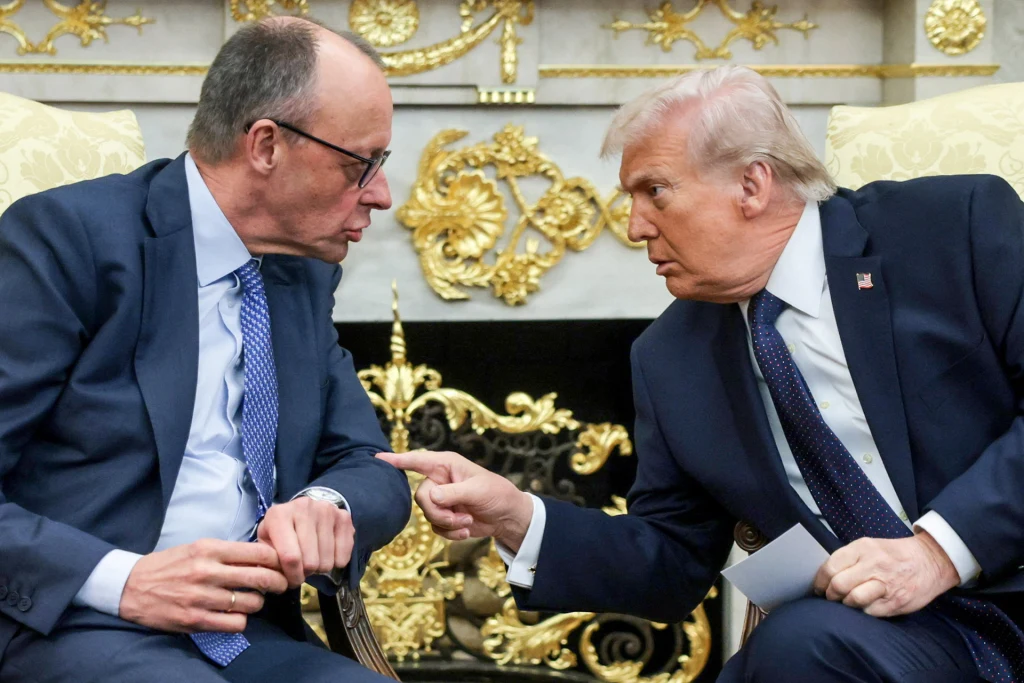
Germany’s position has been more sympathetic to the underlying goals of the United States and Israel in their new joint military operation in the Middle East. Chancellor Friedrich Merz has described Iran as a major security threat and argued that decades of sanctions and diplomacy have failed to halt Tehran’s destabilizing activities. While Berlin joined France and the UK in their calls for restraint, Merz has also emphasized that Western governments share an interest in preventing Iran from acquiring nuclear weapons and supporting regional militant groups. “Now is not the moment to lecture our partners and allies,” he said before flying to Washington earlier this week. During his visit to the White House, Merz mentioned that they were “on the same page” but stayed quiet when Trump criticized some of his European counterparts. He emphasized Germany intended to work with the United States to prepare for “what will come the day after” the conflict.
In Southern Europe, governments have been more openly critical. Spain’s Prime Minister Pedro Sánchez strongly condemned the attacks and refused to allow U.S. forces to use Spanish bases for military operations against Iran. Even after Trump threatened to “cut off all relations” with Spain, Sánchez doubled down. Italy’s government has also raised legal concerns about the strikes, with Defense Minister Guido Crosetto describing them as inconsistent with international law. Although Rome remains politically close to Washington, the episode has exposed lingering European discomfort with unilateral military action.
Poland, by contrast, has offered clear political backing for the operation. Polish President Karol Nawrocki has framed the conflict primarily through a security lens, arguing Iran’s actions pose a broader threat to international stability. Similar voices of support have come from other parts of Eastern Europe, including the Baltics, the Czech Republic, and Romania. Poland’s position reflects its broader strategic alignment with Washington on matters of defense and deterrence.
Taken together, these responses reveal a Europe that remains deeply divided on questions of military intervention and the use of force. But the lack of a unified European reaction also reflects the fundamental reality that Europe has relatively limited strategic weight in the conflict itself and faces an increasingly strained relationship with its most important ally, the United States.
At the start of 2026, European leaders had hoped to finally turn the page on what many privately described as a humiliating year of “appeasement” of the Trump administration. In 2025, European governments largely tried to avoid confrontation or escalation with Washington, even as U.S. policy toward its allies became increasingly hostile. As Nathalie Tocci and I argued in the previous issue of Foreign Affairs (“How Europe Lost”), Europe’s strategy amounted to little more than a holding operation—an attempt to buy time while bending the knee to Trump to avoid open conflict with the United States.
By early 2026, however, that approach appeared to be changing. European governments had begun taking active steps to act more independently. In late December 2025, the European Union (EU) agreed to a €90 billion loan package to sustain Ukraine’s war effort against Russia through 2026 and 2027 via joint debt issuance, marking one of the largest collective financial commitments ever made for European defense.
At the same time, the EU pushed back against Trump’s threats to Denmark’s sovereignty over Greenland in mid-January 2026. When Washington threatened to impose new tariffs on eight European NATO members in connection with that dispute, the EU quickly responded with coordinated retaliatory measures. For the first time since Trump returned to power in 2025, Europe seemed prepared to defend its interests more assertively.
The Iran conflict poses a fresh curveball for European leaders. For most governments on the continent, the central geopolitical priority remains the war in Ukraine. In that context, the U.S.–Israeli conflict with Iran produces both opportunities and risks. On the one hand, Iran has been a key supplier of drones and other military equipment to Russia. A conflict that forces Tehran to divert resources toward its own defense could reduce that support. On the other hand, the war has already contributed to higher energy prices, which benefit Russia’s export revenues and strengthen Moscow’s ability to finance its war effort. Equally important, the new conflict risks distracting Washington from the European theater. For governments across the continent, continued U.S. engagement in the defense of Ukraine remains essential. From their point of view, a prolonged Middle Eastern “war of choice” pulling U.S. attention and resources away from Europe would be deeply unwelcome.
There is also the issue of trade. Following the U.S. Supreme Court’s recent decision to strike down the Trump administration’s use of tariffs under the International Emergency Economic Powers Act (IEEPA), European governments are wary of provoking a new transatlantic trade confrontation. For many policymakers in Brussels, Berlin, and Paris, maintaining a stable economic relationship with the United States has become an urgent priority at a moment of heightened global economic uncertainty.
None of this means Europe has abandoned its longer-term ambition to become a more autonomous geopolitical actor. In fact, many of the structural changes currently underway point in the opposite direction. European defense spending is rising rapidly, with Germany in particular committing to massive new investments in its armed forces. The EU has also accelerated efforts to diversify its trade relationships, pursuing new agreements with partners such as India, Indonesia, and Mercosur. Meanwhile, the continent’s energy diversification—initially triggered by Russia’s invasion of Ukraine—continues to reshape Europe’s economic and strategic landscape.
Of course, these transformations will take time. Building military capabilities, developing alternative supply chains, and strengthening Europe’s economic resilience are projects measured in years rather than months. In the short term, European governments have little incentive to escalate tensions with Washington over a war they neither initiated nor control. Nor do they have much practical capacity to influence its outcome. For now, Europe’s strategy is likely to remain one of cautious distance: avoiding direct involvement in the conflict while focusing on the priorities that matter most to the continent itself.
That may not make for a particularly inspiring display of strategic leadership. But from the perspective of European policymakers, it may also be the most realistic option available at the moment.