
Iraq reinforces its Syrian border following Aleppo clashes between government forces and SDF. Baghdad fears violence could spread eastward, triggering displacement, IS prison breaks, and regional destabilization threatening national security.
Iraq is boosting its security along its border with Syria, where fighting between government forces and the SDF rages on in the city of Aleppo.
Iraq is closely monitoring developments in northern Syria and is strengthening security along its border with the neighbouring country, amid fears that the ongoing clashes in Aleppo could spread eastward.
Security decision makers warned about the possibility of violence in Aleppo spreading to other Syrian areas controlled by Kurdish-led forces adjacent to Iraq, especially the Deir Ezzour and Al-Hasakeh governorates, sources told The New Arab’s sister site, Al-Araby Al-Jadeed.
The fighting in Syria’s second city between government forces and the Syrian Democratic Forces (SDF) erupted after efforts to integrate the Kurdish de facto autonomous administration and military into the country’s new government stalled.
The SDF, the military arm of the autonomous administration, controls most of northeastern Syria – roughly a third of the country’s total land area.
Since the fighting began in Aleppo on Tuesday, at least 21 civilians have been killed, according to figures from both sides, and tens of thousands have fled the city.
The clashes have been some of the most intense since Syria’s new Islamist authorities took power in December 2024, after ousting Bashar al-Assad’s regime.
Both sides blamed the other for starting the violence in Aleppo, where the fighting was mostly concentrated in the Kurdish-majority Sheikh Maqsoud and Ashrafiyah neighbourhoods.
After the fighting in Aleppo, there are worries that the Syrian government may try to storm the northeast, bringing the war closer to Iraq.
Boosting border security
According to a senior Iraqi security official, “high-level directives have been issued to military commanders calling for a comprehensive and integrated review of the plan to secure the shared border with Syria along the Nineveh province front”, which faces areas controlled by the SDF on the Syrian side.
“This includes a reassessment of military deployments, surveillance mechanisms, and the level of field readiness, in line with the nature of potential threats.”
An official, who wished to remain anonymous, confirmed to Al-Araby Al-Jadeed that the directives are “pre-emptive”, based on Syrian assessments suggesting that Syrian army operations could, in the near future, extend to areas controlled by the SDF along the border with Iraq.
He noted that “the new plan is still under review and is based on a range of potential scenarios, including expected waves of displacement, unregulated movements by armed groups, or attempts by extremist elements to infiltrate”.
According to the Al-Araby Al-Jadeed report, Iraqi authorities fear that instability in areas controlled by the SDF could lead to the escape of thousands of prisoners affiliated with the Islamic State group (IS) or enable IS cells active in the vast Syrian desert to move into Iraq.
The SDF spearheaded the fight against IS in 2019, and many former IS members remain in SDF custody in northeastern Syria. IS has claimed several deadly attacks in Syria the past year.
Security experts say Baghdad wants to avoid a repeat of previous scenarios that saw spillover from the Syrian conflict. Iraq has been rattled by decades of insecurity.
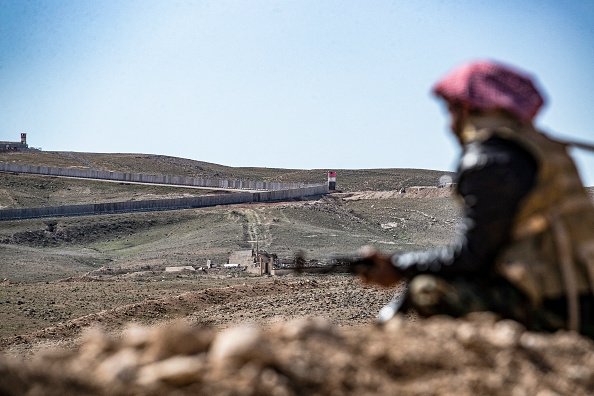
Since the fall of the Assad regime, Iraq has moved fast to complete the construction of a concrete wall along its 620-kilometre-long border with Syria. The project has become locally known as the “border closure”.
Construction of the concrete wall began in 2022, initially covering around 170 km of high‑risk sectors. Since then, Iraq has extended it and reinforced it with trenches and other barriers.
Many of Iraq’s political parties, particularly Iran-aligned Shia factions, do not view Damascus’ new rulers favourably. Many Iraqi Shia militias fought alongside Assad regime forces during the Syrian conflict.
Bringing Syria’s armed factions and regions under state control has been a massive challenge for the new government, as ethnic and religious minority groups voice concern over their future in the fractured country.
Government and government-aligned forces have been accused of committing serious human rights violations such as summary executions during sectarian clashes last year in the south and coastal region, which killed and injured thousands.