
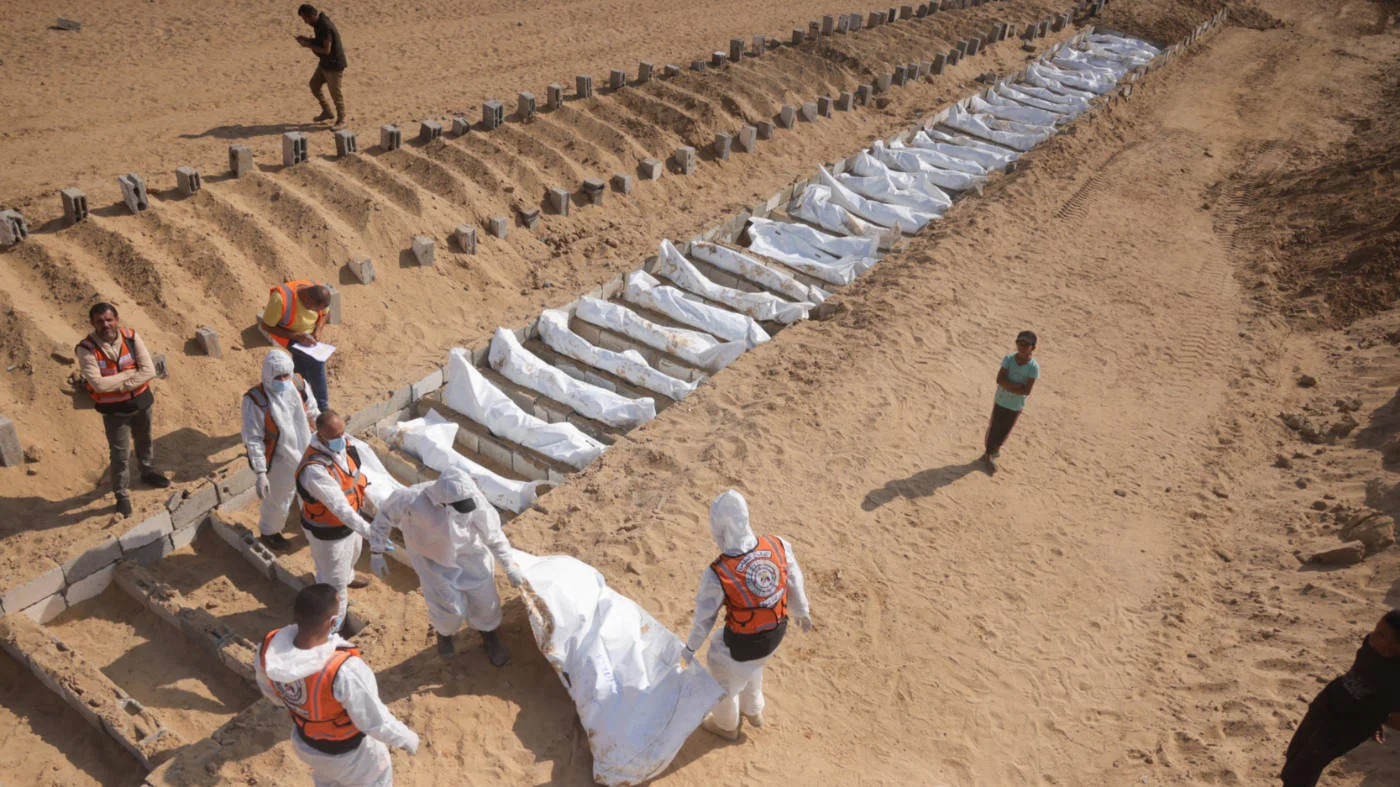
The Palestinian Ministry of Health’s death toll of 72,072 is a reliable minimum, verified by ID numbers from Israel’s own registry. Independent studies, including The Lancet, confirm significant undercounts—estimating over 100,000 killed by late 2025. Israel’s military now privately confirms 70,000 fatalities, admitting most were civilians.
Israeli forces have killed tens of thousands of Palestinians since the genocide in Gaza began on 7 October 2023.
While the Palestinian Ministry of Health of health says it documanted just over 72,000 deaths, a study published by The Lancet Global Health in February found that the true toll during the first 16 months of the conflict was likely significantly higher than official figures indicate.
The Israeli attack has been described as a genocide by major international and Israeli human rights organisations, including Human Rights Watch, Amnesty International and B’Tselem.
What is the Palestinian Ministry of Health?
The Palestinian Ministry of Health (MoH) in the Gaza Strip is the enclave’s public health authority, overseeing hospitals and other medical facilities.
It is staffed by doctors and medical professionals and operates under the local government administration in Gaza, which is run by Hamas. The ministry also coordinates with the Palestinian Ministry of Health in Ramallah.
Each Palestinian resident is assigned an identification number in accordance with Israeli-administered population registry policies.
Once the ministry confirms a fatality, the individual’s identity – including their ID number – is formally recorded as deceased.
The ministry documents only those deaths that reach hospitals under its supervision and after all identifying information has been verified.
Since the war began in October 2023, the ministry has acknowledged that many people remain buried under rubble or lie in areas inaccessible to medical teams, and therefore have not yet been officially recorded as dead.
Throughout the genocide, lists of individual names, ages, gender and ID numbers have been published by the ministry. According to the ministry, as of 22 February, 72,072 Palestinians have been officially killed.
This includes 614 killed in ongoing attacks since the “ceasefire” took effect on 11 October 2025. Another 171,741 have suffered injuries as a result of the conflict, according to the ministry.
The latest full list published by the ministry on 7 October 2025 showed that over half those killed were women, children under 18, or the elderly (those over 65).
The ministry does not distinguish between fighters and civilians.
Why do international organisations view it as reliable?
The ministry has faced significant challenges collating figures, including the forced and repeated displacement of Gaza’s population, the destruction of the enclave’s administration, and repeated outages of its IT systems.
Despite the challanges, the ministry is considered reliable by international organisations working in Gaza, including UN agencies and the World Health Organisation. Its figures are quoted without qualification in regular humanitarian reports published by the UN Office for the Coordination of Humanitarian Affairs (Ocha), which independently assesses humanitarian conditions in the strip.
In previous wars, such as the 2008-9 Gaza War and the 2014 Gaza War, the ministry’s counts have matched independent UN tallies.
Michael Spagat, professor of economics at Royal Holloway University and chair of the NGO Every Casualty Counts, told Middle East Eye that the inclusion of ID numbers in the ministry’s casualty lists means its figures are externally verifiable.
“The population registry is controlled by Israel so Israel can check instantly to make sure that everyone on this list is real,” he said.
“For casualty reporting this is an unprecedented level of transparency. So there’s no requirement that you trust Hamas. The data is there in great detail to be examined.
“Many people have examined it and, although it is possible to find flaws – inevitable in a huge data set – nobody has ever found major problems.”
But Spagat added that “it has not been possible to keep up with the sheer pace of killing in real time so we should regard MoH figures as reliable minima, not comprehensive accounts.”
Despite this, the ministry’s reporting has come under scrutiny throughout the genocide, mainly by Israel and the United States.
The figures were criticised by Israeli government and military spokespeople, including Jonathan Conricus, who said in November 2023: “Those numbers issued by the Hamas-controlled entities in Gaza are, simply put, false. They are exaggerated numbers of women, children and the elderly.”
What does the Lancet Global Health research show?
The Lancet Global Health’s study estimates that 75,200 Palestinians were killed in Gaza between 7 October 2023 and 5 January 2025. That’s an average of around 150 people per day or 3.4 percent of Gaza’s population
This is 35 percent more deaths than were recorded by the Palestinian Ministry of Health, which counted 49,090 fatalities for the same period. An official ceasefire was agreed in October 2025, although subsequent Israeli attacks have seen more than 600 killed according to the ministry.
The Lancet study estimates that an additional 8,540 people were killed by indirect results of the conflict, which includes non-violent causes such as starvation and Israeli-imposed restrictions on access to medicine and healthcare.
An estimated 12,000 further Palestinians remained missing at the time of the survey: the bodies of these are believed to be still trapped under the rubble of destroyed buildings. This brings the likely death toll by January 2025 to more than 95,000.
At least another 25,000 Palestinians were killed in the renewed war and Israeli-imposed famine between March and October last year.
The study estimates that 56 percent of those killed were women or under the age of 18 – two percent higher than the proportion recorded by the Ministry of Health records.
The paper concludes that the Ministry of Health “appears to provide conservative, reliable figures while working under extraordinary constraints”.
Why is the new Lancet study significant?
The Lancet Global Health is a subsidiary of The Lancet, which has published since 1823 and is among the world’s most prestigious medical journals.
Independent academic research into the number of people killed in Gaza has been extremely limited due to the Israeli military blockade.
Medics, human rights investigators and foreign journalists have all been prohibited from entering the strip.
The Lancet Global Health’s study is the first peer-reviewed research to provide an estimated death toll that is wholly independent of the Palestinian ministry.
What was the study’s methodology?
The researchers ensured that the survey was “population-representative” to estimate the number of Palestinians killed, rather than counting every individual death.
Researchers contacted more than 2,000 households in the enclave, which were selected to provide an accurate sample of the population.
Interviewees were asked to give details about deaths among family members, from which researchers calculated an estimate of the total death toll.
The study’s authors note that one limitation of this method is that in several instances, entire extended families had been wiped out by Israeli attacks, leaving no one to answer the survey.
The study’s authors include academics from Stanford University, Princeton University; Royal Holloway, University of London, Université Catholique de Louvain; the Palestinian Center for Policy and Survey Research, Ramallah; and the Peace Research Institute, Oslo.
Professor Spagat, who co-authored the paper, told Middle East Eye that the findings “definitively put to bed the notion that Ministry of Health figures are inflated. I would say without hesitation that the Ministry of Health figures are substantial undercounts.”
What have other studies reported?
In February 2025, The Lancet published “Traumatic injury mortality in the Gaza Strip from Oct 7, 2023, to June 30, 2024: a capture–recapture analysis”, one of the first major studies into death tolls in Gaza, authored by academics at the London School of Hygiene and Tropical Medicine and Yale University.
It estimated that 64,260 Palestinians had been killed by traumatic injury during the first nine months of the Israeli bombardment between 7 October 2023 and 30 June 2024. That is more than 40 percent higher than the ministry’s count for the same period.
That estimate was based on data collected through online surveys, ministry hospital lists and social media obituaries.
Another study, published in November 2025 by the Max Planck Institute for Demographic Research in Germany and the Centre for Demographic Studies (CED) in Barcelona, reached similar conclusions to The Lancet Global Health’s latest research.
The paper, “Accounting for uncertainty in conflict mortality estimation: an application to the Gaza War in 2023-2024” estimated that between 70,614 and 87,504 Palestinians had been killed by traumatic injuries in Gaza up until 31 December 2024.
Its authors reached this figure by modelling data from public sources, including the Palestinian Ministry of Health, B’Tselem and the Ocha.
Other findings included that the huge loss of life has substantially lowered the average life expectancy for Palestinians in Gaza to 26.1 years for men and 34.3 years for women – less than half the pre-war expectancy.
The authors later reapplied their model to more recent data, and concluded that more than 100,000 Palestinians had been killed by 6 October 2025.
In November 2025, another Lancet study estimated that more than three million years of human life had been lost in Gaza, based on the 60,000 deaths recorded at the time of writing by the Ministry of Health.
What has Israel said about the death toll in Gaza?
Israel initially dismissed the fatality numbers issued by the ministry as being unreliable, given the involvement of Hamas.
Oren Marmorstein, a spokesperson for Israel’s Ministry of Foreign Affairs, said in May 2024 of the numbers: “They are not accurate and they do not reflect the reality on the ground.
“The parroting of Hamas’ propaganda messages without the use of any verification process has proven time and again to be methodologically flawed and unprofessional.”
But then on 29 January 2026, a senior Israeli army official told journalists that 70,000 Palestinians had been killed in the war – confirming the Palestinian figures which had previously been disputed.
And in August 2025, +972 Magazine reported figures from a classified Israeli military intelligence database that fewer than 9,000 Palestinian fatalities had been identified as alleged Hamas fighters.
At that time, the ministry in Gaza had recorded at least 53,000 fatalities, suggesting that 46,000 – or 83 percent – of those Palestinians killed were civilians.
What has the rest of the world said about the figures?
The US hasn’t explicitly commented on how many people it thinks have died in Gaza. But President Donald Trump appeared to accept that the ministry figures were an undercount in October 2025.
“From the Hamas standpoint, they probably lost 70,000 people. That’s big retribution,” he said, quoting a number larger than the MoH’s own count at the time.
His predecessor Joe Biden expressed doubt about the MoH’s accuracy during his tenure as US president, saying in October 2023: “I have no notion that the Palestinians are telling the truth about how many people are killed. I’m sure innocents have been killed, and it’s the price of waging a war. But I have no confidence in the number that the Palestinians are using.”
UK Foreign Secretary Yvette Cooper appeared to accept the figures during her February 2026 speech to the UN Security Council, in which she said “over 70,000 Palestinians” had been killed in Gaza. But the UK Foreign Office concluded in September 2025 that Israel’s actions in Gaza did not amount to genocide.
The ministry figures are regularly quoted in media statements by governments of Arab majority countries.