
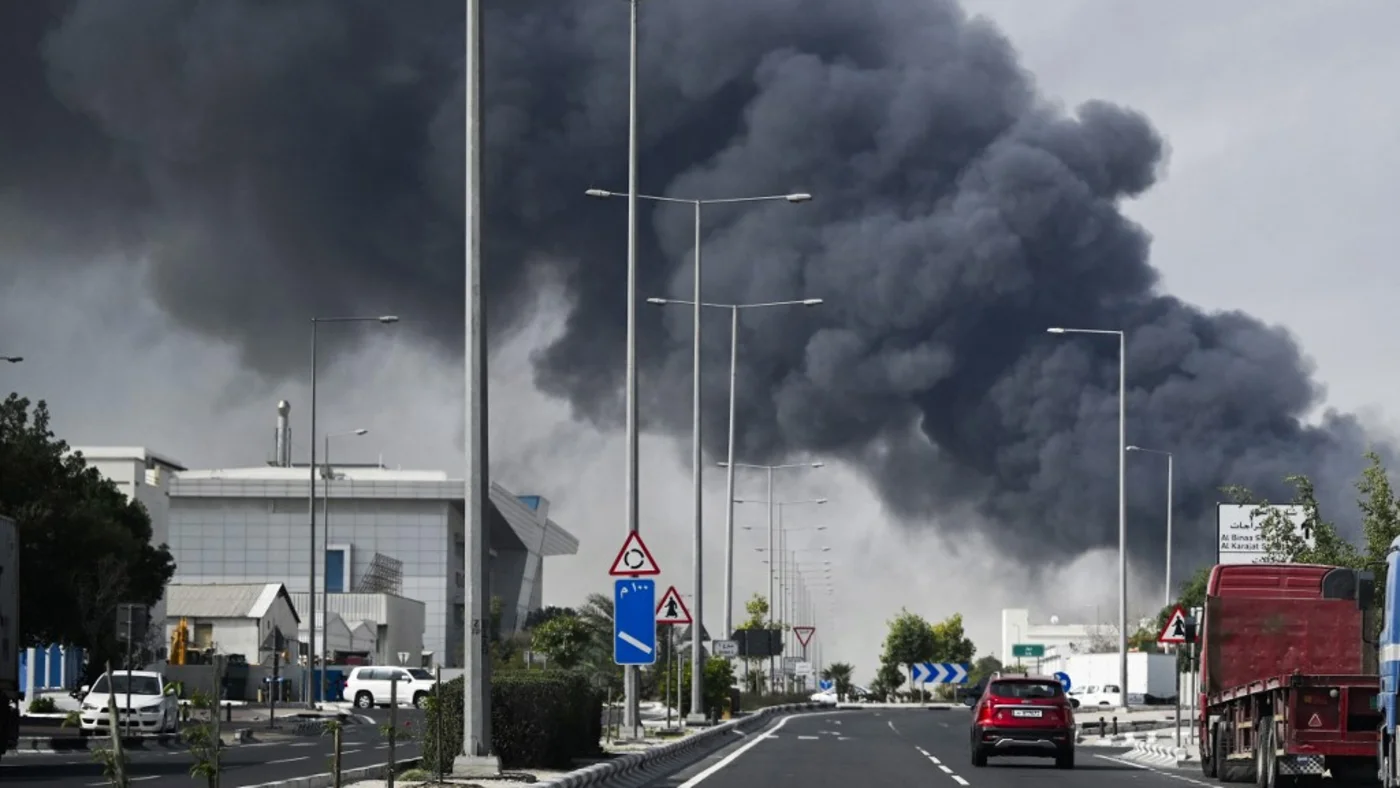
On Saturday morning, the departure board at Dubai’s main airport began to stack up with delays. Over the water, pale arcs rose, flared and vanished – interceptors, officials later said – leaving chalk traces in a sky turning white.
Similar scenes occurred in Abu Dhabi, Doha, Manama and Kuwait City. Then, in the afternoon, both the Dubai airport and Kuwait airport were hit. The Gulf was in shock.
Why US President Donald Trump ultimately chose war with Iran is still hard to pin down. He ran on “America First”, then drifted into something closer to “Israel First”, even as a deal was within reach – a deal that, by many accounts, would have beaten the agreement he tore up in his first term.
Was it a distraction from the Epstein Files? Did Israeli Prime Minister Benjamin Netanyahu, determined to remake the Middle East, manoeuvre Washington into a fight whose very chaos serves his aims?
Israel wanted this war, and it set the tempo. If Trump had refused to back it, Israel was likely going to strike anyway, daring the US to rescue an ally while making Trump look weak.
Whatever the motive, the Gulf has become collateral damage in Israel’s war, its monarchies absorbing the costs of a conflict they did not choose and tried hard to prevent. Claims that Saudi Arabia wanted this war circulate in the media, often sourced to unnamed voices, while Saudi interlocutors I trust reject it outright.
These stories appear to be part of a campaign: shift blame, split the Gulf, give Israel political cover.
Ongoing nightmare
Iran’s response has raised questions. It has hit the very states that tried to help avert war – Qatar and Oman – aiming to force them to pressure Washington to step back from the abyss of a conflict the US is unlikely to win.
For now, the Gulf feels abandoned by the US: asked to do diplomacy, punished for doing it, and left to absorb the blowback – again.
The squeeze did not begin on Saturday. Since 7 October 2023, Gulf states have been caught between an Iran that looked hesitant to establish deterrence directly, and an Israel gripped by an offensive creed, swinging like a bull in a china shop and leaving scorched earth from Gaza outwards.
Iran chose to fight through its allies and partners, then shied away from the kind of deterrence that might have stopped the spiral. The result is a region in chaos.
The Biden White House watched, blinking, offering Israel near-blanket support. Then came a Trump team gradually abandoning its “America First” mantra, trying to shape global affairs coercively but remotely, with no consideration for ripple effects.
For the Gulf, this has been an ongoing nightmare. Its business model is not built on ideology or conquest. It is built on connectivity: trade lanes, capital flows, data systems and energy logistics. Interrupt any of that, and you do not just dent growth; you puncture the very business model that the Gulf states have successfully built in recent decades.
Washington has quietly delegated much of the region’s statecraft to Gulf mediators, above all Qatar and Oman. Doha has carried messages between Israel and Hamas, and between the US and Iran. Muscat has done the same, often more discreetly.
The reward has been incoming fire. Qatar has been struck by the parties it mediates for – twice by Iran, once by Israel – three times in less than a year. Oman was not spared in this latest round either. Washington’s security commitment looks more shaky each time.
Strategic autonomy
Iran’s barrage on Saturday went beyond theatre. Waves of drones and missiles hit military sites and critical national infrastructure: airports, ports, energy facilities. Hotels and buildings were struck. Gulf air defences intercepted many projectiles, yet the shock ran deep across the capitals. Iran aimed at the centre of gravity of Gulf economies: their energy and logistics infrastructure.
Gulf leaders hoped they were facing a painful, containable spasm that diplomacy could cap within a few days. That hope rests on the realisation that interceptor stocks are finite. Iran can throw cheap drones at a wide map, often through decentralised networks that – since the killing of the supreme leader, Ayatollah Ali Khamenei – operate with loose coordination from a central command already strained.
Gulf air forces will shift further towards forward defence, with help from partners such as Britain and France. Every step up that ladder inches the Gulf states closer to the US-Israeli war effort.
The Gulf has to avoid being dragged into Israel’s vision for the region: one of managed chaos in degraded states. Regime change in Tehran is not within reach from the air. The demise of Khamenei will likely leave an Islamic Republic that is neither Islamic nor a republic, but rather a military dictatorship run by the Revolutionary Guards.
Israel’s approach of triggering Iran to go all-out against its Gulf neighbours risks producing a Gulf order in which the monarchies are treated as a junior partner, expected to bankroll security and accept strategic decisions made elsewhere.
The alternative is a sovereign Gulf policy rooted in strategic autonomy and Gulf unity. The Gulf’s security architecture is still anchored to the US, yet the Gulf is not powerless. It can choose where, when and how its military capabilities are used.
It can demand that the US limit escalation launched from or imposed upon its territory. It can price access, basing and cooperation as strategic assets that Washington should not mistake as entitlements. It can use its weight as one of the most important pools of capital invested in the US, and its overall net contributions to American power, to insist that Gulf security is not a disposable side issue.
Netanyahu understands that Israel’s grip on Washington’s foreign-policy bubble will not last forever. That might have been one reason he pushed for war now, and for it to run long. The Gulf states should take notice.
They can still emerge from the post-7-October events as the undisputed centre of gravity and stability in the Middle East, outshining the increasingly theocratic, ethno-nationalist state of Israel, which remains a net consumer of US power.
For this to happen, the Gulf has to find a third path of “Gulf First”, not Israel or America First. This means proactively choosing and shaping its own destiny, rather than being a pawn in someone else’s agenda. The current crisis could thus inadvertently become another defining Gulf moment.