
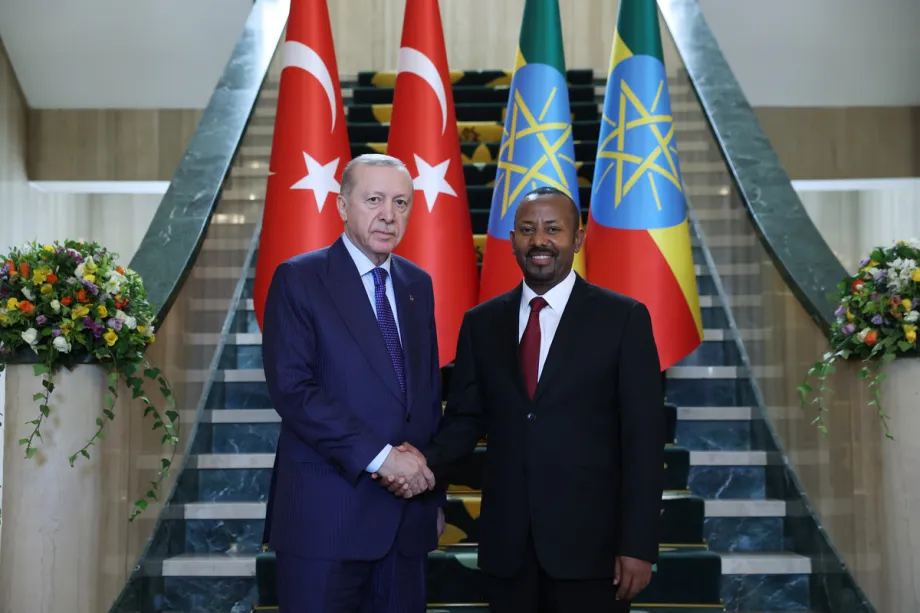
At the edge of the Red Sea, where history has always been written in salt and blood, a new chapter is quietly unfolding. It is not the clash of empires that once defined relations between the Ottoman fleet and the highland kingdom of Abyssinia. It is something subtler, more ambitious, and perhaps more consequential for the future of Africa and the wider Indo-Pacific. Turkey and Ethiopia — once adversaries in the sixteenth century, now partners in the twenty-first — are testing whether middle powers can reshape the geopolitical grammar of the Horn of Africa.
The historical memory is long. Scholars have chronicled how Ottoman forces, allied with the Adal Sultanate, seized Massawa and Suakin, pressing hard against Ethiopia’s sovereignty in the 1500s. Religious rivalry and imperial competition framed those encounters. Yet by 1896, after Emperor Menelik II’s stunning defeat of Italy at Adwa, Sultan Abdülhamid II offered congratulations rather than cannons. Shared anxiety over European colonialism recalibrated the relationship. Cooperation, however tentative, replaced confrontation. History pivoted under pressure.
From Cold War Drift to Strategic Embrace
Fast forward to the Cold War, and the two nations drifted apart once more — Ethiopia under the Soviet umbrella, Turkey anchored in NATO. Addis Ababa even shuttered its embassy in Ankara in 1984, reopening it only in 2006. It is in the past two decades that the transformation has been most dramatic. Ethiopia’s 2002 shift toward economic diplomacy coincided with Ankara’s ‘Opening to Africa’ strategy under Recep Tayyip Erdoğan. The alignment was almost serendipitous.
Today, the numbers tell a story of strategic intent rather than sentimental revival. Around 260 Turkish companies operate in Ethiopia, employing roughly 20,000 local workers. Total Turkish investment exceeds US$2.5 billion across 13 major projects. Bilateral trade approached US$400 million by 2019. Ethiopia has become Turkey’s largest trading partner in Africa. Turkish Airlines began direct flights to Addis Ababa in 2006, and aviation agreements signed in 2021 deepened logistical integration between Istanbul and Addis. TİKA, Turkey’s development agency, opened its first African office in Ethiopia in 2005, funding vocational training, health initiatives, and cultural restoration projects such as the Najashi tomb.
These are not trivial gestures. They represent a deliberate embedding of Turkish presence in the economic and cultural bloodstream of the Horn.
Investment, Drones, and Deeper Ties
Yet economics alone does not define this partnership. Defence cooperation has surged with striking speed. In August 2021, Prime Minister Abiy Ahmed and President Erdoğan signed a suite of defence agreements. By 2023, Turkey’s parliament ratified a comprehensive military cooperation pact encompassing joint exercises, intelligence-sharing, counter-piracy operations and defence industry collaboration. Turkish arms exports to Ethiopia leapt from virtually zero in 2020 to approximately US$95 million by late 2021, largely driven by Bayraktar TB2 drone sales. Washington voiced ‘profound humanitarian concerns’ as these drones reportedly featured in the Tigray conflict, a reminder that hardware carries moral weight.
Culturally, too, the connection is evolving. More than 1,500 Ethiopian students had studied in Turkey by 2020 under scholarship programs. Educational exchange, often dismissed as soft power theatre, plants seeds that mature quietly in ministries, universities and businesses. It is in these human linkages that geopolitical durability is forged.
A Crowded and Consequential Arena
The Horn of Africa is no ordinary theatre. It is a strategic fulcrum linking the Suez Canal, the Bab el-Mandeb Strait and the Indian Ocean sea lanes. Nearly 12 per cent of global trade transits the Red Sea corridor. China has built its first overseas military base in Djibouti. Gulf states compete for port concessions. The United States, France and Japan maintain military facilities nearby. Into this crowded arena steps Turkey — a NATO member with Ottoman memory, Islamic affinity, and an assertive foreign policy doctrine.
Ankara’s approach is distinctive. Officials frequently describe their engagement as ‘no strings attached’, framed as grants rather than loans and cast in the language of ‘fair, equal and win-win’ cooperation. That agreement reaffirmed Somalia’s sovereignty while opening negotiations on Ethiopia’s maritime access under Somali authority. In a region haunted by zero-sum calculations, such choreography was notable.
Ethiopia’s calculus is layered. Having endured decades of Western aid conditionality, Addis Ababa is wary of moralising lectures. It welcomed a US$3 billion aid and investment package from the United Arab Emirates in 2018. It maintains deep commercial ties with China. It engages Russia in military procurement. Turkey is one pillar in a diversified portfolio of partners. This is not naivety; it is strategic hedging.
The Risks Behind the Partnership
Yet scepticism lingers. Analysts have warned that humanitarian assistance can become a strategic gateway. In Somalia, Turkish firms manage key infrastructure, including ports and airports, prompting debates over sovereignty and long-term dependence. Could Ethiopia, Africa’s second-most populous nation with more than 120 million citizens, risk similar entanglement?
Egyptian lawmakers have voiced unease that Turkish–Ethiopian military intimacy could aggravate tensions over the Grand Ethiopian Renaissance Dam. Chatham House analysts have underscored the regionalisation of the Tigray conflict, warning how external involvement can amplify domestic fractures. The line between partnership and proxy is perilously thin.
There is resonance here from middle powers; navigating between giants must cultivate agility. The Horn’s volatility — from Sudan’s civil war to the unresolved tensions of the Nile basin — demands creative diplomacy. Turkey’s mediation suggests that emerging powers can broker outcomes where traditional Western actors struggle for credibility.
South-South or Same Old Story?
The deeper question is philosophical. Can South–South cooperation transcend the asymmetries that plagued North–South development models? Can a partnership born of historical rivalry become a template for equitable engagement in a multipolar world?
The answer will not emerge from communiqués alone. It will be shaped by transparency in contracts, respect for sovereignty, and restraint in the use of force. Drones may alter battlefields, but trust determines stability.
If joint ventures prioritise technology transfer and local capacity-building, this relationship could catalyse industrial transformation rather than dependency. If, however, ambition eclipses accountability, the Horn may simply witness another chapter of external competition layered atop internal fragility.
A Future Beyond Empire
For the Horn of Africa, the stakes are existential. Climate shocks intensify displacement. Youth unemployment fuels migration across deserts and seas. Ports and railways are not merely infrastructure; they are lifelines to dignity and opportunity. If Turkey’s investments and mediation strengthen Ethiopia’s resilience while reinforcing regional dialogue under African Union and IGAD frameworks, this could mark a turning point.
History in this region has rarely been gentle. Yet in the interplay between Turkish pragmatism and Ethiopian aspiration lies a possibility — that partnership, carefully stewarded, can outgrow rivalry. The Horn of Africa deserves nothing less than a future shaped not by the echoes of empire, but by the steady architecture of mutual respect and strategic patience.