
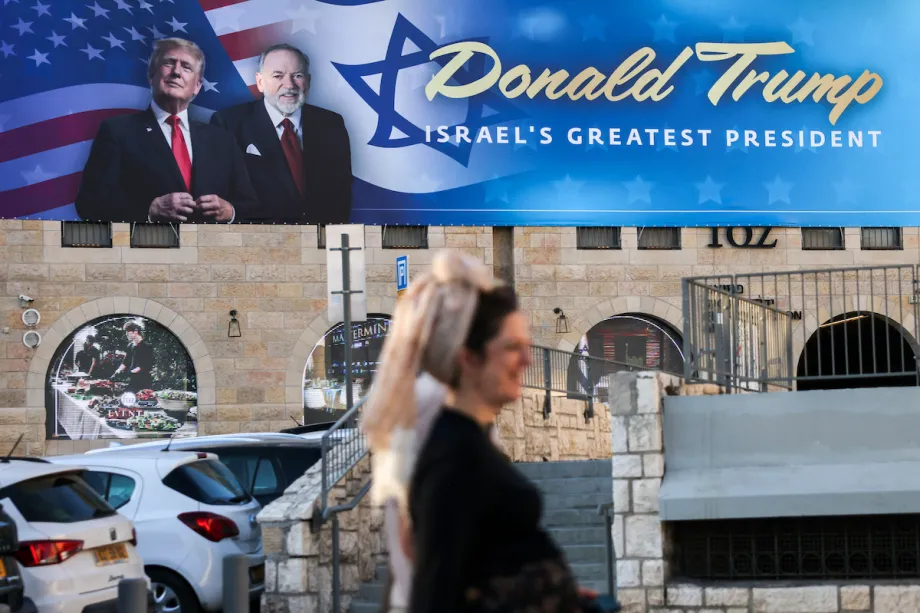
Huckabee’s endorsement of full Israeli control over occupied territory signals Washington’s abandonment of two-state diplomacy. The reaction—unified Arab condemnation and shifting U.S. public opinion—reflects accelerating annexation on the ground. Brinkmanship empowers hardliners, isolates America, and may permanently redraw the conflict’s map.
When a sitting United States ambassador declares that it would be “fine if they took it all,” diplomacy does not merely slip — it crosses a threshold. Mike Huckabee’s endorsement of full Israeli control over occupied Palestinian territory, delivered on The Tucker Carlson Show, was not an offhand remark. It was a political signal. And in the context of a 78-year conflict defined by land, law and legitimacy, such signals carry strategic weight.
For decades, successive US administrations have formally endorsed a negotiated two-state solution. That position was often inconsistently applied, and frequently undermined by events on the ground, but it served as a diplomatic anchor. It affirmed that occupation was not sovereignty and that territorial disputes required negotiation, not absorption. Huckabee’s declaration tears at that anchor. When a serving ambassador validates total territorial control, the message received across the region is unmistakable: Washington’s commitment to two states is unreliable for all purposes and intent.
The reaction was swift and unusually unified. The Organization of Islamic Cooperation (OIC), on Thursday, will be convening an emergency meeting of foreign ministers in Jeddah, condemning Israeli occupation measures aimed at annexation, including new land-registration procedures in the occupied West Bank under the label of “state property”. The OIC warned that such measures alter the legal, political and demographic character of Palestinian territory and undermine the two-state solution.
The Arab League, under Secretary-General Ahmed Aboul Gheit, issued a direct rebuke, describing the remarks as extremist and inflammatory. In a joint declaration, Arab and Muslim-majority governments rejected any claim of Israeli sovereignty over occupied Palestinian land and warned that expansionist rhetoric would further destabilise the region. Civil society voices were even sharper. The advocacy group DAWN called for Huckabee’s dismissal.
These reactions are rooted in more than diplomatic sensitivity. They reflect an accelerating reality on the ground. Settlement expansion continues apace. Land is reclassified as “state property”. Administrative mechanisms steadily entrench Israeli control over the occupied West Bank. Annexation is not announced in a single dramatic decree; it is consolidated through paperwork, zoning regulations and incremental legal redefinitions.
Huckabee’s statement therefore does not exist in isolation. It aligns with a broader trajectory in which the territorial basis for a viable Palestinian state is removed. To say “it would be fine if they took it all” is to signal that such consolidation is not merely tolerated, but acceptable.
Yet the deeper rupture may be unfolding not only in Tel Aviv or Ramallah, but in Washington itself. America is falling out of love with Israel. The war in Gaza has profoundly shaken what was once one of the most stable alliances in modern diplomacy.
Public opinion in the United States has shifted dramatically. Polling shows sympathy for Israel at a 25-year low. A recent survey found that 43 per cent of Americans believe Israel is committing genocide in Gaza — a staggering figure in a country that has historically shielded Israel from diplomatic censure. The steepest decline in support is among Democrats, particularly younger voters. But cracks are now visible among Republicans as well.
Carlson has platformed voices arguing that Israel drags the United States into regional conflicts and diverts resources from domestic priorities. The slogan is shifting from “America First” to “America Only”.
This right-wing scepticism is not rooted in solidarity with Palestinians. It blends isolationism, fiscal nationalism and, in some quarters, conspiratorial undertones. But politically it is significant: support for Israel is no longer immune from internal challenge within the Republican base.
Meanwhile, several of America’s closest allies — including Britain, Canada, France and Australia — have recognised a Palestine statehood, mostly citing the catastrophic humanitarian conditions in Gaza. Washington has opposed these moves, but the shift underscores how reliant Israel has become on US diplomatic protection.
In this fragile environment, Huckabee’s rhetoric amounts to ideological brinkmanship. Brinkmanship involves pushing a volatile situation to the edge to test limits. Here, the test is whether the United States can openly signal acceptance of territorial absorption without collapsing its own domestic consensus or further isolating itself internationally.
The stakes extend beyond Palestine.
It also narrows the space for any political resolution. The two-state solution has long been described as moribund, hollowed out by settlement expansion and political paralysis. But there is a difference between a framework in distress and one implicitly declared obsolete. Words from a senior diplomat can accelerate what was gradual decline into formal abandonment.
Maximalist rhetoric strengthens hardliners on all sides. It reinforces narratives of existential struggle and sacred entitlement, leaving little room for compromise. Moderates are sidelined; absolutists are empowered.
If the United States intends to preserve even the possibility of a negotiated settlement, clarity is essential. Silence will be interpreted as assent. And if a serving ambassador publicly contradicts longstanding policy, accountability becomes unavoidable. Calls for Huckabee’s dismissal are not theatrical — they are an attempt to reaffirm that annexationist rhetoric does not define American diplomacy.
The US-Israel relationship has shaped Middle Eastern geopolitics for half a century. Today, it stands at a moment of profound recalibration. Domestic American opinion is shifting. International patience is thinning. Regional tensions are escalating.
Brinkmanship may energise ideological constituencies, but it rarely produces durable peace. When diplomacy edges toward endorsement of permanent territorial absorption, it does more than test limits — it redraws them.And once redrawn, maps are difficult to restore.