
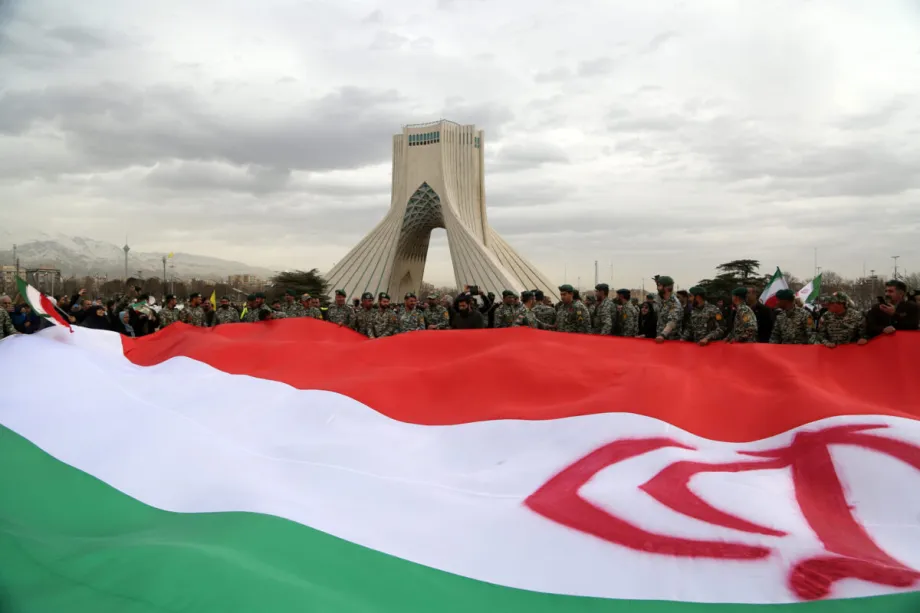
On its 47th anniversary, the Islamic Republic projects defiant endurance. Leveraging Oman-based diplomacy against Trump’s “Maximum Pressure 2.0,” Tehran trades regional expansion for strategic, state-preserving consolidation.
As the sun rose over Tehran yesterday, 11th February, the familiar echoes of revolutionary slogans filled Azadi Square, marking the 47th anniversary of the 1979 Islamic Revolution not its collapse. For decades, observers have peered through the fog of sanctions and social unrest, wondering if each anniversary might be the Republic’s last. Yet, as the 47th year arrives, the expected “obituary” has once again been shelved in favour of a complex “celebration.”
This year, the stakes are uniquely high. While internal pressures and the memory of recent domestic crackdowns linger, the external landscape has shifted back to a familiar, albeit more volatile, theatrical stage. With Donald Trump back in the Oval Office, the world is braced for “Maximum Pressure 2.0.” Instead, the anniversary arrives amidst a flurry of diplomatic signals: back-channel negotiations in Oman have quietly commenced, even as Israeli Prime Minister Benjamin Netanyahu pushes for maximum power–desperately determined to draw Trump into another regional war.
Tehran’s survival to this 47th milestone suggests a regime that has mastered the art of “crisis-living.” But as the fireworks fade, the fundamental question remains: is this a genuine show of endurance, or merely a stay of execution? By opting for the negotiating table in Oman rather than the “armada” in the Gulf, the US has provided the Islamic Republic with the oxygen needed to reach today. However, with the regional shadow of war growing and a restless youth population watching from the sidelines, one must ask if the path to the 48th anniversary will be paved with diplomacy or the final chapters of a long-failing state.
The scene in Tehran today is less an obituary and more a testament to the Islamic Republic’s seasoned ability to navigate existential crises. As the 47th anniversary celebrations unfold across the country, the atmosphere is defined by a sense of defiant survival. While critics have spent decades predicting the system’s imminent collapse under the weight of “Maximum Pressure” and internal economic strain, the state has once again demonstrated its institutional depth. This year’s anniversary is particularly significant; it serves as a public assertion of sovereignty at a time when the regional map is being redrawn. Rather than a regime on the brink, the image projected today is one of a regional power that has successfully absorbed decades of hostility, effectively signalling to both its citizens and its adversaries that the revolutionary project remains the primary arbiter of Iran’s destiny however with softer touch.
The path to this 47th anniversary was paved not with the expected collapse, but with a strategic return to the negotiating table. Despite the shadow of an American “armada” in the Persian Gulf and the persistent threat of further military escalation, the diplomatic channel in Oman has become the Republic’s most vital lifeline. There is a profound irony in the current dynamic: while Netanyahu arrived in Washington yesterday to urge a final, decisive blow against Tehran’s regional influence, the Trump administration appears increasingly drawn to the prospect of a “Great Deal.” By facilitating these indirect talks in Muscat, Washington has effectively acknowledged that the Islamic Republic remains a reality that cannot be simply sanctioned out of existence. It also means that Washington, finally, accepted that Iran’s nuclear program, used as a pretext for recent escalations, can only be curbed or ended through negotiations. The same conclusion the EU powers have long since reached.
For Tehran, 11th February serves as a victory of patience over pressure; it is an assertion that through a combination of regional leverage and nuclear hedging, it has secured the diplomatic oxygen necessary to outlast the most aggressive “Maximum Pressure” campaigns.
The road to this 47th year has been paved with immense sacrifice and a recalibration of Iran’s regional footprint. Critics point to the recent erosion of the “Axis of Resistance”—marked by the tactical degradation of traditional allies in the Levant and the shifting political sands in Damascus—as evidence of a declining power. Indeed, the Islamic Republic has had to endure a gauntlet of direct Israeli strikes and American military posturing that would have toppled a less cohesive state. In many ways, Tehran has faced a “Venezuela scenario”: a systematic attempt to paralyse the nation through suffocating sanctions, the freezing of overseas assets, and the constant spectre of a full-scale invasion. Yet, unlike Caracas, Tehran has managed to maintain a disciplined internal security apparatus and a “resistance economy” that, while strained, remains functional. The regime has traded regional expansion for domestic consolidation, proving that while its external “shield” may be bruised, its core sovereignty remains an indigestible reality for its adversaries.
The success of these reforms is what has allowed Tehran to avoid the “Venezuela scenario” so many of its detractors predicted. While Caracas saw its oil industry and social fabric undergo a near-total collapse under similar “Maximum Pressure,” Tehran has leveraged its institutional depth and diverse regional trade networks to remain standing. The Islamic Republic has survived not just by resisting US and Israeli aggression, but by adapting to it—curbing its former regional expansionism for a period of domestic consolidation. This “fortress-like” resilience has been tested by the recent January unrest and the 12-Day War of 2025, yet the state emerged with its security apparatus intact. By forcing the world to acknowledge its endurance, Iran has turned the “obituary” into a dialogue, though the threat of a “Smart Intervention” or a renewed military “armada” ensures that this stability remains precarious.
Ultimately, the 47th anniversary is not the obituary many in Washington and Tel Aviv had scripted, but a strategic pause in a long-running drama. While Benjamin Netanyahu uses his platform in the US today to warn of Tehran’s “Axis of Resistance” and its missile capabilities, the quiet halls of Muscat tell a different story—one of a pragmatic survival that has outlasted even the most aggressive attempts at regime change. By successfully shifting the focus back to the nuclear file and securing bilateral talks with the Trump administration, Tehran has demonstrated that its revolutionary project possesses a unique, albeit embattled, durability. However, as the 47th year begins, the survival of the 48th remains tethered to these very negotiations. If the “Great Deal” in Oman fails to translate into tangible economic relief for a weary Iranian public, or if the “armada” in the Gulf is finally unleashed, today’s celebrations may indeed be remembered as a final high-water mark. The question is no longer whether the Republic can reach its 47th year, but whether the diplomacy born today in Oman is enough to ensure there is a 48th to celebrate.