
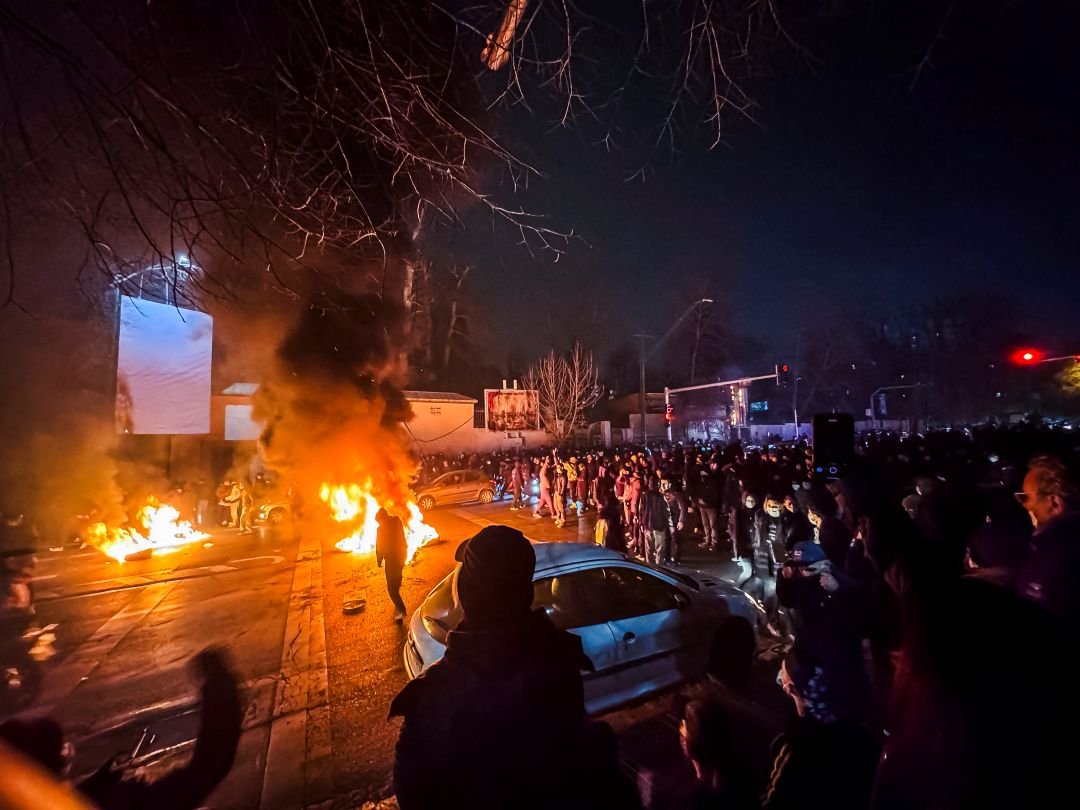
Once again, Iran is experiencing nationwide upheaval and, as on past occasions, the state has responded with brute force. This time, however, U.S. threats of military intervention create additional dangers. Instead, Washington should offer major economic incentives in exchange for meaningful political change in Iran.
Popular protests in Iran, which began in late December 2025 amid an economic downturn accelerated by the national currency’s collapse in value, have rapidly evolved into nationwide upheaval. The government has cracked down, including with beatings, shootings and a near-total internet blackout. So far, state forces have killed several hundred protesters and arrested thousands, though the true numbers are almost certainly much higher. In Washington, the Trump administration has warned the Iranian regime to halt its repression. It is considering both military and non-military options for intervention, on 12 January saying it will impose 25 per cent tariffs on any government doing business with Tehran. Iranian officials have threatened harsh retaliation for any military action and suggested that pre-emptive strikes are on the table, too. Rather than run the risk of military escalation, the U.S. should create other incentives for change from within Iran. Only Iranians can determine what reform looks like, but, for the U.S., linking sanctions relief to the political renewal that the country badly needs is a better way to help the protesters than bombing.
No Change, No Exit
Starting in late December 2025, market instability prompted demonstrations among Tehran bazaar merchants – the cadre of shopkeepers who have long been a pillar of the Islamic Republic’s support – that quickly spread outside the capital. Soon, marchers were giving voice to grievances that went well beyond financial hardships, calling for an end to the regime that took power in 1979. To take this course, just three years after the brutal clampdown on the “women, life, freedom” protests, in which nearly 500 demonstrators were killed and many more injured, was extraordinarily brave and a measure of how desperate things have become. Both in 2022 and since then, the regime has proven able and all too willing to quash dissent with brute force.
The protests snowballed in the lingering shadow of the twelve days of hostilities with Israel (and briefly the U.S.) in June 2025 that left Iran’s nuclear program severely damaged, many in the senior ranks of its military killed, its defensive vulnerabilities exposed and its intelligence deficiencies on full display. To hear the Islamic Republic’s leaders tell it, the lesson of the twelve-day war was that the system was still standing, having taken the worst beating its external foes could administer. They believed that cohesion at home had helped them ward off the threat from abroad.
It proved to be wishful thinking. If the war forged a moment of national unity, it was short-lived and swiftly undermined by the system’s own failings. As with previous rounds of protest over the past decade, the regime’s sclerotic response to political and socio-economic malaise has turned the country into a tinderbox. In the past, the leadership in Tehran might have argued that it deserved latitude for having provided security for Iran’s citizens in a region ridden with conflict. This time, the regime’s failure to protect the country in the twelve-day war instead suggested that it is no longer capable of honouring the most basic element of the social contract.
Indeed, for much of the Iranian public, leadership failure is a resonant theme. Two years of confrontation with Israel after Hamas’s 7 October 2023 attack severely degraded both Iran’s nuclear program and the “axis of resistance” that Iran had built up elsewhere in the Middle East, over decades and at massive cost, to project power and deter adversaries. Meanwhile, Tehran’s effort to counter U.S. sanctions through construction of a “resistance economy” that relies on domestic capacity and non-oil trade has proven disastrous as mismanagement and corruption speed up the country’s economic freefall.
But perhaps the greatest leadership failure of all has been resistance to change at home. Under octogenarian Supreme Leader Ali Khamenei, the system has faced repeated popular challenges to its rule, time and again crushing them with an iron fist and proceeding to govern as poorly as before. That approach bought it time, but success measured only by the maintenance of coercive power gave the country’s leaders little impetus to address the grievances underlying public discontent. The regime’s refusal to expand political and social freedoms, or to overhaul the sputtering economy, meant that it was continuously narrowing its options from the ineffective to the counterproductive.
What Iran’s regime is now struggling to contain is the predictable consequence of rejecting major changes in how it runs the country. Over the past two weeks, senior government officials have acknowledged the financial stress that citizens feel, rolling out reforms of economic policy and reshuffling personnel. But they face a daunting challenge, with limited resources, in reversing years of mismanagement and endemic corruption that have benefited very few and impoverished far too many. Moreover, pocketbook concerns are only part of the picture: creaking infrastructure, compounded by severe environmental degradation, is producing regular power and water shortages across a resource-rich land; voter participation rates are dwindling, demonstrating the marked decline of the system’s institutional legitimacy; and diplomacy with the U.S. has been at a standstill since the June 2025 war, blocking any hope of sanctions relief that might bring an economic reprieve.
Against this backdrop, the outpouring of popular dissatisfaction spills across boundaries of geography, class and gender: it includes dissent in the bazaar, anger on university campuses and tumult in neglected peripheries. Everywhere the marchers are both men and women, young and old, secular and pious. The regime has reverted to its default posture – the use of force – but perhaps with a greater sense of existential peril than in the past. Even before the protests began, some close to the system’s inner circles were cognisant of having reached a dead end.
External Pressure
The storm into which the Iranian system has sailed at home is linked to the threats it is facing from outside, particularly from the U.S. and Israel. There are two main points of friction with these powers. The first and most immediate relates to the protests, which President Donald Trump has lent support, repeatedly threatening to intervene should the regime persist in using lethal force to put them down, announcing punitive tariffs on any country trading with Iran and warning of further measures. The second relates to Iran’s reported efforts to restore its ballistic missile capacities, prompting Israeli Prime Minister Benjamin Netanyahu, backed by Trump, to admonish that either that development or resurrection of Iran’s dormant nuclear program might bring another round of airstrikes.
Prior to the mass mobilisation in Iranian streets, it appeared that renewed military conflict was not imminent. Israel, having used so many interceptors to knock down Iranian missiles in June 2025, was likely keen to rebuild its diminished stocks before starting another round of major fighting. The U.S., which has concentrated forces in the Caribbean Sea as part of its pressure campaign on Venezuela, likely had more limited options for Middle East intervention than it would otherwise enjoy. Iran was unlikely to initiate hostilities itself, as it is extremely vulnerable with its air defences not yet rehabilitated.
But calculations may be changing. Facing increasing instability, the Iranian regime might gamble on an action that would provoke a U.S. or Israeli strike, hoping to ride a wave of nationalism out of trouble. Israel, which in January has stood back while the U.S. takes the lead on Iran, may see a chance – particularly if Washington is on board – to undermine a regime it views as obstinately working to undermine its security.
As for Washington, during previous rounds of unrest in Iran, U.S. presidents have often proceeded with caution for fear of providing the regime with further motivation to repress the people. President Barack Obama issued muted statements in 2009, when the regime was quelling the Green Movement, in hopes, according to him, of avoiding making “the United States … the issue inside of Iran”. As subsequent mass protest broke out under the first Trump and Biden administrations, the White House responded with verbal condemnations and more sanctions, but few officials mooted the idea of direct intervention – largely for the same reason.
Trump, however, appears to be emboldened by the tactical success of the 3 January raid grabbing Venezuelan President Nicolás Maduro and impressed by the size and determination of Iran’s protests – seeing an opportunity to put an end to a regime regarded by successive U.S. administrations as a bitter adversary. His repeated threats to hit the regime if it keeps killing protesters have put his credibility on the line. Perhaps most important, he has within the last year ordered strikes on Iran without provoking a major war – in fact by doing so he brought Israeli bombing to an end. Many among his Republican allies and Iranian diaspora opposition figures are encouraging him to go for the jugular.
Trump has made clear that the administration is still weighing further action. On 12 January, he suggested that the U.S. was preparing to meet with Iranian interlocutors but also said it might need to strike before that could happen. As indicated by the tariff announcement, there are steps short of a military operation that the administration might take. It could order cyber operations aimed at inhibiting the regime’s ability to throttle communications in Iran and making the crackdown more difficult to execute. But while low-cost in comparison to other options, such a measure may fall short of the spectacle Trump likes to stage. Piling on new and more stringently enforced sanctions could squeeze key government personnel and sources of revenue. But Iran is already sanctioned to the hilt, and some additional penalties could backfire. For example, imposing a full embargo on seaborne Iranian oil exports would likely expose other ships in the Strait of Hormuz – one of the world’s most critical energy chokepoints – to Iranian fire. Nor does the U.S. appear to have the naval assets in place right now to enforce it.
As for military options, these could narrowly focus on leadership targets in an effort to produce chaos at the top of the system and galvanise the opposition below. But who would emerge from such a scramble remains deeply uncertain. A broader campaign aimed at key Iranian military facilities and personnel could help weaken the iron fist but might not force it to unclench. It could also prompt Iranian retaliation. Tehran has threatened strikes on Israel as well as on U.S. forces stationed throughout the Gulf and in nearby waters, something U.S. partners in the region are keen to avoid.
Iran is no match for the U.S. and Israel, and strong Iranian retaliation would run a high risk of provoking a U.S. response that could further destabilise the regime. But bent on rectifying the widespread perception of its weakness as it faces a once-in-a-generation convergence of internal and external threats, the regime is likely to be more risk-tolerant than usual. Iran is unlikely to show the same caution it did in June 2025, when it mounted a largely performative attack, reportedly telegraphed in advance, on a U.S. airbase in Qatar in response to the U.S. strikes. Senior Iranian officials say they believe their “best defence is offence”. They think they should “go big or go home” by firing hundreds of missiles at U.S. assets and Israel. Outgunned as it is, the regime could feel a desperation that leads to recklessness.
What Now?
The regime in Tehran can choose one of two broad approaches in dealing with the crisis it is facing. The first would involve making fundamental political and economic changes – even though it has in the past resisted such reforms (especially under pressure) and given every indication of rejecting them in the present. The second path would be to hope the protests start to fizzle due to fear and fatigue. The regime could then use a combination of economic triage and outright repression to buy itself still more time. But the first course could well see unrest continue as discontent percolates, and the second will invite further anger from below and aggravate the risk of action from outside.
As for Western decision-makers, amid all the uncertainty, there are a few grim realities to keep in mind. First, no matter how odious the Islamic Republic’s behaviour, some of Iran’s possible futures could well be worse. A sudden collapse of the regime could lead to prolonged violence along ideological, ethnic and sectarian lines. There is every reason to wish that Iran can avoid the mayhem seen in Iraq, Syria and Libya in recent decades, but cautionary tales cannot be ignored. Nearly half a tonne of near-weapons grade uranium (sufficient for ten nuclear warheads and dozens of dirty bombs) is unaccounted for after the June 2025 war. It could wind up in hands less predictable than the regime’s. Or some within the Revolutionary Guards could take control of this stockpile, having determined that Khamenei or the entire clerical establishment are a liability and moved to appropriate power. Nor can it be completely ruled out that elements within today’s regime could still make a covert dash toward weaponisation before it could be detected and stopped. In any of these eventualities, there is no reason to believe that repression of dissent would end if the system’s remnants were to dig in.
Secondly, U.S. military action against the political leadership or repressive apparatus may well further weaken the system but could lead its embattled core to unleash a scorched-earth campaign against its own people, U.S. interests and U.S. allies. None of these outcomes are pre-ordained, but the hope of seeing the back of a system few will lament should not obscure the full range of potential consequences.
The reality is that both Iran and its outside adversaries lack good options. Tehran deems surrendering to its people’s wishes as perilous as bowing to Trump’s demands, but it has almost no cushion left for continued resistance. As for the U.S. and Israel, a long-range bombing sortie to hit symbolic targets or cripple infrastructure would make a big bang but generate all the dangers described above. Such a strike would also stand little chance of transforming Iran into a stable and responsible power, at least in the short term, and absent a prior or imminent Iranian attack would be difficult to justify legally (though such concerns have not been an impediment to the administration elsewhere). These risks and costs may be of lesser concern to Israel, which might be content to see Iran weak and chaotic rather than run by a hostile regime. But such scenarios disturb Arab Gulf capitals and would ill serve U.S. interests.
If military options are bad, diplomacy has a steep hill to climb, too. Mistrust is marrow-deep, especially on the Iranian side, given the Islamic Republic’s history with Trump: he withdrew from a fully functional nuclear deal with Iran in 2018 and bombed Iran in the middle of negotiations in 2025. A return to talks about Iran’s nuclear or ballistic missiles program, as Trump has suggested might be on the cards but has since ruled out while repression continues, would be a slap in the protesters’ face, potentially empowering the regime and leaving the country lurching from one crisis to another. Nor is the U.S. likely to be effective as the standard-bearer for democratic reform in Iran. Setting aside the administration’s own complicated record when it comes to upholding democratic norms at home and abroad, such change will need to be driven from within Iran if it is to have any chance of enduring.
That said, the U.S. does have important leverage it can use to create incentives for players within the Iranian system. Washington could, for example, make clear that major sanctions relief, which the regime needs to address the fury driving demonstrations, and reintegration into the global economy, are contingent not only on the nuclear concessions Tehran is dangling as a negotiation gambit but also on more fundamental political change. Precisely what such reform would look like would be a question for Iranians to answer. While protesters are unified in their disdain for the status quo, what would lie beyond it remains the subject of debate both inside and outside Iran. One path that appears to enjoy support among prominent actors in Iran is an internationally monitored vote for a constituent assembly, which would then devise a new political order. Even if Tehran does not accept such a course now, it could generate a debate within a system that is bound to undergo transformation as the question of who will succeed the 86-year-old Supreme Leader looms larger.
Nuclear and regional security issues remain as important as ever, and the Trump administration could make clear that to benefit from sanctions relief Tehran would also have to commit to maintaining long-term suspension of uranium enrichment; allowing international inspectors to view and secure pre-war fissile stockpiles; and refraining from attacks on U.S., Israeli or allied interests in the region. But the requirement for tangible progress toward political reform would be a way of responding to the moment that at least has a chance of enhancing rather than undermining prospects for positive change.
It is hard to imagine the Supreme Leader himself or indeed many of those around him agreeing to any form of transition at all. But these are unusually challenging times, and for all those who will baulk at the notion, others in positions of influence may find the proposition tempting as an off-ramp, especially given the inevitable eventual transition to the post-Khamenei era. Investing in this approach could help Washington give the system’s opponents a way out from under a moribund system and toward a government that enjoys popular legitimacy, with economic opportunity growing, and is positioned for stable relations with Iran’s neighbours. More immediately, it would curb the risks of a renewed, unpredictable military confrontation and Iran collapsing into chaos at a deeply uncertain moment.