
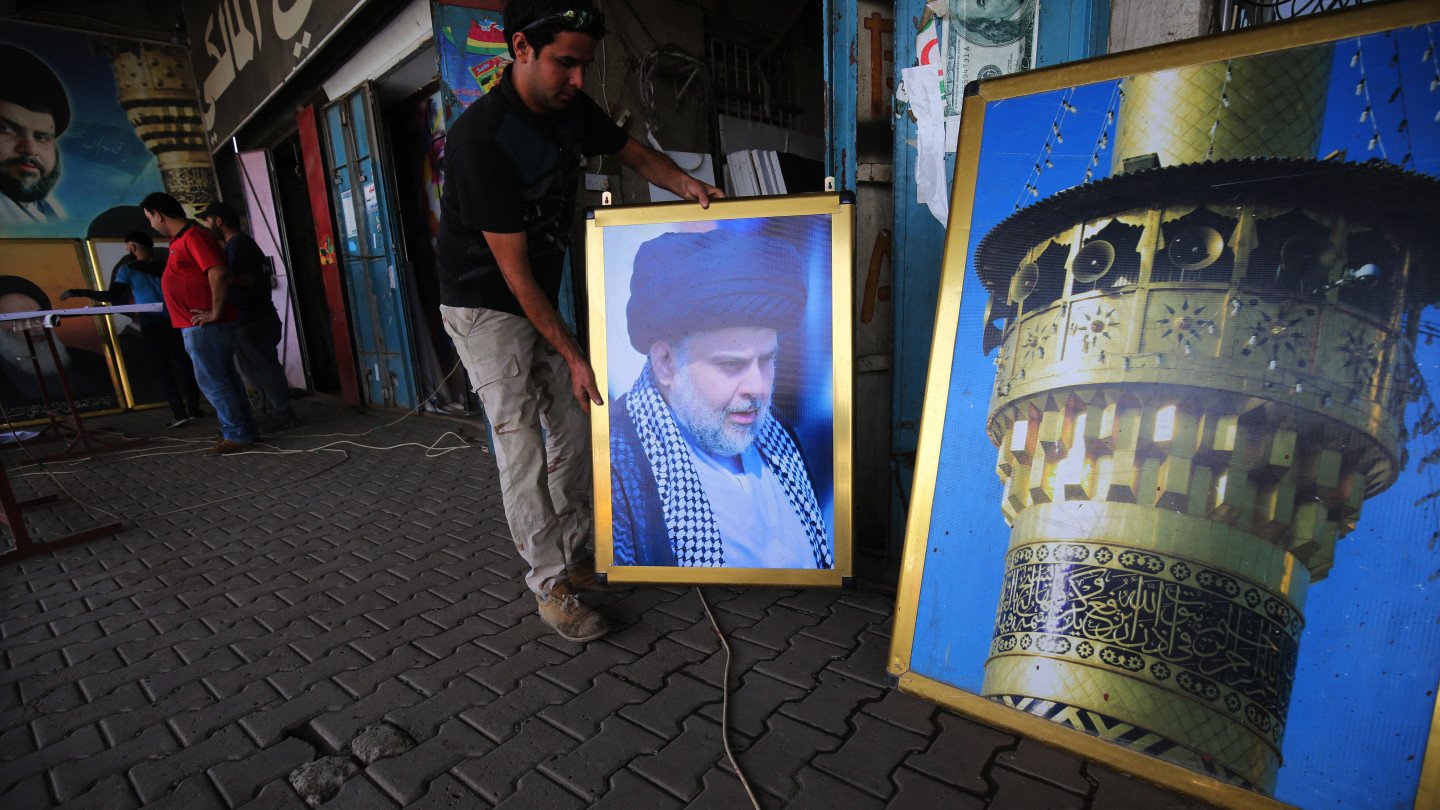
Muqtada al-Sadr’s 2022 political withdrawal appears to be a strategic repositioning rather than a permanent retreat. By focusing on religious and social grassroots mobilization, the movement maintains influence, preparing for an eventual return.
Muqtada al-Sadr announced his withdrawal from Iraqi politics in 2022, but observers say it was a calculated repositioning rather than a permanent retreat.
Since Iraqi cleric Muqtada al-Sadr announced his withdrawal from politics in mid-June 2022, the Sadrist movement has charted a new course, redefining its role while maintaining a position as one of the most influential Shia forces in Iraq over the past two decades.
Once a key player in government formation and decision making, the Sadrists are now more active in religious and public events, focusing on ideology and strengthening organisational and social ties within their grassroots base.
This shift comes after a long record of political engagement marked by both confrontations and alliances, culminating in al-Sadr’s decision to step away from domestic power struggles.
Observers, however, say the move was a calculated repositioning rather than a retreat, sending signals both to political rivals and the supporters that have long underpinned the movement’s influence.
Why did the Sadrist movement withdraw from politics?
On 15 June 2022, al-Sadr withdrew from Iraq’s political process, saying he would not take part in future elections to avoid associating with “corrupt” politicians.
He made the announcement during a meeting in Najaf with Sadrist bloc lawmakers who had resigned from parliament eight months after the legislative elections. The Coordination Framework later formed a government under Prime Minister Mohammed Shia al-Sudani with support from Sunni and Kurdish parties.
Whether a tactical pause or part of a strategy to wait for a more favourable moment, questions are now being asked about how long the Sadrist movement will remain outside of the political arena, especially amid rising domestic tensions and shifting regional dynamics.
In recent months, Sadrists have organised numerous social and religious events across southern and central Iraq and in Baghdad, including public donation drives for the sick and needy as part of widely supported social solidarity campaigns.
“This should not be seen as a retreat but as a calculated repositioning to maintain their grassroots base and organisational structure while avoiding the costs and internal conflicts of direct political engagement,” Majasha Al-Tamimi, a political activist close to the National Shia Movement, told The New Arab.
“Symbolically, this behaviour can be seen as part of unspoken political messages indicating that the movement remains present, influential, and capable of mobilising the street when needed, while choosing its timing and methods,” Al-Tamimi added.
Historically, the Sadrist movement has adeptly used religious and popular activities as a political lever, even during periods of marginalisation or boycott. While a return to politics remains uncertain, the movement has lost none of its ability to exert influence in Iraqi society.
“Shifts within the Shia camp and regional and international developments could produce a moment in which the movement judges a return necessary to protect its base or recalibrate the political balance,” Al-Tamimi said.
“In this sense, the Sadrist movement may be formally withdrawn, but in practice it is in a state of strategic waiting, monitoring developments from the sidelines for an opportunity to re-enter on more favourable terms.”
Will al-Sadr return to politics?
Independent politician Nabil al-Azzawi told The New Arab that the movement’s recent focus on religious and social activities indicates that it has not completely withdrawn from politics.
“The movement had been a founding force and a key pillar of Iraq’s post-2005 politics until its withdrawal, when it held the largest bloc in parliament. Even while boycotting formal politics, it continued to closely monitor negotiations and developments,” he said.
Muqtada al-Sadr founded his movement after 2003, combining religious, social, and political rhetoric with an ability to mobilise the street, making it one of Iraq’s most prominent political and religious forces over the past two decades.
It has a broad grassroots base across major cities and rural areas, including Baghdad, Najaf, Karbala and Basra. It entered politics in the first parliamentary elections after the fall of Saddam Hussein and secured repeated electoral gains, with members holding ministerial posts in successive governments.
Its history, however, has been marked by sharp swings between active engagement in governance and periods of boycott or withdrawal.
Despite its abandonment of legislative and executive institutions, the Sadrist movement retains strong social, religious, and organisational influence, with this indirect political weight remaining a factor in calculations over the next Iraqi government.
The movement’s base, which previously acted as a “key on-the-ground actor”, exerted considerable pressure during the premierships of Nouri al-Maliki, Haider al-Abadi, and Adel Abdul Mahdi, and still has the organisational capacity for rapid mobilisation and influence, especially during crises.
Other Shia political forces are “closely watching Muqtada al-Sadr’s reactions, and all indications suggest the Sadrist movement will not remain outside politics indefinitely,” Al-Azzawi said.
“This is because al-Sadr still believes in the political process and its outcomes, but only under formulas of change, not the current approach of political recycling.”
The movement’s post-withdrawal focus on religious and social activity reflects a “deliberate shift” in how it engages with society, political researcher Mohammed Ali Al-Hakim told The New Arab.
While the initiatives are outwardly nonpolitical, they carry indirect messages aimed at preserving popular influence and maintaining alternative channels with supporters.“The movement’s broad social base makes such activities a natural way to sustain internal cohesion, suggesting the withdrawal is being framed as temporary without surrendering its place in Iraq’s political landscape,” Al-Azzawi added.
“The future of the withdrawal will depend on a range of domestic and regional factors, which could either push the movement to remain outside politics or prompt it to reconsider its position depending on how events unfold.”