
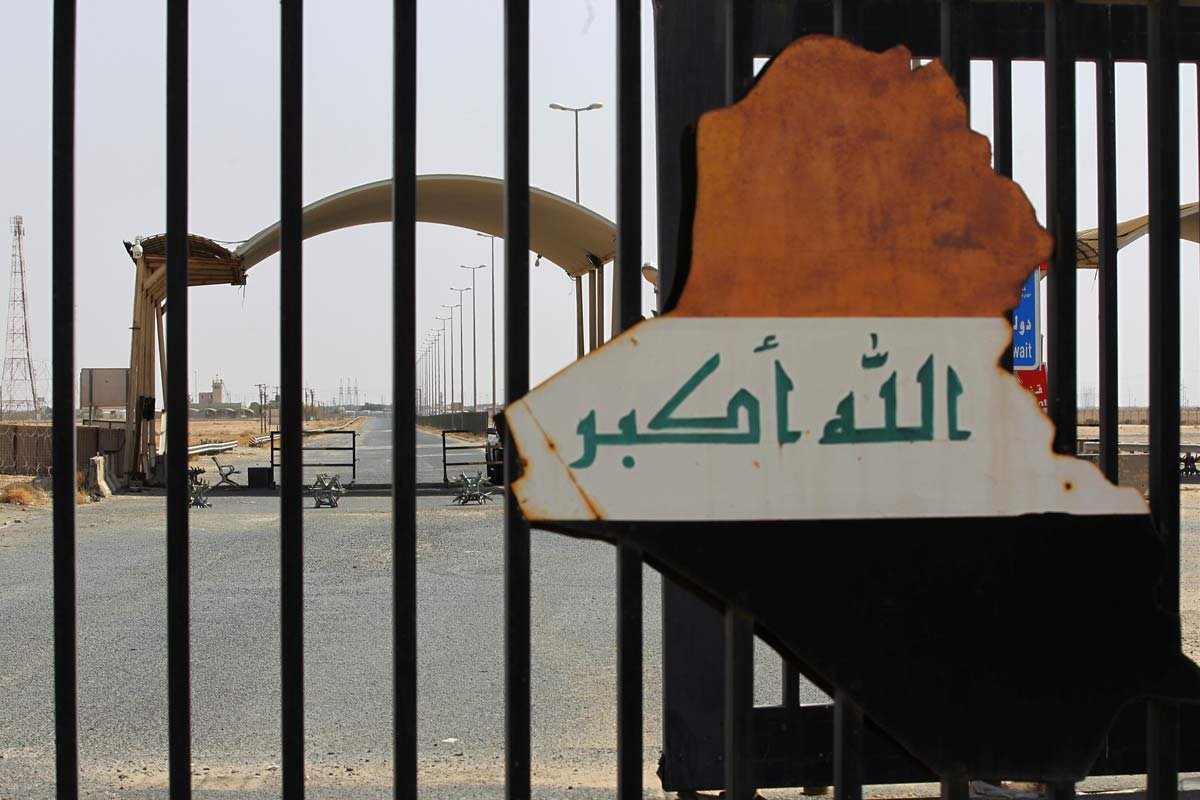
A group of Iraqi politicians has revived disagreements over a Gulf waterway shared by Iraq and Kuwait, sowing mutual suspicion at a time when bilateral ties are otherwise getting better. The two states should redouble efforts to resolve their differences in these matters.
Thirty-five years after Iraq invaded Kuwait, occupying it for seven months, the two Gulf neighbours have managed to put much – though not all – of that acrimonious past behind them. A new chapter in Iraqi-Kuwaiti relations opened with the advent of Iraq’s first elected government in 2005, two years after the U.S. invasion that removed Saddam Hussein, touching off a period of internal tumult and conflict. Since then, the two countries have undertaken several political, cultural and economic initiatives that have proven mutually beneficial. But an enduring headline has been the sluggish progress in resolving longstanding disputes that were compounded by the 1990-1991 Iraqi occupation of Kuwait. Iraqi politicians, in particular, have aggravated suspicion between the two countries by invoking these differences, seemingly hoping to boost their own electoral fortunes.
The Khor Abdullah Dispute Resurfaces
There is no clearer example of this sort of politicking than the flareup in the last two years over the Khor Abdullah, a narrow waterway shared by Iraq and Kuwait that empties into the Gulf. A group of Iraqi politicians, saying a bilateral 2012 agreement regulating navigation in the channel infringes on Iraqi sovereignty, persuaded the Supreme Court to rule that the parliamentary vote to ratify that accord failed to meet constitutional requirements. A related point of contention concerns the partially undelimited maritime boundary beyond what is known as Point 162, the border marker at the mouth of the Khor in the Gulf.
These disagreements over the Khor Abdullah have unfortunately resurfaced at a time when Iraq and Kuwait have otherwise been making strides in transcending the antipathy left by the 1990-1991 occupation. The two states should redouble efforts to resolve their differences over maritime matters and prevent domestic political wrangling from harming bilateral ties. While international attention is understandably focused on the escalating hostilities between Israel and Iran, that should not be allowed to derail efforts to manage other regional peace and security issues – including around the Khor Abdullah.
A Persistent Dispute
Over the years, a number of Iraqi politicians – mostly hailing from around Basra in the country’s south – have aired grievances over concessions that they claim Baghdad was compelled to make following Kuwait’s liberation from Iraqi occupation in 1991. Among other things, they take issue with UN Security Council Resolution 833 of 1993, which sought to address one source of conflict by demarcating the two countries’ land border and parts of the maritime boundary.
The resolution drew from the findings of the UN Iraq-Kuwait Boundary Demarcation Commission, which recommended awarding half of the Khor Abdullah to Kuwait and the other half to Iraq, based on an exchange of letters between the two countries in 1963. It did not delimit the entire maritime boundary, stopping at Point 162 at the channel’s mouth, because the 1963 correspondence did not cover waters farther out toward the Gulf. Kuwait was pleased with the resolution, which it viewed as validating longstanding Kuwaiti territorial claims that successive Iraqi regimes – despite the old letters and the Kuwait government’s repeated subsequent entreaties – had refused to acknowledge. Some in Iraq, however, felt that the UN had taken advantage of Baghdad’s weak position after the 1991 war to give Iraqi territory to Kuwait.
The maritime boundary stretching past the Khor into the Gulf is a sensitive issue in both countries. Both have long had plans to expand port facilities on the waterway. Both would also benefit from a channel of territorial waters beyond the Khor that allows for the passage of more and bigger cargo vessels to and from the docks. Delimiting the border past Point 162 would help both Iraq and Kuwait proceed with port development on the shores of the Gulf without worrying that future quarrels might prevent one or both from using the new facilities’ full capacity.
Court Rulings, Political Motives, and Regional Repercussions
Why does this dispute persist? The ouster of Saddam Hussein’s regime by the 2003 U.S.-led invasion, followed by the election of a new Iraqi government two years later, ought to have provided the diplomatic space to lay the matter to rest. Indeed, in 2012, then-Prime Minister Nouri al-Maliki’s government reopened negotiations with Kuwait over the Khor Abdullah. The two countries reached an agreement, which Maliki signed, that sought to organise navigation in the Khor within the already delimited boundary, address environmental concerns and move the two countries closer to demarcating the remainder of the maritime border past Point 162. It was a technical accord, but it was meant to serve as a confidence-building measure as well. Both the Iraqi and Kuwaiti parliaments approved the agreement the following year, and they jointly deposited it at the UN.
But as that deal was being reached, Iraqi politicians with self-pronounced nationalist agendas began to sow doubt. They reasserted old grievances about Resolution 833, which they said worked in Kuwait’s favour. There were heated exchanges among Iraqi legislators. Lawmakers from the south, along with a number of government officials, said the agreement sold Iraq short by accepting the UN’s demarcation of the Khor boundary. Maliki defended his decision to sign, noting that it conferred important benefits on Iraq. Among other things, it established a joint mechanism for both regulating navigation in the waterway and arranging for removal of sediment that occasionally builds up, hampering passage of shipping.
In 2023, two aggrieved lawmakers brought the Khor issue back to the fore by challenging the 2012 agreement before Iraq’s Federal Supreme Court. They claimed that the agreement violated Iraqi sovereignty and was adopted without the two-thirds parliamentary vote required under Article 61 of the 2005 constitution. In 2013, ratification had been deemed successful, even though only 122 of 325 parliamentarians voted in favour, because 122 represented at least two-thirds of the members present and voting (the parliament quorum rules required only 50+1 attendance). The court ruled in the two lawmakers’ favour. The ruling did not confine itself to technical arguments. It also included a paragraph referring to Kuwait as part of the Basra province under the Ottoman Empire and noted that Iraq had continued to view Kuwait as part of its territory throughout the 20th century – language that set off alarm bells in Kuwait, as it evoked rhetoric used by past Iraqi governments, including Saddam Hussein’s.
A Provocative Ruling
The Iraqi court’s 2023 ruling initiated a diplomatic crisis with Kuwait. Kuwaitis criticised the ruling for propagating what it called “historical fallacies” regarding Kuwaiti statehood. It further noted that the 2012 accord was the outcome of years of negotiation and merely organises navigation within an already delimited maritime boundary in the Khor. Together with the other five Gulf Cooperation Council (GCC) member states, Kuwait called on Iraq to affirm it would continue to respect the agreement. Both Kuwait and other Gulf countries made clear they saw both the lawmakers’ petition and the court’s ruling as politically motivated. Several prominent Iraqis voiced similar views, including former Foreign Minister Hoshyar Zeibari. In a televised interview, he said the appeal’s timing suggested it was geared toward undermining reconciliation with Kuwait. But the Iraqi government stayed quiet for eighteen months, neither endorsing the ruling nor challenging it.
Several observers have suggested that the lawmakers’ motivation in appealing the 2013 ratification was tied to a dispute over the Arash-Durra gas field, which sits underneath the Gulf and remains undeveloped. Iran lays claim to the field, while Kuwait and Saudi Arabia assert that it lies in Kuwaiti waters and have agreed to split the Arash-Durra gas profits 50-50 once the field is tapped. The Iraqi legislators who filed the appeal would almost surely prefer that Iran prevail in this dispute. They represent the Huqouq party, the political wing of Kata’ib Hizbollah, and are known to be aligned with Tehran.
Yet irrespective of the Arash-Durra issue, popular Iraqi grievances with Kuwait over both land and maritime border demarcations may have been enough on their own to spur the southern politicians to action. Such sentiments do not command a majority in Iraq, but they are fairly widespread in Basra and its environs.
Baghdad in a Bind
The Khor Abdullah dispute has put the Iraqi government in a bind. Prime Minister Mohammed Shiaa al-Sudani wants to maintain the agreement his predecessor Maliki signed with Kuwait. But he has been hesitant to push back against the southern lawmakers, whose support he may need in national elections in November. Meanwhile, Sudani’s rivals wish to undermine his government at every turn. For example, when the government invited Kuwait to the Arab League summit that it hosted in Baghdad on 17 May, a number of parliamentarians on the transportation committee, headed by Zahra al-Bajari from Basra, protested Kuwait’s participation in the gathering.
As the dispute persisted, the Sudani government decided that it had to take a position on the court’s 2023 decision. In early April, just a month before the Baghdad summit, Sudani and President Abdul Latif Rasheed appealed to the judges to reinstate the 2012 accord – after two delays, the court is now slated to consider the appeal on 22 June. Then, on 22 April, the president of Iraq’s Supreme Judicial Council, Faiq Zaidan, visited Kuwait and was warmly received. Zaidan wields significant power in Iraq’s political establishment and his visit was perceived as a signal of support for the 2012 agreement. Finally, on 12 May, just five days before the Arab League summit convened in Baghdad, one of Sudani’s advisers published an opinion piece outlining the government’s position. The message was unequivocal: Iraq will honour the treaties it has signed.
None of these steps have fully reassured Kuwait about the Khor Abdullah flareup, however. Concerned that the root issue has not been addressed, Kuwait and other GCC states have signalled their displeasure with the way the dispute has developed. They showed their frustration through their level of representation at the 17 May summit. Few were represented at the head of state or government level. Kuwait sent its foreign minister; it had sent higher-ranking officials on previous occasions. Saudi Arabia and Bahrain also dispatched foreign ministers. Oman and the United Arab Emirates sent their deputy prime ministers (who in the UAE’s case is also the vice president). The only GCC head of state present – the Qatari emir – left before giving his scheduled speech, leaving a lower-ranking official to deliver it in his stead.
A Dissonant Note amid Major Progress
Fortunately, the dispute over the Khor Abdullah has not derailed neighbourly relations. But unless addressed, it threatens to erode the hard work done by successive Iraqi and Kuwaiti governments to improve ties. In 2022, Iraq made the last of its UN-mandated war compensation payments to Kuwait for the 1990-1991 occupation. Both countries have shown commitment to the 1993 Tripartite Commission established to recover missing persons from the war, as well as to the joint development of shared oilfields. Kuwait hosted a major Iraq reconstruction summit in 2018; agreed in 2019 to upgrade the Safwan border crossing at the Iraqi government’s request; supported Iraq’s electricity needs; and spearheaded the effort to link Iraq with GCC countries through the Electrical Interconnection Project. More recently, the two governments have stepped up security cooperation: Kuwait repatriated ex-Iraqi officials linked to the “heist of the century”, a multi-billion dollar plundering of state coffers using shell companies to move tax money abroad, while Iraq extradited a Kuwaiti fugitive.
Meanwhile, port projects are advancing, the Khor Abdullah flap notwithstanding. Iraq is expanding shipping facilities at the Grand Faw port in Basra, at the head of the Khor. Kuwait is moving apace to develop its nearby Mubarak Al-Kabeer port, which also overlooks the waterway. Some Iraqi and Kuwaiti commentators view these ventures as mutually exclusive, but the two governments have sought to dispel such concerns. Iraq has invited Kuwait, along with other GCC countries, to partner in its Development Road project, which aims to connect the Gulf via Grand Faw with Türkiye by rail, road and oil pipeline. Kuwait is open to exploring the arrangement and any other one that may strengthen bilateral ties. To that end, in February, Sudani named a special envoy to boost bilateral ties, and Kuwait reciprocated. These appointments have enabled renewed bilateral talks over the maritime border and other issues of shared concern.
Fostering Stronger Bilateral Ties
The foregoing steps reflect a deliberate effort on both sides of the border to foster mutual good-will. Yet spoilers, especially Iraqi parliamentarians willing to use legal tactics and inflammatory rhetoric for domestic political gain, are in abundance. The challenge for both countries’ leaders will be to contain these counterproductive efforts, working to clean up the Khor Abdullah dispute and delimit the rest of the maritime border, while paving the way for stronger ties.
First, the parties should be prepared for the possibility that the Federal Supreme Court will reject the appeal of the prime minister and the president, and refuse to reinstate the 2012 agreement. If that happens, Baghdad has other options for honouring the content and spirit of the agreement. For example, it could propose a bill to parliament that requires Iraq to continue applying the agreement’s navigation rules in the channel. Passing such a bill could be difficult and time-consuming. While it presses forward internally, the government should continue to act in accordance with the letter of the agreement and to reassure Kuwait of Iraq’s commitment to international treaties it has signed. Kuwait should welcome these efforts – a step that would be consistent with its long-expressed willingness to settle the border issue (and other bilateral issues as well).
Secondly, the recently named special envoys, supported by the two countries’ joint Technical and Legal Committee, should agree to a timeline for delimiting the remainder of the maritime boundary beyond Point 162. They should also agree to a clear dispute resolution mechanism that enables international adjudication if a bilateral accord proves unreachable. Getting to a border deal in 2025 is unrealistic, especially with Iraqi elections fast approaching in November. But setting the joint committee’s timeline and scope of work is urgently needed.
Thirdly, the two states should consider crafting a broader deal that looks to issues beyond the maritime boundary – to include better cooperation on border security, the development of joint oilfields and the strengthening of other economic ties, including integrating the Grand Faw and Mubarak al-Kabeer port projects. This goal is highly aspirational, but it would clearly serve the interests of both states given their mutual interest in optimising resources and facilities – like the two ports – that lie in such close proximity.
Fourthly, the two parties should buttress their efforts at greater practical cooperation with an initiative that brings both countries to terms with the past. Developing joint educational curricula and history texts will further align the two states’ national narratives in ways that do not disrupt or threaten each other, helping them imagine a bolder, collaborative future that is less beholden to the past.
Finally, international partners should prepare to fill the gap that will be created when the UN Assistance Mission to Iraq (UNAMI) wraps up (at the request of the Iraqi government) at the end of 2025. The mission has been key to addressing issues that have lingered since the Iraqi occupation of Kuwait, such as the whereabouts of missing Kuwaiti persons and Kuwait’s stolen national archives. Ideally, the parties will now take the lead in resolving such issues bilaterally, as quickly and smoothly as possible. But if that proves difficult, and no tangible results are forthcoming, a post-UNAMI roadmap might prescribe that the UN appoint a high-level coordinator who reports to the UN Security Council or that the UN endorse a mechanism that includes the two countries and the GCC that reports to the UN Secretary-General.
Better Iraq-Kuwait ties are possible. Both peoples are eager for improvement, as seen in 2023, when scores of Kuwaitis came to Basra to cheer their football team in the Gulf Cup, and the following year, when Iraqis flocked to the tournament in Kuwait. The warm people-to-people exchanges on those occasions underscore that, if the two governments act with urgency and energy, they would not only resolve their outstanding disputes but also breathe new life into bilateral relations.