
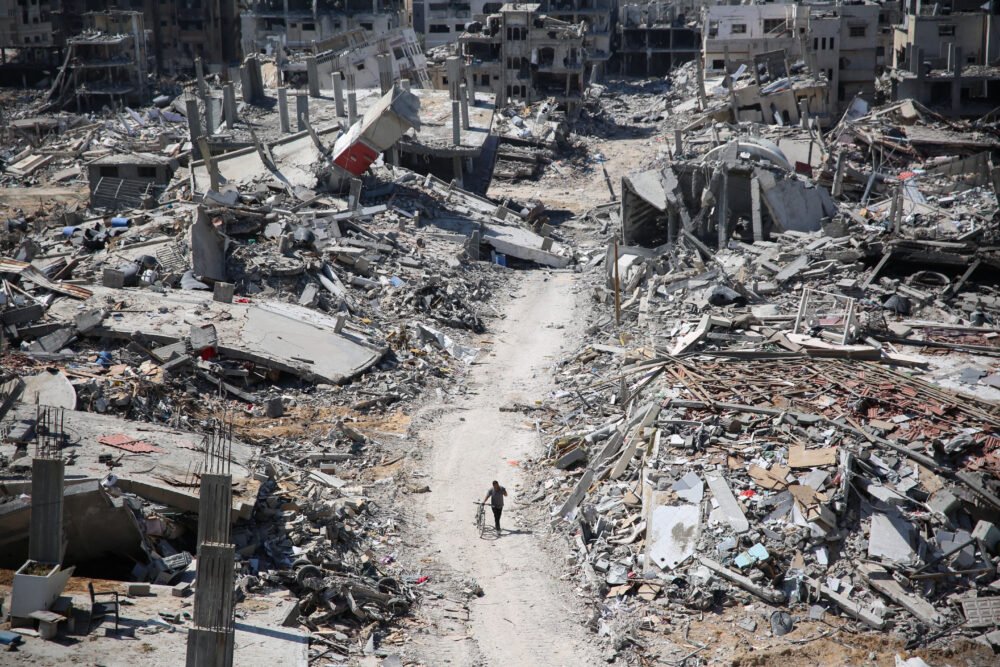
In November 2025, the United States sought and obtained approval for a United Nations Security Council Resolution (UNSCR 2803) endorsing the formation of a Board of Peace (BoP) and International Stabilization Force (ISF) to support the implementation of the 20-point peace plan agreed to by Israel and Hamas the previous month. The ISF’s stated role is to help secure and demilitarize the Gaza Strip, primarily by facilitating the decommissioning of weapons, protecting civilians, and training and advising burgeoning Palestinian police forces. In the intervening months, however, progress on standing up the ISF has stalled, and conflicting messaging from US officials provides more questions than answers.
Why It Matters for the US
The ISF is vital to President Donald Trump’s announced Comprehensive Plan for Gaza. Per the UNSCR, the ISF is to serve under the recently announced BoP as its primary monitoring and implementing mechanism. Implemented successfully, the ISF should provide the security for both Palestinians and Israelis necessary to facilitate progress in Gaza. However, conflicting information about the Comprehensive Plan and the BoP raises questions about the timing and even viability of the ISF as it was initially conceived.
Ally and partner response to the ISF has been muted amid unresolved questions. The ISF was originally envisioned as a multinational force including contingents from Muslim nations that could engage with Hamas and the broader Palestinian populace. Early enthusiasm among potential contributors has evaporated, however, as the specifics and objectives of the ISF mission have not been clarified. In particular, basic questions regarding the delineation of “peace keeping” and “peace enforcement” remain unanswered, and potential contributors are wary of any scenario that could place them in conflict with Palestinians.
The Trump administration has appointed a US two-star general to lead the ISF. A January 16 White House statement regarding its plan to end the Gaza conflict named US Army Major General Jasper Jeffers as the ISF’s commander. At the same time, US officials have persistently messaged that no US forces would set foot in Gaza. As other force commitments remain elusive and key details pertaining to the posture, mandate, basing, budget, or international make-up persist, the US may face tough questions about the scope of its role.
Policy Considerations
Aligning strategy (BoP) with operations (ISF). The BoP Charter released on January 18 does not mention “Gaza” and adopts a more international tone than the UNSCR authorization outlines. This makes it difficult to envisage a scenario whereby non-BoP members would second forces to the ISF. Importantly, this would eliminate most experienced and capable NATO allies and partners from consideration (with BoP member Turkey reportedly interested in the ISF but rejected by Israel).
Defining what remains a mission in name only. Developments surrounding the ISF mission remain fluid. Recent reports suggest that ISF forces will be confined to the “green” zone of Gaza, a buffer area located behind a “yellow” line unilaterally established by the Israel Defense Forces. Thus, in the “red” zone, where Hamas remains active, the newly formed civilian National Committee for the Administration of Gaza and future Palestinian police forces will be depended upon to maintain order and support demilitarization efforts. While this may facilitate increased force commitments to the ISF, it will likely diminish their ability to carry out key components of their remit as outlined in the UNSCR.
Clarifying the growing US role in the ISF. With international force commitments stalled, the Trump administration has indicated a willingness to accept a larger role in the ISF. The appointment of a US commander raises a number of policy-relevant questions regarding the overall US force commitment and US materiel required for the mission. This is especially pertinent if other force commitments are contingent on the availability of US military support such as intelligence, surveillance, and reconnaissance as well as medical evacuation, among others.