
For much of the past several years, normalization between Saudi Arabia and Israel seemed almost inevitable — the logical next step after the Abraham Accords, and the missing keystone to uphold a likeminded United States-led regional order that would lock in favorable Middle Eastern geopolitics for Washington. The question was not if, but when.
That assumption no longer holds. It took a severe blow on October 7, 2023, and from the devastating war that followed. Pessimistic pundits declared it dead, even as US officials continued to pursue an eventual breakthrough.
What is different about this moment, however, is that the guns in Gaza have largely fallen silent — but so too has talk of normalization in Washington, Riyadh, and Jerusalem. In fact, things are moving in the opposite direction in private and now in public.
Saudi-Israel normalization is drifting away — not collapsing outright but steadily receding into, at best, a long in-between. Saudi officials have begun to say so openly. After Israeli strikes on Hamas leaders inside Qatar on September 9, 2025, a former Saudi intelligence chief remarked that the kingdom would normalize ties when Israel began to act like a “normal country.”
Last week, Israeli Prime Minister Benjamin Netanyahu, when asked about Saudi-Israeli normalization, gave a revealingly hedged answer: Israel would be “happy” if Saudi Arabia wants peace with “a secure and strong Israel” and not support those delegitimizing it.
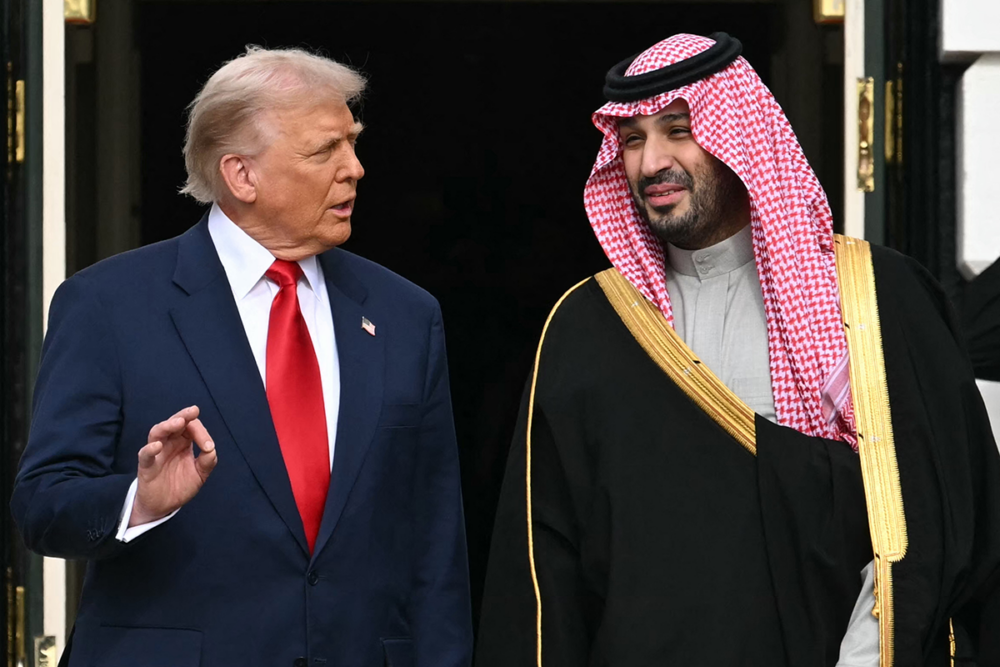
Recent US-Saudi diplomacy only underscores the point. President Donald Trump’s high-profile Gulf visit and the return of Crown Prince Mohammed bin Salman (MBS) to Washington after a seven-year absence produced major US-Saudi announcements, from nuclear cooperation to advanced fighter jet sales — but no visible progress toward normalization. In fact, many of the incentives once envisioned as part of a three-way bargain were quietly repackaged as US-Saudi achievements. Important pieces moved forward. The erstwhile centerpiece did not.
As each country embraces other priorities, normalization is functioning less as a guiding objective than a promising possibility if the timing and terms eventually work out. In other words, this is a missed opportunity in the making.
Riyadh and Jerusalem drift apart
Although the regional threat from Iran has abated considerably, many of the strategic benefits of normalization remain. For Israel, recognition by the Arab world’s most influential state would offer a chance to restore badly damaged international legitimacy and regain diplomatic momentum — and for leaders seeking one, it would provide a rationale for statesmanship or at least restraint when it comes to the West Bank. For Saudi Arabia, normalization would be the best chance to lock in American security commitments beyond any single presidency, enlist Israel as an overt partner in modernization and self-defense, and brand the kingdom’s future ruler as a global statesman. For the United States, brokering such a deal would create new horizons for enhanced regional cooperation and burden-sharing, while reinforcing Americaʼs role as the Middle East’s preeminent outside power for decades to come.
Yet the cracks are widening
Saudi leaders increasingly worry that Israel is heading to a place the kingdom cannot follow. The war in Gaza has intensified public anger. The West Bank is moving fast in the wrong direction. Israeli military actions beyond its borders have rattled Gulf capitals. Netanyahu’s far-right coalition and its reliance on military force to reshape the region clash with Saudi preferences from Syria to East Africa. Israel has done so much to weaken Iran and the Axis of Resistance that it has reduced the shared threat perception that drew the Gulf states closer to it. Moreover, while Riyadh has welcomed Tehran’s recent setbacks, it fears further escalation could spark retaliation into the Gulf. The bottom line is that if Israel continues to be seen in Saudi Arabia as a force for regional instability, normalization is unlikely to proceed.
Of late, Saudi Arabia also appears to be taking its own steps — initial, but pointed — in a direction that Israel cannot follow. Riyadhʼs long-simmering rivalry with Abu Dhabi has boiled over, and on several contentious issues between Saudi Arabia and the United Arab Emirates, Israel is aligned with the Emiratis — and has become a target of vitriolic Saudi public commentary linking the UAE and Israel. This is essentially the opposite of preparing the public for normalization. It is too soon to say whether Saudi Arabiaʼs recent moves to upgrade relations with Pakistan and possibly Turkey represent a shift toward maximum flexibility or the beginnings of a regional coalition to counterbalance Israel and the UAE. But they do speak to Saudi Arabiaʼs willingness to foreground and publicize its differences with the UAE and Israel as other regional threats recede. These trend lines, too, are pointing in the wrong direction. A regional environment where Saudi-Emirati tensions calcify is one where Saudi-Israeli normalization is unlikely. And the US administration has so far shown no discernible inclination to manage the growing divide among its friends.
Compounding matters, while other regional states previously engaged in incremental steps toward normalization — such as third-country visits, opening quasi-diplomatic interest offices, and the like, backed by efforts to bring the public along — Saudi leaders appear to prefer one big move, all of which contributes to the sense that normalization has lost important ground and continues to do so.
What a deal still requires
Even if these negative trends were reversed and normalization were to get back on track, two serious substantive challenges lay ahead on the path toward a three-way deal.
The first is the question of Palestinian statehood. As anger over the war in Gaza grew, Saudi Arabia drew a bright red line, insisting on a credible path toward a Palestinian state as a condition of recognition. Saudi Arabia reinforced this position by backing international recognition efforts and investing in Palestinian institutional capacity. Standing beside President Trump in the Oval Office, the Saudi crown prince reiterated the position, politely but unmistakably: “We want to be part of the Abraham Accords, but we also want to be sure that we secure a path to a two-state solution.
Yet this demand runs directly into Israeli politics, especially after October 7. On the eve of the Saudi leader’s visit to Washington, Netanyahu undercut the president’s efforts to press MBS on normalization when he formally restated his opposition to any future Palestinian state to placate his far-right coalition partners.
The second obstacle is further down the road. As it faces likely retaliation for recognizing Israel, Riyadh seeks the strongest possible US security guarantee as part of the package — likely a treaty-level commitment unprecedented outside Europe and East Asia. Such a guarantee requires Senate ratification.
That remains a tall order. It has been decades since a treaty of this magnitude advanced. Skepticism toward Israel has deepened considerably on both sides of the aisle, as has antipathy toward new overseas commitments. Many Democrats and some Republicans remain wary of the kingdom. Trump himself may be reluctant to bind US hands so tightly — and finding a satisfactory substitute will not be easy.
Nobodyʼs first priority
Taken together, these challenges reflect a deeper reality: All three parties have shifted from seeing normalization as a “need-to-have” to a “nice-to-have” result, and maybe an outcome for another day.
For Israel’s current government, the overriding priority is preventing another catastrophic surprise like October 7 while consolidating its presence in the West Bank — even if that means closing the road to Riyadh. When Israelʼs far-right finance minister dismissed Saudi demands for Palestinian self-determination with an ugly insult, he was forced to apologize for his slur — but not for the underlying substance. The episode underscored the limits of Saudi leverage over Israeli policy.
For Saudi Arabia’s leadership, normalization’s benefits are real but not existential; the existential priority is domestic stability and security amid economic transformation and royal succession. Any normalization pathway that seriously jeopardizes these objectives is likely to be deemed not worth the risk. It may turn out that Saudi Arabia, while attuned to Washington’s hopes for a breakthrough, has in reality simply moved on and decided it cannot justify normalization to its public in the next few years.
The United States, and Trump in particular, would welcome Saudi-Israel normalization as a legacy achievement. Indeed, the administration has kept the door open — forestalling outright West Bank annexation and withholding a formal security guarantee during MBSʼs Washington visit. But the administration has also pursued other priorities, content to deepen bilateral ties and sign mega-deals while managing crises with Israel on parallel tracks.
The clocks that must align
Normalization has receded, but despite formidable obstacles, it remains too early to declare it dead — or even dormant for the remainder of President Trumpʼs term. In fact, it may yet resurface, especially given the president’s enduring focus on the topic and the goodwill and leverage he can claim with both parties. With prioritization, pressure, and a sense of urgency, creative solutions to difficult problems can arise. For a three-way bargain to succeed, at least three political clocks — running at different speeds and hard to synchronize — must align: Saudi, Israeli, and American. A fourth, less predictable, Palestinian clock is also at work.
The Saudi clock began with the Gaza cease-fire last October. Saudi leaders need time — for public sentiment to cool, for conditions on the ground to improve, and for more favorable regional dynamics to emerge. Requirements regarding Palestinian statehood could soften, especially under US pressure, but they will not disappear. All sides need to use the intervening period to deliver progress — above all in Gaza. A renewed slide into conflict in Gaza, Lebanon, Iran, or the West Bank would push any opening further into the future and out of reach. The Saudi clock is patient — and therefore unforgiving.
The Israeli clock begins after the upcoming elections, which must take place by the end of October. Three scenarios loom. A new government could create some distance from current policies and explore flexible formulas short of full statehood. A Netanyahu return with fewer far-right partners might create limited room — but he would have to depart significantly from past practice to exercise it on this file. Another far-right coalition would likely foreclose normalization for years to come.
The American clock may be running shorter than many realize. Once the 2028 presidential race kicks into gear, leaders in both parties will likely grow more willing to defy President Trump and more reluctant to endorse new security commitments. Trump may favor symbolism over binding guarantees — but without them, normalization will struggle to move forward.
A harder-to-determine Palestinian clock is also ticking. At some point, a conflagration over deteriorating conditions and the lack of a political horizon in the West Bank could push normalization out of reach once again.
Taken together, these clocks point to a narrow, contingent window for success during this presidential term. If the region stays calm, there is a chance the Saudi, Israeli, and US clocks could converge. But it is just as easy to imagine renewed regional conflict, Israeli political entrenchment, and rising American reluctance in the coming year.
A closing window?
Time is an underrated force in international politics. Opportunities rarely close on schedule; they disappear when events intervene. As a State Department official on October 7, I saw how a single bloody day blotted out the sun on so many other regional goals and priorities, including normalization. The next shock — a crisis elsewhere that absorbs Washington’s attention, West Bank annexation, or leadership changes that reorder priorities — could push normalization further off still, along with a range of other regional goals.
President Trump may at some point change course and try to force the question into ripeness. But Israeli and Saudi leaders know his presidency will end. Ultimately, MBS may determine that the kingdom has already secured many of the benefits without assuming the risks. Israelʼs government may decide that territorial control matters more than international legitimacy regardless of the costs. And the United States may want normalization rhetorically but prove unwilling to underwrite it strategically or politically. For all three, that would be a survivable choice. But for each one, it would represent a meaningful missed opportunity.
Too often, policymakers assume today’s opportunities will still be available tomorrow. Many are far more perishable than they appear. Whether Saudi-Israeli normalization ultimately succeeds will depend less on perfect alignment than on whether leaders recognize the moment they are in — and choose to act before it slips away.